

On this page
You blow through the wand and the film wobbles, stretched into a long tube. A moment later it pinches off and settles into a ball. Not a cube, not an egg, but a sphere. Two ideas explain why, one from physics and one from geometry. The physics part, surface tension and excess pressure, is in Class 11 physics.
What is surface tension, and why does a soap film have it?
Molecules at the surface of a liquid are pulled inward by the molecules around them, so the surface acts like a stretched skin that tries to shrink. Surface tension is the force per unit length along that skin, measured in newtons per metre (N/m).
Water at 20°C has a surface tension of 72.8 dynes/cm, which is 72.8 mN/m, and soaps and detergents lower it, according to HyperPhysics at Georgia State University.
In a 2018 study, Aakash Sane, Shreyas Mandre and Ildoo Kim measured flowing soap films and found their surface tension levels off at about 30 mN/m, except in thinner films or weaker soap solutions, where it is higher (Journal of Fluid Mechanics). So soap does not remove surface tension; in those films it was cut to well under half, which helps a thin film stretch without snapping.
A soap bubble is an extremely thin film of soap and water enclosing air (Wikipedia: Soap bubble). The film has two surfaces, one facing the air inside and one facing the air outside, and both pull (HyperPhysics: bubble pressure).
Why does surface tension make a bubble round?
A stretched surface stores energy, and more area means more energy. So the film pulls itself in until its area is as small as it can be. It cannot shrink to nothing, because air is trapped inside. The real question is: which shape holds a fixed volume of air with the least surface?
The answer is a sphere. The isoperimetric inequality says that a sphere has the smallest surface area for a given volume (Wikipedia: Isoperimetric inequality). A free soap bubble takes the shape of least surface area that can contain its volume (Wikipedia: Soap bubble).
There is a second way to see it. The air pressure inside the bubble is the same everywhere, so the film must curve by the same average amount everywhere. A single closed bubble whose curvature is the same at every point is a sphere.
Worked example: how much area does a sphere save?
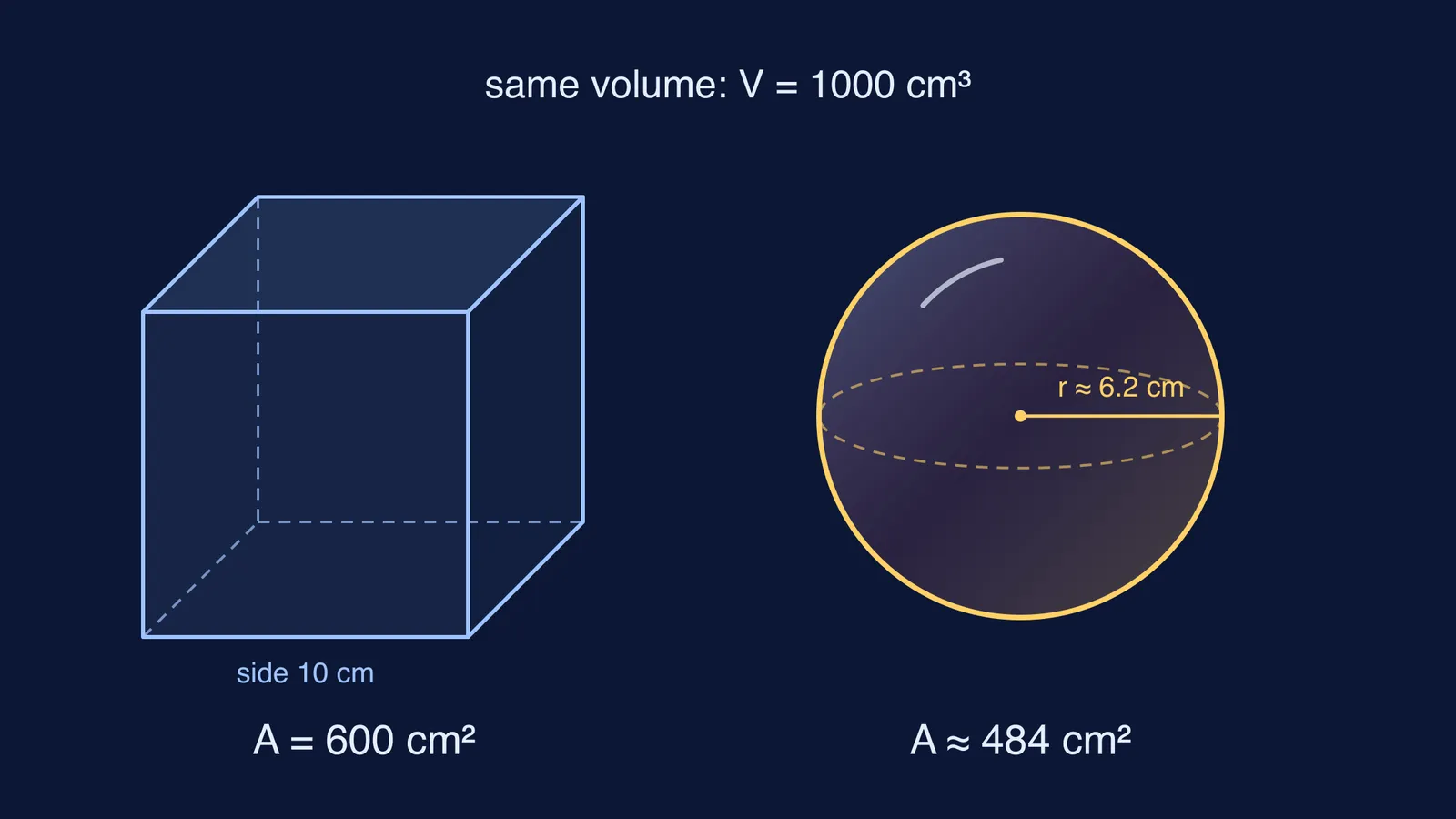
Take 1 litre of air, which is 1000 cm³, and wrap it two ways.
As a cube: each side is 10 cm, so the surface area is 6 × 10 × 10 = 600 cm².
As a sphere: (4/3)πr³ = 1000 gives r ≈ 6.20 cm, so the area is 4πr² ≈ 484 cm².
The cube needs about 116 cm² more film, roughly 24% extra.
The surface energy is tension × area × 2 surfaces. With 0.030 N/m from the 2018 soap-film study (Journal of Fluid Mechanics), the extra 0.0116 m² costs about 0.030 × 0.0116 × 2 ≈ 0.0007 J.
That energy is tiny, but nothing holds the cube's corners in place, so the film slides downhill in energy until no saving is left: the sphere.
How much pressure is inside a soap bubble?
For a bubble with two surfaces, the pressure inside exceeds the pressure outside by ΔP = 4T/R, where T is surface tension and R is the radius (HyperPhysics: bubble pressure). A liquid drop or an air bubble inside water has only one surface, so the same reasoning gives 2T/R.
Try the numbers with T = 0.030 N/m:
A bubble of radius 2 cm: ΔP = 4 × 0.030 / 0.02 = 6 Pa.
A bubble of radius 1 cm: ΔP = 12 Pa.
The smaller bubble has the higher pressure. Join a small and a large bubble with a tube and air flows from the small one into the large one, so the small one shrinks. Many students expect the opposite, and it is a classic exam question on surface tension.
Why are some bubbles not round?
While you are still blowing, the film is held by the wand and pushed by moving air, so it is not a free, closed surface. Once it floats free, it rounds up.
When bubbles touch, they share a wall. Because the tension is the same in each film, three films meet at equal angles of 120° (Wikipedia: Soap bubble). Proving that the familiar double bubble is the least-area way to enclose two volumes took mathematicians until 2000; the proof by Michael Hutchings, Frank Morgan, Manuel Ritoré and Antonio Ros was published in 2002 (Annals of Mathematics).
The Fermi Simulation Lab has interactive simulations for ideas that are easier to see than to read. For the surrounding theory, from surface energy to excess pressure, the Fermi Concept Library gives every concept in physics its own lesson.
Next time a bubble floats past, check whether you can explain its shape in one breath: shrink, trap, sphere.


