On this page
A lifter is a light triangle of balsa and aluminium foil that rises off a bench when a thin wire along its top is held at about 30 kV. It has no propeller and no moving parts, and it looks like a trick. It is not. It is ordinary electrostatics: ions drift through air in an electric field, bump into neutral molecules, and push the air down. Here is how to work out the thrust, why the gap matters more than the voltage, and why thrust per watt follows the same rule as a jet engine.
Safety first. 30 kV is a dangerous voltage. Supplies that make it can give a painful or harmful shock and can store charge after they are switched off. This post explains the physics only. Do not try to build or power one at home.
How does a lifter make thrust from ions?
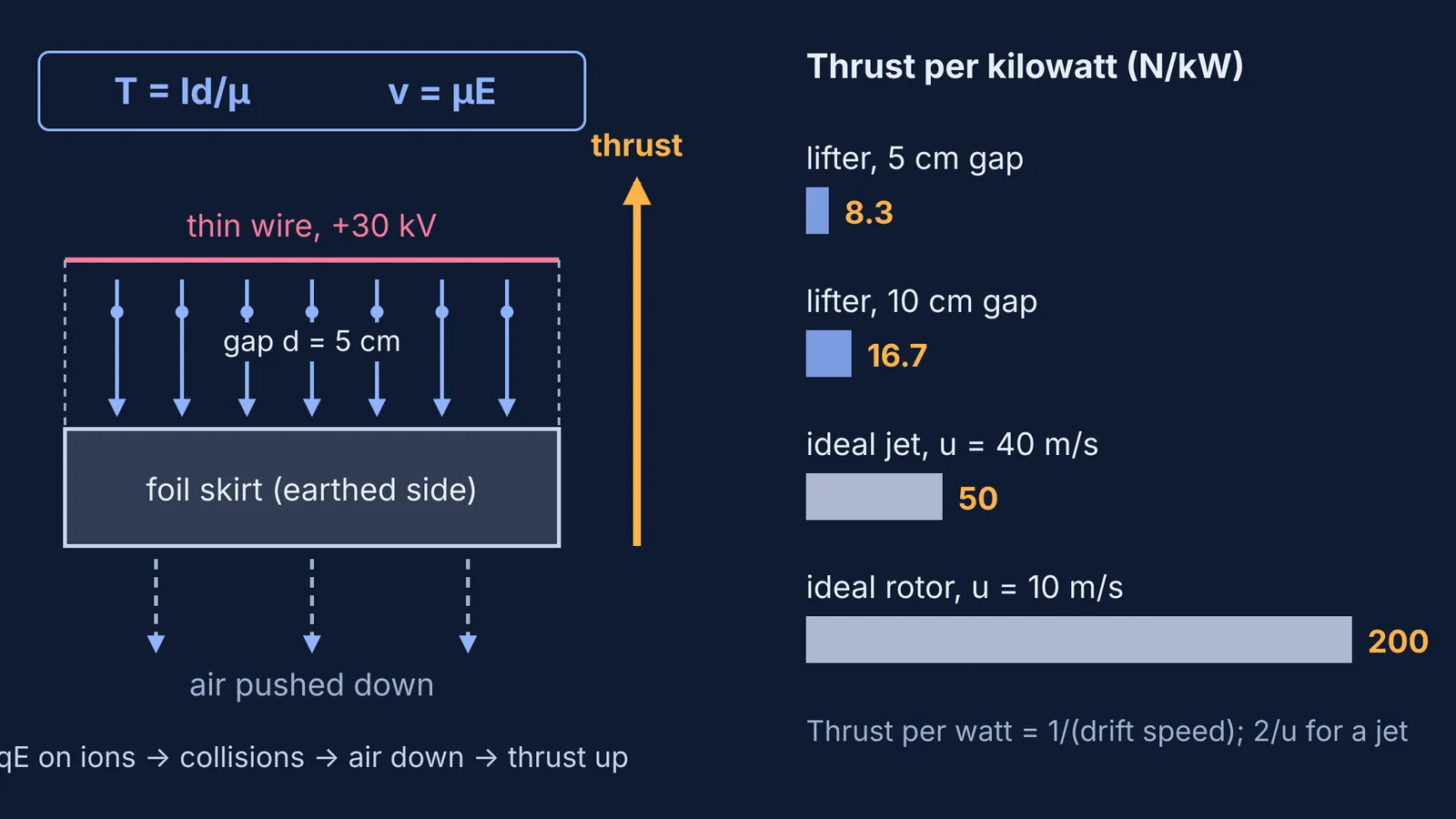
The thin wire sits a few centimetres above a strip of foil. Close to a thin wire the electric field is very strong, so the air there breaks down in a tiny glowing sheath called a corona. The corona makes positive ions (with a positive wire). The rest of the gap stays an insulator: the average field across a 5 cm gap at 30 kV is 6 × 10⁵ V/m, below the roughly 3 × 10⁶ V/m that breaks down dry air. Why a sharp point or thin wire reaches breakdown first is covered in the post on how much charge a sphere can hold in air.
The ions are pulled toward the foil by the force qE. They do not speed up freely, because they hit air molecules billions of times a second. Instead they reach a steady drift speed:
v = μE
where μ is the ion mobility. This is the same drift you meet in the ion mobility spectrometer post, which uses drift time to identify molecules. In a lifter we care about something else: where the force goes.
Why is the thrust T = Id/μ?
Each ion feels qE but does not accelerate, so the same force must be passed on to the neutral air through collisions. Add up the force on every ion in the gap.
Charge per unit volume is ρ. Current density is J = ρv = ρμE, so ρE = J/μ.
Force on the ions in a thin slice of area A and thickness dx is ρE A dx = (J/μ) A dx = (I/μ) dx.
Add the slices across the gap d: T = Id/μ.
Notice that E has dropped out. The field is strong near the wire and weaker near the foil, but the answer depends only on current, gap and mobility. The electrical power is P = IV, so
T/P = d/(μV) = 1/v̄
where v̄ = μV/d is the drift speed in the average field. Thrust per watt is one over the drift speed. Slow ions give more thrust per watt.
Worked example: how much does 1 mA at 30 kV push?
Take round, illustrative values: I = 1.0 mA, V = 30 kV, d = 5.0 cm and μ = 2.0 × 10⁻⁴ m²/(V s) for small positive air ions. Real mobility depends on the ion species and on humidity, so treat μ as an illustrative round number.
Average field. E = V/d = 30,000/0.05 = 6.0 × 10⁵ V/m.
Drift speed. v = μE = 2.0 × 10⁻⁴ × 6.0 × 10⁵ = 120 m/s. An ion crosses the gap in about 0.42 ms.
Thrust. T = Id/μ = (1.0 × 10⁻³ × 0.05)/(2.0 × 10⁻⁴) = 0.25 N. That is the weight of about 25 g.
Power. P = IV = 1.0 × 10⁻³ × 30,000 = 30 W.
Thrust per kilowatt. 0.25/30 × 1000 = 8.3 N/kW. Check: 1/v = 1/120 N/W = 8.3 N/kW.
Does it rise? A 5 g lifter weighs 0.005 × 9.81 = 0.049 N. The thrust is about five times larger, so yes.
Units check: A × m ÷ (m²/(V s)) = A V s/m = W s/m = J/m = N.
Now keep I and V the same and double the gap to 10 cm. Then T = 0.50 N and T/P = 16.7 N/kW, because the ions drift at only 60 m/s. This is a scaling, not a design. In a real device the corona current rises steeply with voltage and falls as the gap widens, so you cannot pick I, V and d independently.
Why does a wide gap beat a high voltage?
The thrust per watt is d/(μV). Raising V makes the ions drift faster, and fast exhaust wastes energy. Widening d at the same voltage slows them, so more of each joule goes into push. The same rule governs any propulsion that throws a fluid backwards. If you accelerate air from rest to speed u, thrust is ṁu and the kinetic energy given per second is ½ṁu², so the ideal thrust per watt is 2/u.
Ideal jet with a 40 m/s jet speed: 2/40 = 0.05 N/W = 50 N/kW.
Ideal rotor pushing air at 10 m/s: 2/10 = 0.2 N/W = 200 N/kW.
These are ideal momentum-theory limits, not measured engine figures. Ion wind gets 1/v rather than 2/v because collisions turn part of the energy into heat in the air. Still, because ion drift speeds are low, thrust per watt can be high on paper. In a vacuum the story flips: an ion thruster throws xenon out at 40 km/s, carrying its own propellant, and gets very little thrust per watt but a great deal of thrust per kilogram of fuel.
Has ionic wind ever flown a real aeroplane?
Yes. In 2018 an MIT team led by Steven Barrett flew a 5 m wingspan, 2.45 kg aeroplane powered only by ionic wind, with an onboard 40 kV converter, over ten indoor test flights. The paper is Xu et al., "Flight of an aeroplane with solid-state propulsion", Nature 563, 532–535 (2018). A Nature Electronics research highlight on the flight reports a measured thrust-to-power ratio of about 5 N/kW, with an overall efficiency of only about 2.6%. That plane had wings, so its thrust only had to beat drag; a lifter must hold up its whole weight. Earlier laboratory work by the same group is in Masuyama and Barrett, Proc. R. Soc. A (2013).
You can see the measured 5 N/kW sits below our illustrative 8.3 N/kW. Real devices lose power to the corona itself, to ions that never cross the full gap and to drag on the electrodes.
If you want to see how charges move in fields before tackling questions like this, the Simulation Lab has interactive simulations for ideas that are easier to see than read.
Quick checklist
Corona at a thin wire makes ions; the rest of the gap stays below breakdown.
Ions drift at v = μE and hand their force qE to the air through collisions.
Thrust T = Id/μ, independent of how E varies across the gap.
Power P = IV, so thrust per watt = d/(μV) = 1/(drift speed).
1 mA, 30 kV, 5 cm, μ = 2 × 10⁻⁴ m²/(V s): 0.25 N, 30 W, 8.3 N/kW.
Slow, wide flows give more thrust per watt; the ideal jet rule is 2/u.
No air, no thrust. And 30 kV is dangerous: physics only, no home builds.