

On this page
A black-and-white film is coated with tiny crystals of silver bromide held in gelatin. Light starts the picture, a developer makes it visible, and then the film still has to be "fixed", or the remaining silver bromide will darken the moment you carry the film into daylight. The fixer is sodium thiosulphate, called hypo, and it works by turning insoluble AgBr into a soluble complex ion. That reaction is the photography example NCERT gives under applications of coordination compounds, and it is a favourite one-mark and numerical question.
What happens to AgBr when film is exposed to light?
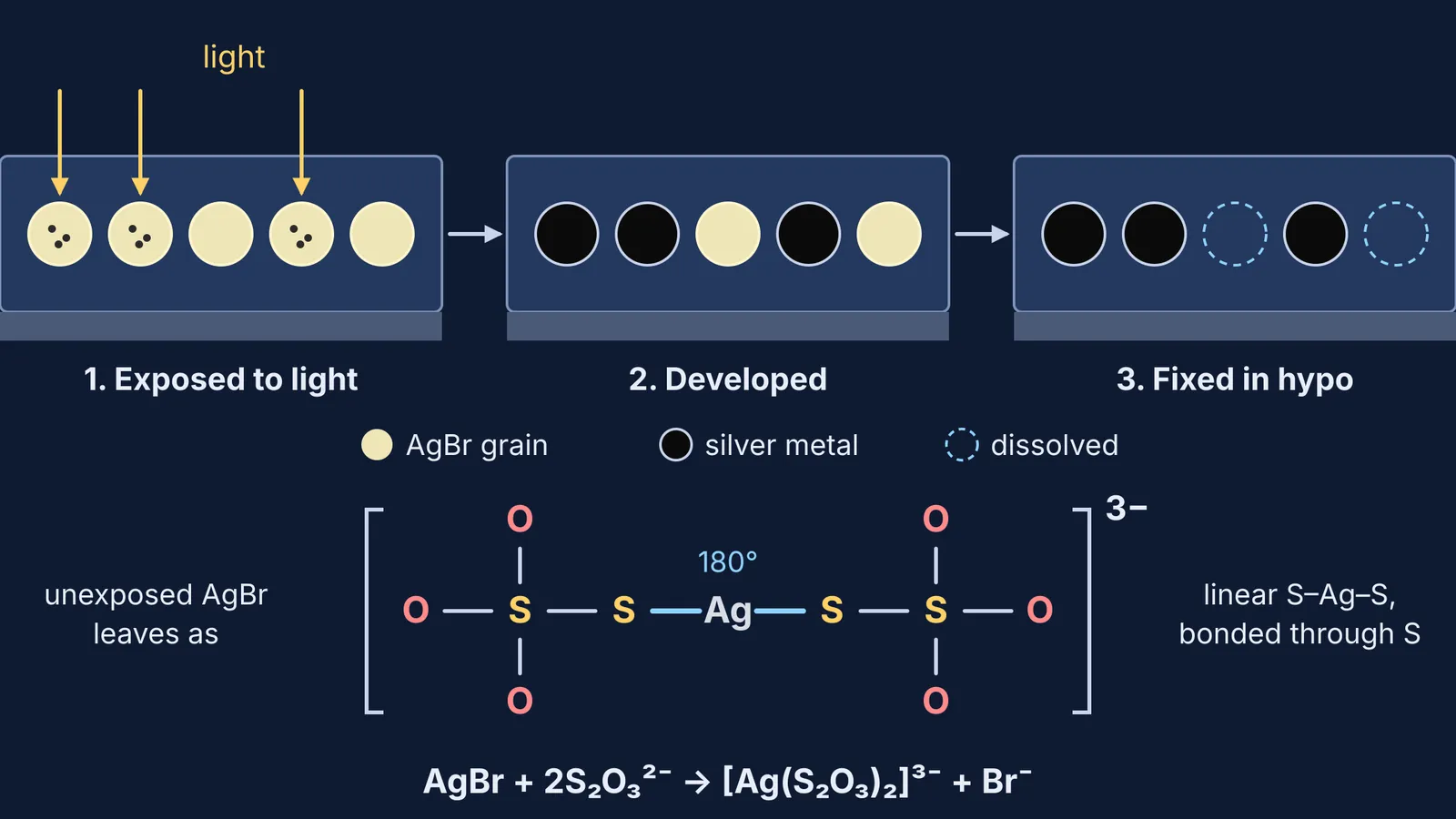
Each AgBr grain is an ionic crystal of Ag⁺ and Br⁻. When a photon is absorbed, an electron is released from a Br⁻ ion and is trapped by an Ag⁺ ion, which becomes a silver atom. A few silver atoms gather at one spot on the grain. This tiny cluster is the latent image: invisible, but it marks the grain as "exposed". The overall change is often written as 2AgBr → 2Ag + Br₂, with the bromine taken up by the gelatin.
The photochemistry of silver halides, and why silver chloride turns grey in sunlight, is covered in how light decomposes silver chloride and how film used it. This post picks up where that one stops.
What does the developer do?
The developer is a mild reducing agent such as hydroquinone in alkaline solution. It can reduce Ag⁺ to Ag, but it does so much faster in grains that already carry a latent-image cluster, because the silver cluster catalyses the reduction. An exposed grain is reduced completely to black metallic silver. An unexposed grain is left almost untouched, provided development is stopped in time.
After developing, the film holds two things: black silver where light fell, and pale, light-sensitive AgBr everywhere else. If you stop here and switch on the light, the leftover AgBr will start to darken and the image will be lost.
How does hypo fix the image?
Fixing means dissolving away every unexposed AgBr grain while leaving the silver metal alone. AgBr is almost insoluble in water, but in sodium thiosulphate solution it dissolves as a complex:
AgBr + 2Na₂S₂O₃ → Na₃[Ag(S₂O₃)₂] + NaBr
As an ionic equation:
AgBr(s) + 2S₂O₃²⁻ → [Ag(S₂O₃)₂]³⁻ + Br⁻
Check the balance. Na: 4 on the left, 3 + 1 on the right. Ag, Br, S (4) and O (6) all match. Charge: −4 on the left, −3 + (−1) = −4 on the right.
The complex salt Na₃[Ag(S₂O₃)₂] is soluble and washes out of the gelatin. Metallic silver does not react with thiosulphate, so the black image stays. What remains is a negative: dark where the scene was bright.
Why does thiosulphate dissolve AgBr when water cannot?
Two equilibria compete. The solid wants to stay solid: AgBr ⇌ Ag⁺ + Br⁻, with Ksp about 5 × 10⁻¹³ at 25 °C. The complex wants to form: Ag⁺ + 2S₂O₃²⁻ ⇌ [Ag(S₂O₃)₂]³⁻, with an overall stability constant β₂ of the order of 10¹³ (tables quote roughly 2 × 10¹³ to 3 × 10¹³). Add the two and the equilibrium constant for dissolving AgBr in thiosulphate is K = Ksp × β₂, roughly 5 × 10⁻¹³ × 2.9 × 10¹³ ≈ 15. A K above 1 means the solid dissolves readily in a reasonable concentration of hypo.
Why is β₂ so large? Ag⁺ is a large, polarisable, soft acid. Thiosulphate binds through its terminal sulphur atom, which is a soft base. Soft–soft pairs form strong, fairly covalent bonds, which is the idea behind why Ag⁺ prefers soft ligands in the HSAB principle. Ammonia, a harder nitrogen donor, gives [Ag(NH₃)₂]⁺ with β₂ only about 1.6 × 10⁷. For AgBr in ammonia, K ≈ 5 × 10⁻¹³ × 1.6 × 10⁷ ≈ 8 × 10⁻⁶, so AgBr is only sparingly soluble even in concentrated ammonia. That is why ammonia cannot fix a film and why the halide tests use it to tell AgCl from AgBr.
To see what the size of K does, compare 1 M solutions. With K ≈ 15, about 0.44 mol of AgBr dissolves per litre of 1 M thiosulphate. With K ≈ 8 × 10⁻⁶, only about 0.003 mol dissolves per litre of 1 M ammonia.
What is the structure of [Ag(S₂O₃)₂]³⁻?
Oxidation state of silver: x + 2(−2) = −3, so x = +1.
Coordination number: 2, one sulphur from each thiosulphate.
Shape: linear, S–Ag–S at 180°, the usual geometry for two-coordinate Ag(I).
Each S₂O₃²⁻ is a monodentate ligand bonded through the terminal S, not through O.
How much hypo do you need? A worked example
Question: What mass of Na₂S₂O₃ is needed to dissolve 1.88 g of AgBr completely as [Ag(S₂O₃)₂]³⁻? (Ag = 107.87, Br = 79.90, Na₂S₂O₃ = 158 g/mol)
Molar mass of AgBr: 107.87 + 79.90 = 187.77 g/mol.
Moles of AgBr: 1.88 ÷ 187.77 = 0.0100 mol.
Mole ratio from the equation: 1 AgBr needs 2 Na₂S₂O₃, so 2 × 0.0100 = 0.0200 mol Na₂S₂O₃.
Mass: 0.0200 × 158.1 = 3.17 g of Na₂S₂O₃.
If the question uses the crystals: hypo is sold as the pentahydrate Na₂S₂O₃·5H₂O (248.2 g/mol), so 0.0200 × 248.2 = 4.97 g.
Mass of complex salt formed: Na₃[Ag(S₂O₃)₂] has molar mass 401.1 g/mol, so 0.0100 mol is about 4.02 g.
The answer to the standard question is about 3.16 to 3.17 g, depending on rounding of the molar masses.
Why must the fixer be in excess?
If thiosulphate runs short, the 1:2 complex cannot form. Ag⁺ and S₂O₃²⁻ then give white silver thiosulphate, which is insoluble and slowly decomposes to black silver sulphide:
Ag₂S₂O₃ + H₂O → Ag₂S + H₂SO₄
This is the same white → yellow → brown → black sequence you see when AgNO₃ is added drop by drop to a thiosulphate solution in salt analysis. On a film it shows up as brown stains. Photographers therefore use plenty of fresh fixer and wash the film well afterwards. For the other reaction of thiosulphate that JEE loves, see sodium thiosulphate and iodine.
For more mole-ratio questions like the worked example, the Fermi Problem Library has a step-by-step solver that explains the reasoning at each stage, including the mole ratio.
Quick checklist
Exposure: light turns a few Ag⁺ in a grain into Ag atoms (latent image).
Developer: reduces exposed grains to black silver; unexposed AgBr stays.
Fixer: AgBr + 2Na₂S₂O₃ → Na₃[Ag(S₂O₃)₂] + NaBr removes unexposed AgBr.
The complex is Ag(I), coordination number 2, linear, S-bonded.
It forms because soft Ag⁺ and soft S bond strongly: β₂ about 10¹³ beats Ksp about 5 × 10⁻¹³.
1 mol AgBr needs 2 mol Na₂S₂O₃: 1.88 g AgBr needs about 3.17 g.
Too little hypo gives Ag₂S₂O₃, which turns into black Ag₂S.


