

On this page
In the late 1950s the Dutch surgeon I. Boerema drained pigs of so much blood that they had almost no red cells left, then put them in a pressure chamber breathing pure oxygen at three atmospheres. They stayed alive, and his paper was titled "Life without blood". The reason is a gas law you meet in Class 12: the amount of a gas that dissolves in a liquid rises in proportion to its partial pressure. This post works out how much oxygen plasma can carry at each pressure and why that is enough for a body at rest. It explains the physics only; it is not medical advice.
How does blood normally carry oxygen?
Almost all of it rides on haemoglobin inside red cells. Each gram of haemoglobin binds about 1.34 mL of oxygen, so blood with 15 g of haemoglobin per 100 mL carries about 1.34 × 15 = 20 mL of oxygen per 100 mL when it is fully loaded. A 2024 review in Frontiers in Medicine by Keith Van Meter gives the same figure: haemoglobin can raise the blood's oxygen content to about 20 volume% (mL per 100 mL).
Breathing more oxygen does not help haemoglobin much, because at normal air pressure it is already nearly full. The other route is plasma, the watery part of blood. Oxygen dissolves in it like any gas in water, but only a little.
What does Henry's law say about oxygen in plasma?
Henry's law says the amount of gas dissolved in a liquid is proportional to the partial pressure of that gas above it. You may have seen it applied to carbon dioxide in why a soda bottle fizzes when you open it. For oxygen in plasma at body temperature, the Van Meter review uses:
dissolved O₂ ≈ 0.003 mL per 100 mL of plasma for every mmHg of oxygen partial pressure.
The partial pressure is what matters, not the total pressure. By Dalton's law, each gas in a mixture contributes its own share. That is the same idea behind Paul Bert's work on oxygen at altitude, where the partial pressure falls instead of rising.
Why do you subtract 47 and 40 mmHg?
The oxygen that dissolves in blood is set by the gas in the alveoli, the tiny air sacs of the lungs, not by the gas in the room. Two other gases take up part of the pressure there:
Water vapour. The air in the lungs is saturated at 37 °C, where the vapour pressure of water is about 47 mmHg.
Carbon dioxide. The body keeps alveolar CO₂ at about 40 mmHg.
When you breathe pure oxygen, nitrogen is washed out, so the alveolar oxygen pressure is roughly the total pressure minus 47 minus 40 mmHg. Breathing air, a standard textbook figure for alveolar oxygen is about 100 mmHg. These are approximate, and we treat the blood leaving the lungs as having the same oxygen pressure as the alveoli, which is a simplification.
Worked example: how much oxygen dissolves at each pressure?
Use 1 atm = 760 mmHg and 0.003 mL per 100 mL per mmHg.
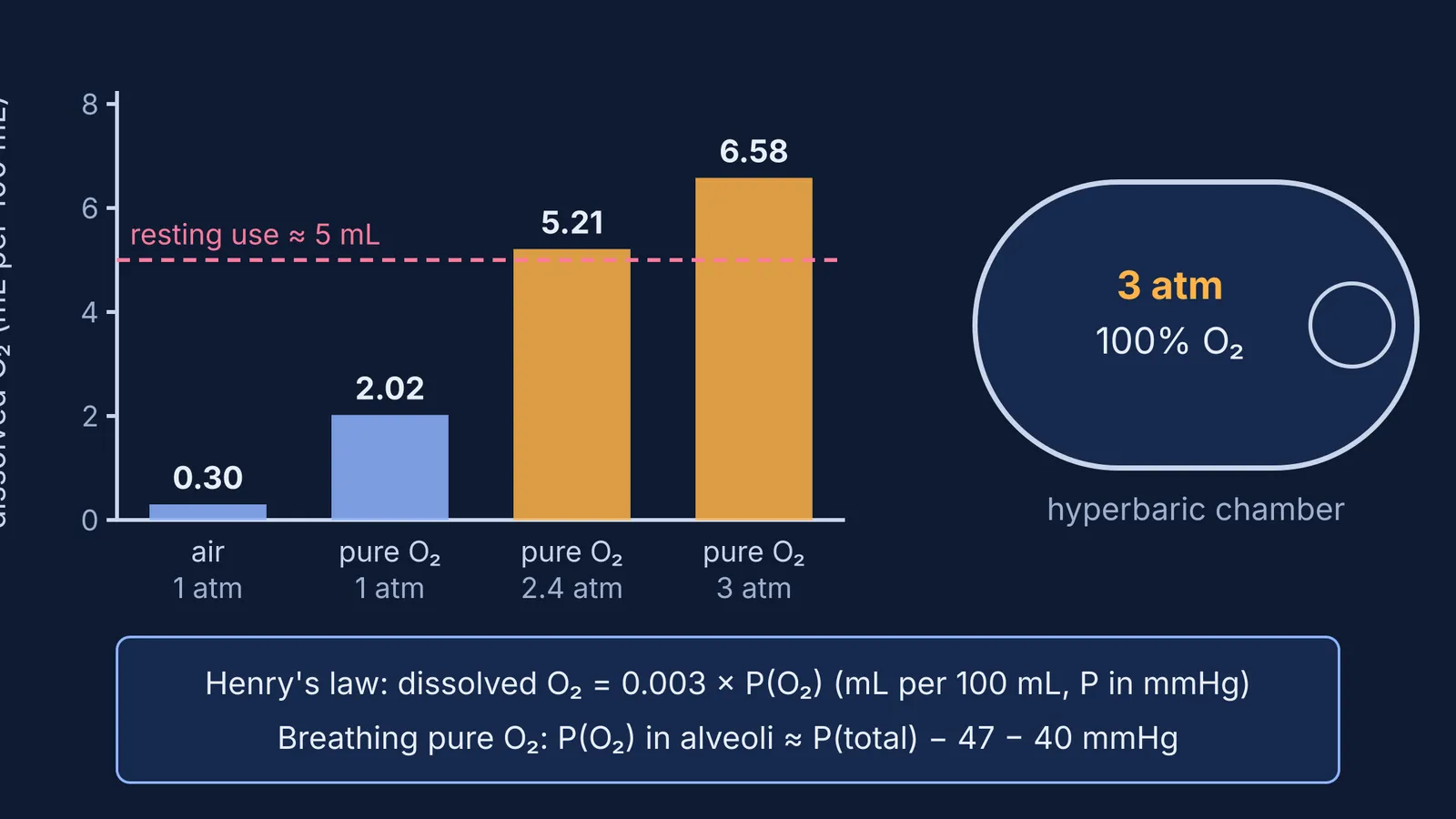
Air at 1 atm. Alveolar oxygen ≈ 100 mmHg. Dissolved: 0.003 × 100 = 0.30 mL per 100 mL.
Pure oxygen at 1 atm. 760 − 47 − 40 = 673 mmHg. Dissolved: 0.003 × 673 = 2.02 mL per 100 mL.
Pure oxygen at 2.4 atm. Total 2.4 × 760 = 1,824 mmHg; alveolar 1,824 − 87 = 1,737 mmHg. Dissolved: 0.003 × 1,737 = 5.21 mL per 100 mL.
Pure oxygen at 3 atm. Total 2,280 mmHg; alveolar 2,193 mmHg. Dissolved: 0.003 × 2,193 = 6.58 mL per 100 mL, about 6.6.
Compare. 6.58 / 0.30 ≈ 22, so the plasma holds about 22 times as much oxygen as when breathing air.
The Van Meter review quotes 2.3 and 6.6 volume% for pure oxygen at one and three atmospheres. Its 2.3 comes from multiplying 0.003 by the full 760 mmHg without removing water vapour and CO₂, which is why it is a little above our 2.02.
How much oxygen does the body need at rest?
A rough estimate uses the Fick principle with typical textbook numbers for a resting adult: about 250 mL of oxygen used per minute and about 5 L of blood pumped per minute. Then each 100 mL of blood gives up about 250 / 50 = 5 mL of oxygen on its way round. Treat this as approximate; it varies between people and organs.
Compare with the worked example. At 3 atm the plasma alone carries about 6.6 mL per 100 mL, more than the roughly 5 mL taken out. The Van Meter review states that breathing oxygen at three atmospheres puts enough dissolved oxygen in plasma to supply the metabolic extraction rate of most tissue in a human body at rest. Haemoglobin is then hardly needed for a short time. At 1 atm, 2 mL is far too little.
What did Boerema show with pigs?
According to the Van Meter review, Boerema bled pigs down to haemoglobin levels as low as 1 g per decilitre and replaced the lost volume with a salt, dextran and sugar solution. He then took the unconscious but still breathing animals to three atmospheres on 100% oxygen, kept them there for 15 minutes, gave back their own blood and brought the chamber back to normal pressure. The pigs walked off unimpaired. The work was published as "Life without blood" in the Journal of Cardiovascular Surgery in 1960. It was a demonstration of physiology, not a treatment.
Why is hyperbaric oxygen not used freely?
Hyperbaric oxygen therapy is prescribed and run by doctors, in chambers built for it. Oxygen at high pressure has its own risks. The Van Meter review says that prolonged oxygen exposure carries potential toxic effects in almost all cases, and that sessions of 60 to 90 minutes with 5-minute air breaks have been documented as safe. It puts serious side effects at about one in 10,000 on average, including pneumothorax, oxygen toxicity seizure, fire or explosion, and arterial gas embolism. Nothing here describes how to treat anyone.
Concentrators are a different matter: they raise the oxygen fraction at normal pressure, as explained in how an oxygen concentrator makes oxygen from room air.
To revise Henry's law and partial pressures, see the Concept Library. For more solubility and gas-mixture numericals, the Fermi Problem Library has a step-by-step solver that explains the reasoning.
Quick checklist
Haemoglobin carries about 20 mL O₂ per 100 mL of blood and is nearly full at 1 atm.
Dissolved O₂ ≈ 0.003 mL per 100 mL per mmHg of oxygen partial pressure.
Breathing pure oxygen: alveolar P(O₂) ≈ P(total) − 47 − 40 mmHg.
Air at 1 atm: 0.30 mL. Pure O₂ at 1 atm: 2.02 mL. At 3 atm: about 6.6 mL.
A resting body takes roughly 5 mL from each 100 mL of blood.
Use partial pressure in Henry's law, never total pressure.


