

On this page
The satisfying pop and fizz of a cold soda is an everyday experience, but it perfectly demonstrates a core principle of physical chemistry. When you twist the cap off a bottle of your favourite carbonated drink, you are conducting a rapid, real-time experiment in gas solubility.
What is the pressure inside a soda bottle?
To understand the fizz, we first have to look at how the drink is made. Carbonated beverages are bottled under high pressure to force carbon dioxide (CO₂) gas into the liquid. A typical soda can or bottle at room temperature is under a pressure of about 250 kPa, or approximately 2.5 atmospheres (atm).
At this high pressure, the CO₂ molecules are packed tightly in the space above the liquid. This pressure forces the gas molecules to dissolve into the water, forming a weak carbonic acid solution. As long as the bottle remains sealed and the pressure is maintained, the gas stays dissolved and the liquid looks completely still.
Why does a soda bottle fizz when you open it?
The moment you break the seal on a soda bottle, the high-pressure gas in the head space rushes out, equalising with the air around you. The pressure inside the bottle suddenly drops from 2.5 atm to the ambient 1 atm.
With less pressure pushing down on the surface of the liquid, the dissolved CO₂ can no longer stay in the solution. The gas molecules gather together to form bubbles, which rise rapidly to the surface and escape. This sudden release of dissolved gas is what creates the characteristic fizzing sound and the foaming bubbles. The liquid will continue to fizz until the remaining dissolved CO₂ reaches a new, much lower balance with the 1 atm pressure of the room.
How Henry's law explains the fizz
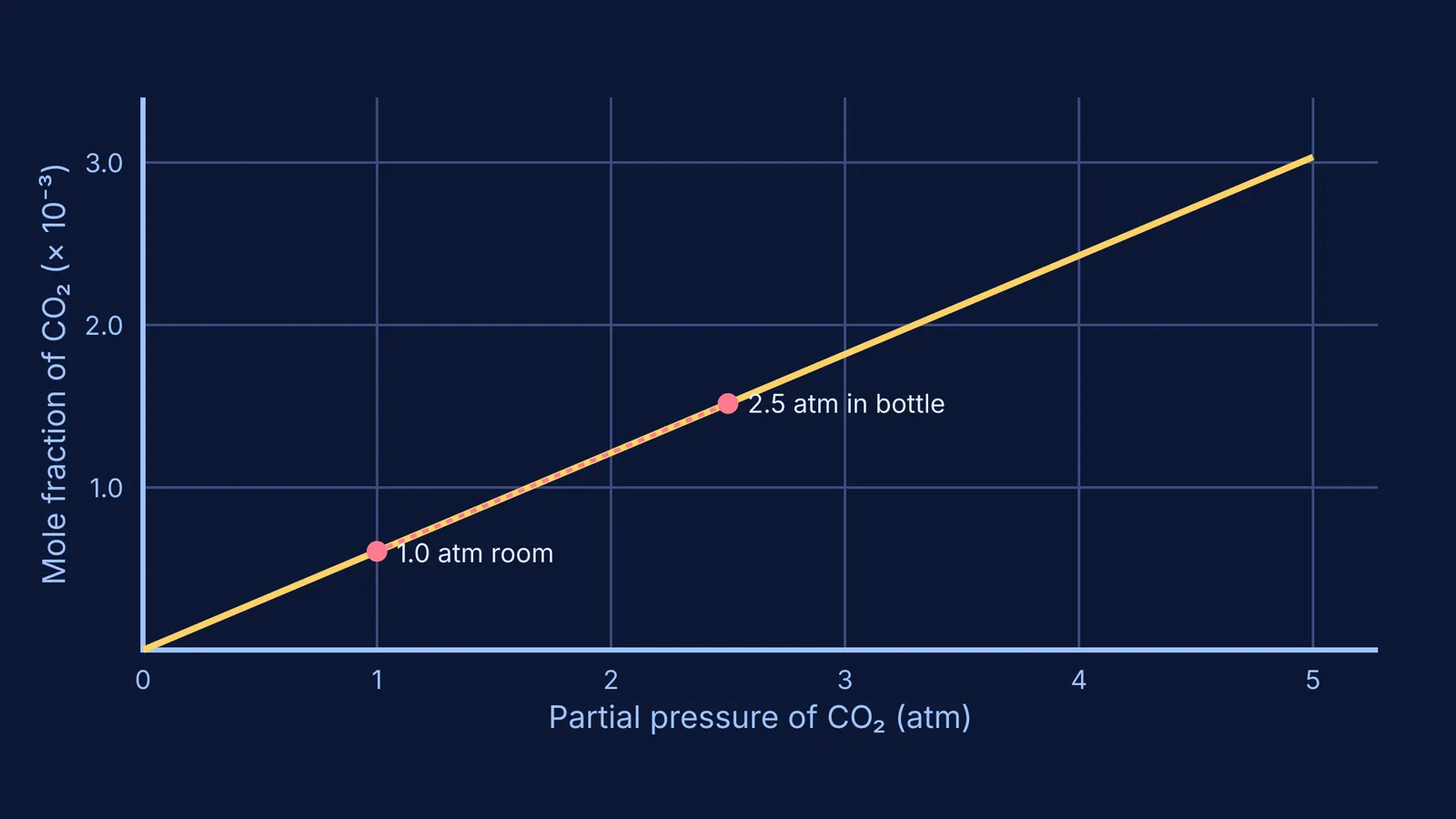
The relationship between the pressure of a gas and how much of it dissolves in a liquid is described by a rule you will meet in Class 12 chemistry. In Class 12 Chemistry, Henry's law states that at a constant temperature, the solubility of a gas in a liquid is directly proportional to the partial pressure of the gas present above the surface of the liquid.
The standard formula is written as p = K_H × x, where p is the partial pressure of the gas, K_H is the Henry's law constant, and x is the mole fraction of the gas in the solution.
Every gas has its own specific constant for a given solvent and temperature. The Henry's law constant for CO₂ in water at 298 K is 1.67 × 10⁸ Pa. This number tells us exactly how much gas the water can hold at a specific pressure. When the pressure (p) drops, the mole fraction (x) of the dissolved gas must also drop, which is why the bubbles appear.
Calculating CO2 in a soda bottle
To see Henry's law in action, let's look at a classic NCERT Class 12 problem: calculating the mass of CO₂ in 500 mL of soda packed under 2.5 atm of pressure at 298 K.
Convert the pressure: First, we convert 2.5 atm to Pascals, which gives us approximately 2.533 × 10⁵ Pa.
Find the mole fraction: Using Henry's law (x = p / K_H), we divide the pressure by the constant for CO₂. This gives (2.533 × 10⁵) / (1.67 × 10⁸) = 1.517 × 10⁻³.
Calculate the moles of water: 500 mL of water weighs 500 g. Dividing this by water's molar mass (18 g/mol) gives about 27.78 moles of water.
Find the mass of CO₂: The moles of CO₂ are the mole fraction multiplied by the moles of water (1.517 × 10⁻³ × 27.78 = 0.042 moles). Multiplying by the molar mass of CO₂ (44 g/mol) reveals that there is roughly 1.85 g of CO₂ dissolved in the bottle.
When you open that bottle and the pressure drops to 1 atm, the calculation changes, and the water can only hold about 0.74 g of CO₂. The missing 1.11 g is exactly what escapes as fizz.
How does temperature affect the fizz?
Temperature plays a major role in gas solubility, which is why we keep our drinks in the fridge. For most gases dissolved in liquids, solubility decreases as the temperature rises. When a liquid is heated, the kinetic energy of the molecules increases. This extra energy makes it easier for the dissolved gas molecules to break the weak bonds holding them in the liquid and escape into the air.
If you open a warm bottle of soda, it will fizz much more violently than a cold one. The higher temperature means the CO₂ is less soluble, so a greater amount of gas rushes out of the solution the moment the pressure is released. This inverse relationship between temperature and gas solubility is another key aspect of physical chemistry taught alongside Henry's law.
Visualising the invisible
It can be hard to picture molecules entering and leaving a solution as pressure changes. Textbooks give you the equations, but seeing the process makes it intuitive.
The Fermi Simulation Lab has interactive simulations for the ideas that are easier to see than to read. You can change the pressure and temperature yourself and watch the gas molecules respond in real time, turning an abstract equation into a concrete visual.
For more on how gases behave, you can explore the Average molar mass of a gas mixture: worked air and vapour examples and see what happens during the Free expansion of an ideal gas: why work and ΔU are both zero.


