

On this page
An oxygen concentrator doesn't create a single oxygen molecule. It starts with ordinary room air and removes most of the nitrogen, so the oxygen already there is left concentrated. Two school chemistry ideas explain the whole machine: the composition of air and adsorption.
What is in the air a concentrator starts with?
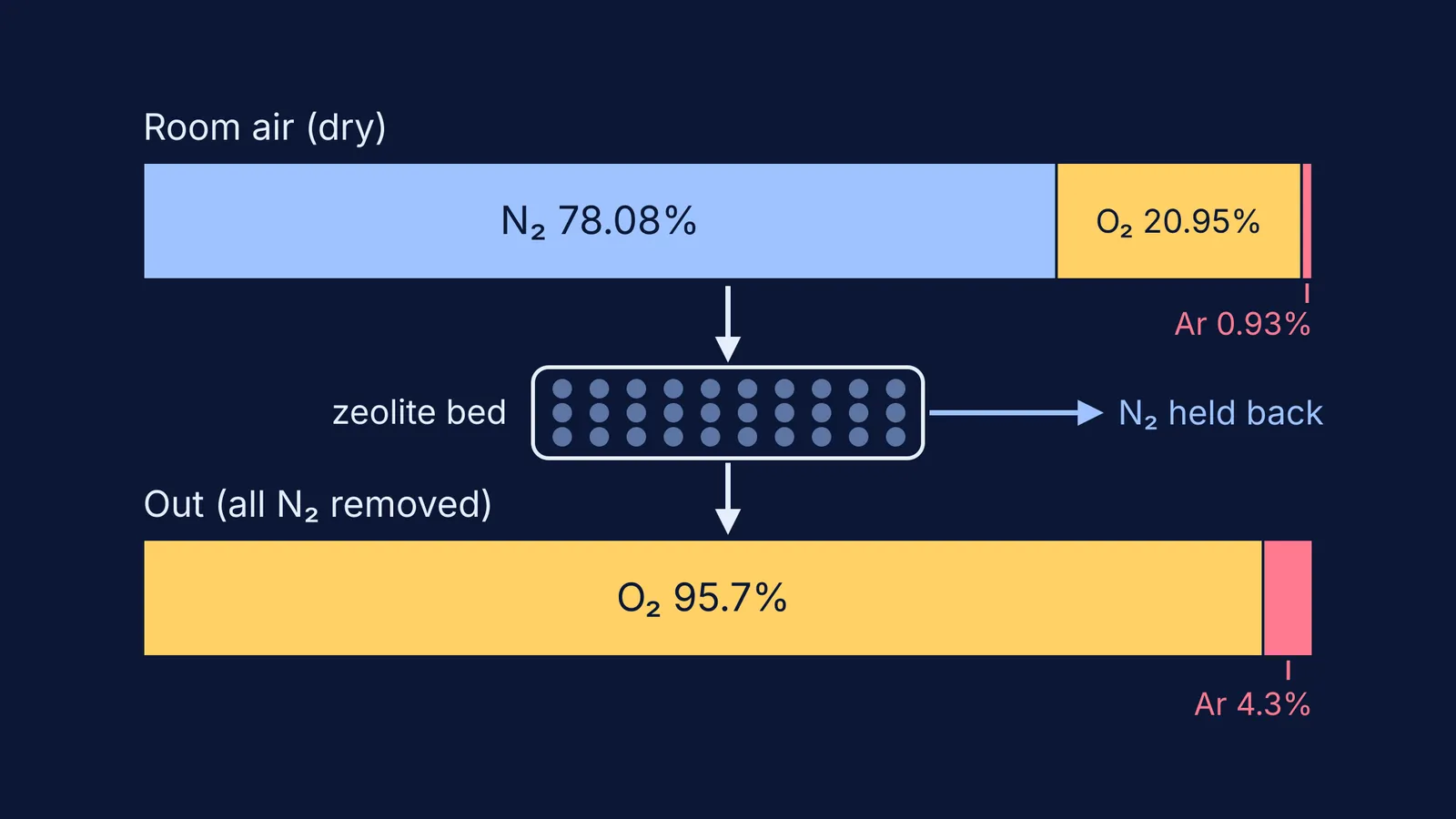
By volume, dry air is 78.08% nitrogen (N₂) and 20.95% oxygen (O₂), according to the NASA Earth Fact Sheet. The same NASA sheet lists argon at 9,340 parts per million, about 0.93%.
So the job is getting rid of nitrogen. Industry does it by liquefying air and boiling off each gas in turn (see fractional distillation of liquid air). A bedside machine uses a solid that grabs nitrogen instead.
How does an oxygen concentrator make oxygen from air?
The method is called pressure swing adsorption (PSA). A 2023 review in Frontiers in Medicine by Yadav and colleagues describes the cycle: compressed air is fed into a column packed with zeolite, the zeolite adsorbs nitrogen, and the column is cleaned out when its pressure is lowered. Here are the steps in order:
Compress: filtered room air is pressurised and fed into the first zeolite bed.
Adsorb: under pressure, nitrogen sticks to the zeolite. Oxygen mostly passes through to the outlet.
Swing: before the bed fills with nitrogen, valves send the air to a second bed.
Purge: the first bed drops back towards normal pressure, its nitrogen comes off and is vented, and the bed is ready again.
Because the beds take turns, oxygen keeps flowing. The review reports that air leaving a concentrator is 90 to 95% oxygen. Its comparison table lists cycle times from 3 to 100 seconds and adsorption pressures from about 1.5 to 4 bar, depending on the zeolite and the design.
In a prototype described in a 2017 Nanomaterials paper by Pan, Omar and Rohani, the beds adsorbed at 1.79 bar above atmospheric pressure and were cleaned under vacuum. In tests, the average peak oxygen concentration was 91.64%.
Why does zeolite grab nitrogen and not oxygen?
Zeolites are crystalline aluminosilicates full of tiny channels, so they have an enormous surface area. Their framework holds positive metal ions, such as lithium in LiX zeolites, and these ions create strong local electric fields.
Nitrogen and oxygen are both nonpolar, but their charge isn't spread evenly along the molecule. Pan and colleagues write in the Nanomaterials paper that the quadrupole moment of nitrogen is three times that of oxygen, which leads to selective adsorption on the zeolite surface. The cations' electric field tugs harder on nitrogen, so nitrogen sticks and oxygen slips past.
Pressure is the switch. More pressure means more gas adsorbed, the trend in the Freundlich isotherm (see how adsorption changes with pressure). High pressure, the bed holds nitrogen. Low pressure, it lets go. That is the "swing". For the chemist behind many synthetic zeolites, read our Edith Flanigen and zeolites profile.
Why can't a concentrator make 100% oxygen?
The catch is argon. A NASA technical report by G. W. Miller notes that conventional zeolite molecular sieves cannot tell oxygen and argon apart, which limits purity to 93 to 95%. You can check that ceiling yourself with the NASA air figures from the first section.
Worked example. Take 100 litres of dry air:
Nitrogen: 78.08 L. Assume a perfect bed holds back all of it.
Oxygen: 20.95 L, which passes through.
Argon: 0.93 L, which passes through with the oxygen.
Product: 20.95 + 0.93 = 21.88 L of gas.
Oxygen fraction: 20.95 ÷ 21.88 = 0.957, or about 95.7%.
So even with perfect nitrogen removal, roughly 4.3% of the product is argon. Real machines leave some nitrogen too, so measured values sit a little lower. Try this: to deliver 5 L of 93% oxygen per minute, how much room air must a machine take in at minimum? (Answer: 5 × 0.93 ÷ 0.2095, about 22 L per minute, and more in practice, since some oxygen leaves with the vented nitrogen.)
How do you write this as an exam answer?
If a question asks how oxygen is obtained from air without liquefying it, cover four points in order:
Air is about 78% nitrogen and 21% oxygen (NASA Earth Fact Sheet).
Zeolite adsorbs nitrogen more strongly, because nitrogen's larger quadrupole moment interacts with the cations.
Adsorption rises with pressure, so beds adsorb when pressurised and release nitrogen when depressurised, taking turns.
Argon isn't removed, so purity stops near 95% (NASA report on sieve oxygen limits).
The two-bed cycle is easier to follow when you watch it run. The Fermi Simulation Lab has interactive simulations for ideas like this, which are easier to see than to read. If adsorption itself is still shaky, the Fermi Concept Library gives every chemistry concept its own lesson.


