

On this page
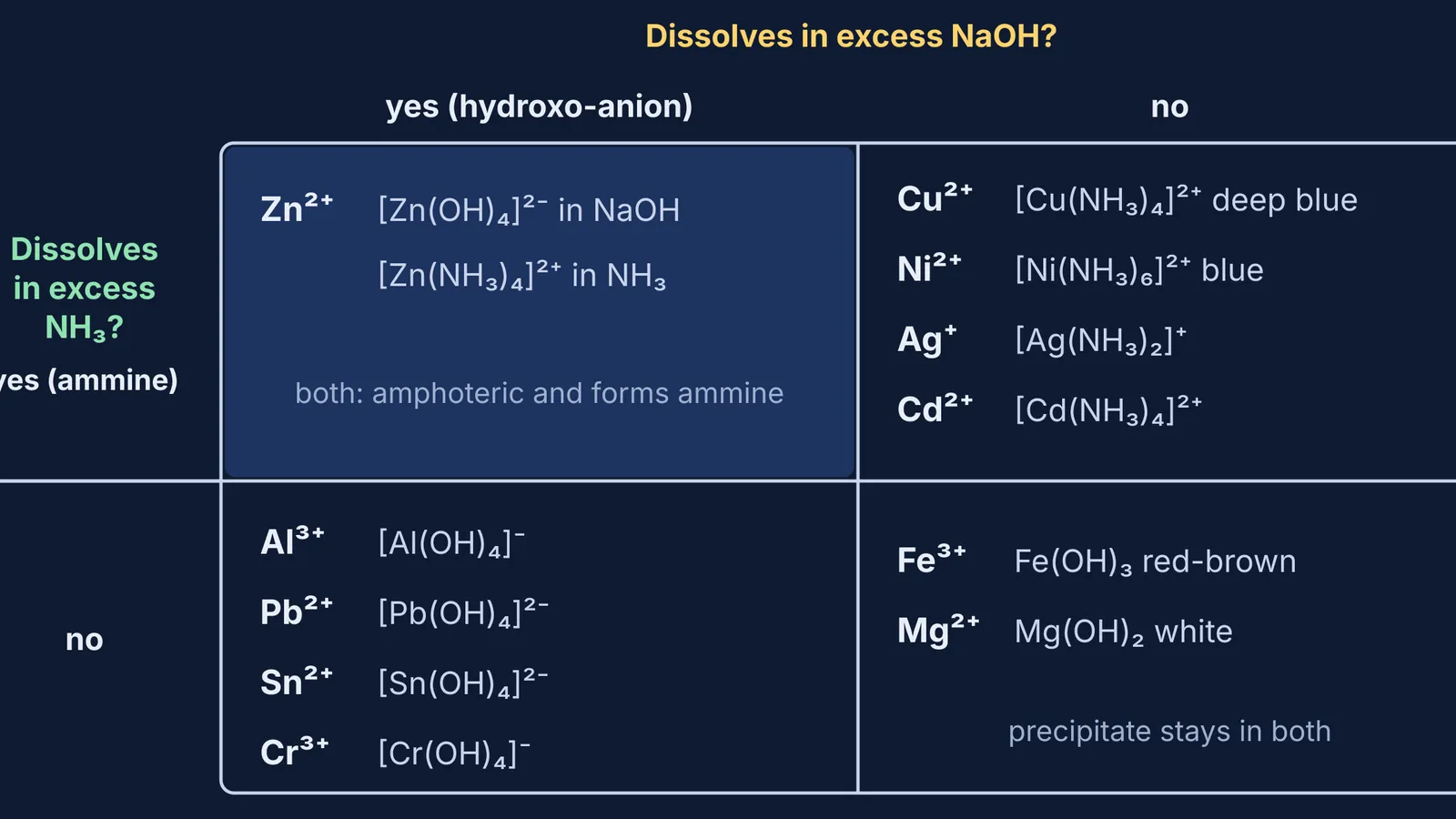
In salt analysis you often add a few drops of a reagent, get a precipitate, and then keep adding. Whether the precipitate dissolves in excess is one of the quickest clues to the cation. The two reagents that matter most are sodium hydroxide and aqueous ammonia. They look similar, since both are bases and both give hydroxide precipitates at first. But in excess they dissolve different hydroxides, for two different chemical reasons. Learn the reasons and the grid of cations stops being a list to memorise.
Why do some hydroxides dissolve in excess reagent at all?
A metal hydroxide precipitate dissolves only if something turns the metal ion into a soluble species. There are two ways that can happen.
Amphoterism (excess NaOH). The hydroxide acts as an acid towards a high concentration of OH⁻. The metal ion accepts more hydroxide ions and forms a soluble hydroxo-anion. For example, Al(OH)₃ + OH⁻ → [Al(OH)₄]⁻.
Complex formation (excess NH₃). Ammonia molecules bind to the metal ion through the lone pair on nitrogen and pull it out of the solid as a soluble ammine complex. For example, Cu(OH)₂ + 4NH₃ → [Cu(NH₃)₄]²⁺ + 2OH⁻.
These are different properties of the metal ion. Amphoterism needs a small, highly charged ion near the metal–non-metal border, such as Al³⁺, Zn²⁺, Pb²⁺, Sn²⁺ or Cr³⁺. Ammine formation needs a transition-metal or d¹⁰ ion that bonds well to nitrogen, such as Cu²⁺, Ni²⁺, Zn²⁺, Cd²⁺ or Ag⁺. A cation can have one property, both, or neither. That gives four boxes. The oxide side of amphoterism is covered in amphoteric oxides like Al₂O₃ and ZnO.
Which hydroxides dissolve in excess NaOH?
The amphoteric ones. Each first gives a precipitate and then redissolves:
Al³⁺: white Al(OH)₃, then Al(OH)₃ + OH⁻ → [Al(OH)₄]⁻ (aluminate)
Zn²⁺: white Zn(OH)₂, then Zn(OH)₂ + 2OH⁻ → [Zn(OH)₄]²⁻ (zincate)
Pb²⁺: white Pb(OH)₂, then Pb(OH)₂ + 2OH⁻ → [Pb(OH)₄]²⁻ (plumbite)
Sn²⁺: white Sn(OH)₂, then Sn(OH)₂ + 2OH⁻ → [Sn(OH)₄]²⁻ (stannite)
Cr³⁺: grey-green Cr(OH)₃, then Cr(OH)₃ + OH⁻ → [Cr(OH)₄]⁻ (green solution)
Older books write the same anions in dehydrated form, such as AlO₂⁻, ZnO₂²⁻ and PbO₂²⁻. They are the same species; [Al(OH)₄]⁻ is just AlO₂⁻ + 2H₂O. Either form earns the mark if the charge balances.
Hydroxides that do not dissolve in excess NaOH include Cu(OH)₂ (blue), Ni(OH)₂ (green), Fe(OH)₃ (red-brown), Mg(OH)₂ (white) and Cd(OH)₂ (white). Ag⁺ gives brown Ag₂O, which also stays.
Which hydroxides dissolve in excess ammonia?
The ones whose metal ions form stable ammine complexes:
Cu²⁺: pale blue Cu(OH)₂, then deep blue [Cu(NH₃)₄]²⁺
Zn²⁺: white Zn(OH)₂, then colourless [Zn(NH₃)₄]²⁺
Ni²⁺: green Ni(OH)₂, then blue-violet [Ni(NH₃)₆]²⁺
Cd²⁺: white Cd(OH)₂, then colourless [Cd(NH₃)₄]²⁺
Ag⁺: brown Ag₂O, then colourless [Ag(NH₃)₂]⁺
Co²⁺: dissolves as [Co(NH₃)₆]²⁺, which is easiest when NH₄⁺ salts are present. It slowly darkens in air as it oxidises to cobalt(III).
The deep blue copper complex is the classic one. Its use as a confirmatory test is covered in confirmatory tests for copper ions with ammonia and ferrocyanide.
Why doesn't ammonia dissolve Al(OH)₃ if it is a base?
Because aqueous ammonia is a weak base and supplies far too little OH⁻ for amphoterism to work. Take 1 M NH₃ with Kb ≈ 1.8 × 10⁻⁵. Then [OH⁻] ≈ √(Kb × c) ≈ 4.2 × 10⁻³ M, so the pH is about 11.6. A 1 M NaOH solution has [OH⁻] = 1 M, which is roughly 240 times more. That is not enough to push Al(OH)₃ to aluminate.
Al³⁺ also does not form an ammine complex in water. It is a small, hard ion that bonds much more strongly to oxygen (water and hydroxide) than to nitrogen. So neither route is open, and Al(OH)₃ stays put. The same holds for Pb(OH)₂ and Sn(OH)₂.
Cr(OH)₃ is a borderline case: a little dissolves in cold, excess ammonia to give a pink-violet tint, but it comes back out on boiling. For the grid, treat it as insoluble in NH₃.
Why do Fe³⁺ and Mg²⁺ hydroxides dissolve in neither?
Fe(OH)₃ is a basic hydroxide with an extremely small solubility product, so it is not attacked by ordinary excess NaOH. Fe³⁺ also does not form an ammine complex in water, because it holds on to oxygen donors and hydrolyses instead. Mg(OH)₂ is plainly basic, and Mg²⁺ has no tendency to bind ammonia in water.
One caution about magnesium. In Group III analysis you add NH₄Cl before NH₃, and then Mg(OH)₂ does not precipitate at all. That is not because it dissolves as a complex. It is because the common-ion effect keeps [OH⁻] too low to reach its Ksp. The reasoning is explained in why NH₄Cl is added before NH₄OH in Group 3.
How do you tell Zn²⁺ from Al³⁺? A worked example
Question: Two colourless solutions each contain one cation, Zn²⁺ or Al³⁺. Both give a white precipitate with NaOH that dissolves in excess. How do you tell them apart?
NaOH does not separate them. Both hydroxides are amphoteric. Zn(OH)₂ + 2OH⁻ → [Zn(OH)₄]²⁻ and Al(OH)₃ + OH⁻ → [Al(OH)₄]⁻. Both solutions end up clear.
Use excess NH₃ instead. To fresh samples, add aqueous ammonia drop by drop, then in excess. Both give a white precipitate first.
Watch the excess. With Zn²⁺, the precipitate redissolves: Zn(OH)₂ + 4NH₃ → [Zn(NH₃)₄]²⁺ + 2OH⁻. With Al³⁺, the white gelatinous Al(OH)₃ stays.
Check the reverse direction too (optional). Take the clear aluminate from step 1 and add solid NH₄Cl. Al(OH)₃ comes back: [Al(OH)₄]⁻ + NH₄⁺ → Al(OH)₃ + NH₃ + H₂O. The zincate solution stays clear, because the NH₃ formed holds Zn²⁺ as [Zn(NH₃)₄]²⁺.
Answer: the solution whose precipitate redissolves in excess NH₃ contains Zn²⁺. The one that keeps a white precipitate contains Al³⁺.
Check the balance in step 4: one Al, four O, eight H, one N on each side, and the charges (−1 and +1) cancel to zero. If you want to see more problems like this solved with the reasoning shown at each step, try the Fermi Problem Library.
Quick checklist
Excess NaOH dissolves amphoteric hydroxides: Al, Zn, Pb, Sn(II), Cr(III).
Excess NH₃ dissolves hydroxides of ions that form ammines: Cu, Zn, Ni, Cd, Ag (and Co with NH₄⁺).
Zn²⁺ is the only common cation in both lists.
Fe³⁺ and Mg²⁺ hydroxides dissolve in neither.
NH₃ cannot dissolve Al(OH)₃: too little OH⁻ (pH about 11.6 for 1 M) and no Al–NH₃ complex.
Write hydroxo-anions as [Al(OH)₄]⁻ or AlO₂⁻; balance the charge either way.


