

On this page
Drop a lump of calcium carbide into water and it fizzes out ethyne. Drop aluminium carbide in and you get methane instead. Magnesium carbide, Mg₂C₃, gives a third gas, propyne. Exam questions love this set because the three compounds look alike on paper but give three different hydrocarbons. You do not need to memorise a list. Once you know which carbon anion is inside each carbide, you can write the gas straight down, and the same logic tells you that nitrides such as Mg₃N₂ and Li₃N give ammonia.
What happens when an ionic carbide reacts with water?
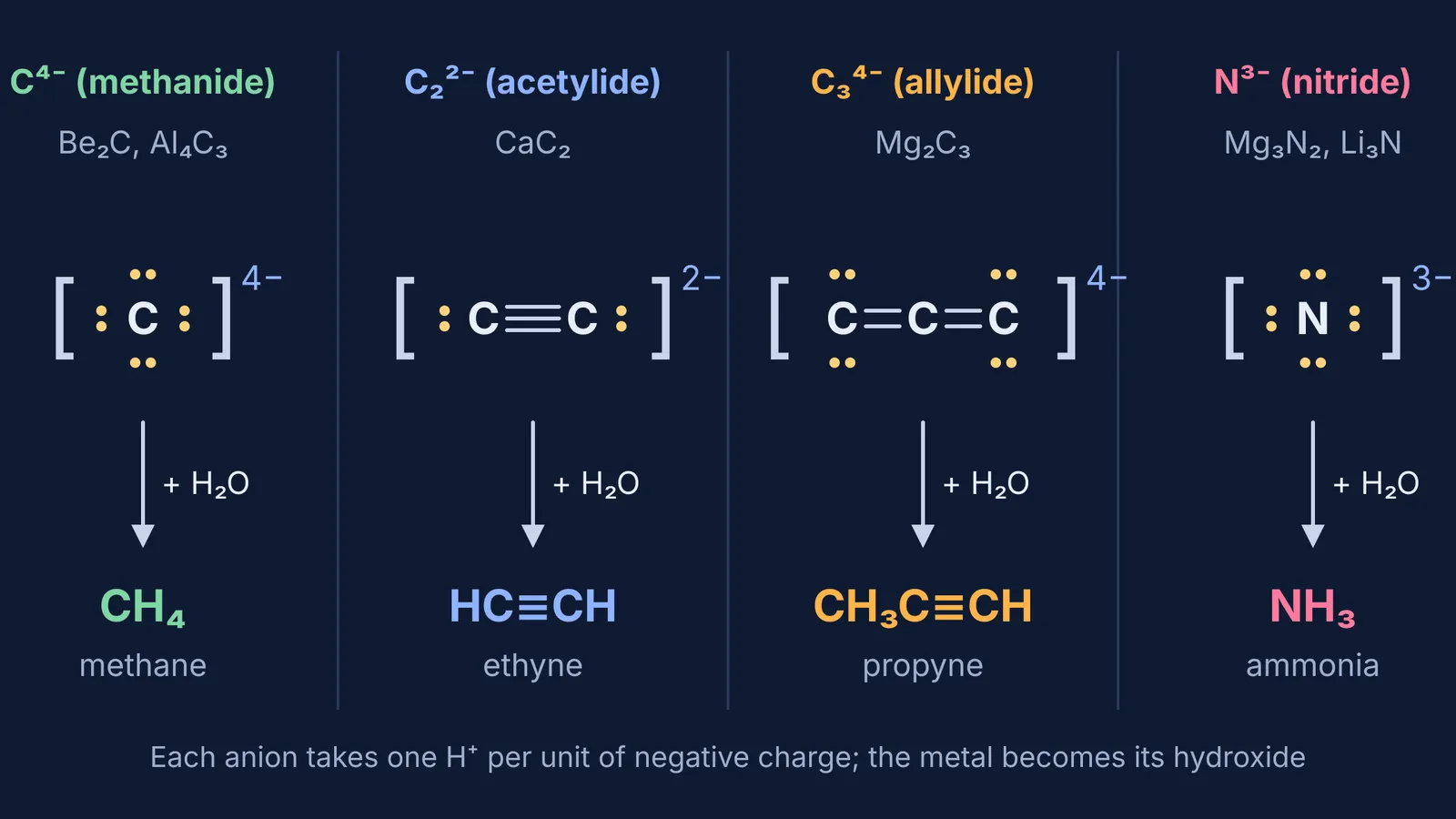
Ionic (salt-like) carbides are formed by the most electropositive metals: Groups 1 and 2, and aluminium. In these solids carbon carries a negative charge. Treat the carbon unit as a very strong base. It is a far stronger base than OH⁻, so it pulls protons off water at once:
The carbon anion picks up one H⁺ for every unit of negative charge.
The metal ends up as its hydroxide.
The hydrocarbon that forms keeps the carbon skeleton of the anion.
So the whole question reduces to this: what is the carbon unit, and what is its charge? The charges are formal. Real carbides are not 100 percent ionic, but the ionic picture predicts the products correctly, and that is what JEE and NEET ask about.
Covalent carbides such as SiC and B₄C, and interstitial carbides such as WC, are a different story. Their carbon is locked into a giant network or into metal lattice holes, and they do not react with water.
Which carbides give methane, ethyne or propyne?
There are three anion types to learn.
C⁴⁻: single carbon atoms (methanides)
Be₂C and Al₄C₃ contain separate C⁴⁻ ions. Each takes four H⁺ and becomes CH₄.
Be₂C + 4H₂O → 2Be(OH)₂ + CH₄
Al₄C₃ + 12H₂O → 4Al(OH)₃ + 3CH₄
C₂²⁻: the acetylide ion
CaC₂, Na₂C₂ and BaC₂ contain [:C≡C:]²⁻. It takes two H⁺ and becomes HC≡CH.
CaC₂ + 2H₂O → Ca(OH)₂ + C₂H₂
C₃⁴⁻: a three-carbon chain (allylide)
Mg₂C₃ contains [:C=C=C:]⁴⁻, with two lone pairs on each end carbon. It has 16 valence electrons, the same as CO₂, and the same linear shape. It takes four H⁺ and becomes C₃H₄, which ends up as propyne, CH₃–C≡CH.
Mg₂C₃ + 4H₂O → 2Mg(OH)₂ + CH₃C≡CH
A quick rule follows: the hydrocarbon is the anion plus as many hydrogens as its negative charge. C⁴⁻ gives CH₄, C₂²⁻ gives C₂H₂ and C₃⁴⁻ gives C₃H₄.
How do you know which anion a carbide has? Use the formula and the metal's charge. In Al₄C₃, four Al³⁺ give +12, which three carbons must balance, so each carbon is C⁴⁻ and the carbons are separate. In CaC₂, one Ca²⁺ balances two carbons, so the unit is C₂²⁻. In Mg₂C₃, two Mg²⁺ give +4 shared by three carbons, so the unit must be C₃⁴⁻.
The everyday use of the CaC₂ reaction is covered in the laboratory preparation of ethyne from calcium carbide, and the reason the same reaction is a food-safety problem is in why calcium carbide ripening of mangoes is banned.
Why do nitrides like Mg₃N₂ and Li₃N give ammonia?
Exactly the same logic works one place to the right in the periodic table. Ionic nitrides contain N³⁻, which is isoelectronic with C⁴⁻ (both have eight valence electrons) and is also a very strong base. N³⁻ takes three H⁺ and becomes NH₃.
Mg₃N₂ + 6H₂O → 3Mg(OH)₂ + 2NH₃
Li₃N + 3H₂O → 3LiOH + NH₃
Ca₃N₂ + 6H₂O → 3Ca(OH)₂ + 2NH₃
This is why burnt magnesium ribbon smells of ammonia if you wet the ash. Magnesium burning in air forms some Mg₃N₂ along with MgO, and water releases NH₃ from it. Lithium is the only alkali metal that combines directly with N₂ to form a stable nitride, one of the points in the anomalous behaviour of lithium.
The pattern continues down Group 15. Calcium phosphide contains P³⁻ and gives phosphine: Ca₃P₂ + 6H₂O → 3Ca(OH)₂ + 2PH₃.
One more NCERT-adjacent case is calcium cyanamide, CaCN₂, made by heating CaC₂ in N₂. It is used as a fertiliser because it releases ammonia slowly in moist soil: CaCN₂ + 3H₂O → CaCO₃ + 2NH₃.
Worked example: how much methane does Al₄C₃ give?
Question. What volume of methane, measured at STP, is formed when 1.44 g of Al₄C₃ reacts completely with water? How much water is used up?
Write the balanced equation. Al₄C₃ + 12H₂O → 4Al(OH)₃ + 3CH₄. Check: 4 Al, 3 C, 24 H and 12 O on each side.
Molar mass of Al₄C₃. 4 × 26.98 + 3 × 12.01 = 143.95 g/mol, about 144 g/mol.
Moles of carbide. 1.44 ÷ 144 = 0.0100 mol.
Moles of methane. The equation gives 3 mol CH₄ per mol Al₄C₃, so 3 × 0.0100 = 0.0300 mol CH₄. This matches the anion picture: each formula unit holds three C⁴⁻ ions, and each one becomes one CH₄.
Volume at STP. Using 22.4 L/mol (0 °C, 1 atm): 0.0300 × 22.4 = 0.672 L, or 672 mL. If your paper uses the IUPAC value of 22.7 L/mol (0 °C, 1 bar), the answer is about 681 mL.
Water used. 12 × 0.0100 = 0.120 mol, which is 0.120 × 18.0 = 2.16 g of water.
For comparison, the same 1.44 g of CaC₂ (64.1 g/mol) is 0.0225 mol and gives 0.0225 mol C₂H₂, about 503 mL at STP. Same mass, different gas and different volume, all because of the anion.
How can you tell the gases apart in the lab?
The gases differ in whether they have an acidic ≡C–H hydrogen, and in their basicity.
Methane (from Be₂C or Al₄C₃) has no acidic hydrogen. It gives no precipitate with ammoniacal AgNO₃ or ammoniacal Cu₂Cl₂.
Ethyne (from CaC₂) is a terminal alkyne. It gives a white precipitate of silver acetylide with Tollens' reagent and a red precipitate of copper(I) acetylide with ammoniacal Cu₂Cl₂.
Propyne (from Mg₂C₃) is also a terminal alkyne, so it gives the same kind of precipitates. Telling it from ethyne needs its molar mass or its reaction products, not the precipitate test alone.
Ammonia (from nitrides) turns moist red litmus blue and gives white fumes of NH₄Cl with HCl.
If you want to practise more mixed stoichiometry problems of this type, the Fermi Problem Library has a step-by-step solver that explains the reasoning at each stage.
What mistakes cost marks on carbide questions?
Writing CH₄ for every carbide. Only the C⁴⁻ carbides give methane.
Writing C₂H₂ for Mg₂C₃ because "Mg is in Group 2 like Ca". The formula is different, and so is the anion.
Forgetting the factor of 3 for Al₄C₃. One formula unit gives three CH₄.
Saying SiC or WC reacts with water. Covalent and interstitial carbides do not.
Writing N₂ or N₂H₄ for a nitride. Ionic nitrides give NH₃.
Quick checklist
C⁴⁻ (Be₂C, Al₄C₃) gives CH₄.
C₂²⁻ (CaC₂) gives C₂H₂.
C₃⁴⁻ (Mg₂C₃) gives CH₃C≡CH.
N³⁻ (Mg₃N₂, Li₃N, Ca₃N₂) gives NH₃; P³⁻ (Ca₃P₂) gives PH₃.
Hydrocarbon = anion + as many H as its charge; the metal becomes its hydroxide.
1.44 g Al₄C₃ gives 0.0300 mol CH₄, 672 mL at STP.


