On this page
In NCERT's Class 12 Biology book (Reprint 2026-27), Human Reproduction is Chapter 2, and the NMC's NEET (UG) 2026 syllabus lists it under Unit 6, Reproduction. Many wrong answers here come not from a skipped page but from a known fact filed in the wrong slot: a gland filed as a duct, a trigger taken for an amplifier, a percentage tied to the wrong measure.
Below are eight frequent slips, grouped by kind, each with its NCERT section, a quick check and a habit. New to the chapter? Begin with our NCERT-first preparation plan for this chapter. This is a study summary, not medical advice.
Where does each structure belong?
"The bulbourethral glands are one of the male accessory ducts."
Why it happens: all seven are named within a few paragraphs of section 2.1 and all relate to semen, so they blur into one list.
What NCERT says (2.1): the accessory ducts are four tubes that store and carry sperms, running from the rete testis to the vasa efferentia, then the epididymis, then the vas deferens. The accessory glands are separate: the paired seminal vesicles, the single prostate and the paired bulbourethral glands, whose secretions form the seminal plasma.
Check: without looking, sort into ducts and glands: prostate, epididymis, seminal vesicle, rete testis, vas deferens, bulbourethral gland, vasa efferentia. You should get four and three.
Habit: ask whether the structure moves something along (a duct) or makes a fluid (a gland).
"The placenta belongs to the embryo."
Why it happens: the chorionic villi grow from the trophoblast, which is embryonic, so the whole organ gets handed to the embryo.
What NCERT says (2.6): the villi interlock with uterine tissue, and the two together build the placenta, a structural and functional link between foetus and mother.
Check: name one part of the placenta that comes from each side. (Embryo: chorionic villi. Mother: uterine tissue.)
Habit: for any "formed by" question, ask "formed by whom, and together with whom?"
Which event comes first?
"Oxytocin is what starts labour."
Why it happens: oxytocin is the hormone everyone links with childbirth, so it lands at step one.
What NCERT says (2.7): the signals start with the placenta and the fully grown foetus. They set off mild uterine contractions, the foetal ejection reflex, and only then does the mother's pituitary release oxytocin. Oxytocin strengthens the contractions, which draw out more oxytocin, a loop that builds until delivery.
Check: in NCERT's chain, is oxytocin the cause of the foetal ejection reflex or its result? (Its result.)
Habit: split every hormone chain into trigger and amplifier before you look at the options.
"Pregnancy begins the moment sperm and ovum fuse."
Why it happens: fertilisation feels like the start of everything.
What NCERT says (2.5): cleavage, the morula and the blastocyst follow on the way to the uterus. Pregnancy is tied to implantation, when uterine cells cover the attached blastocyst and it becomes embedded in the endometrium.
Check: a blastocyst's trophoblast has just touched the endometrium, but uterine cells have not covered it yet. Has the step NCERT links with pregnancy happened? (Not yet: attached, not embedded.)
Habit: when a stem says "leads to pregnancy", look for implantation, not fertilisation.
Which look-alike terms get swapped?
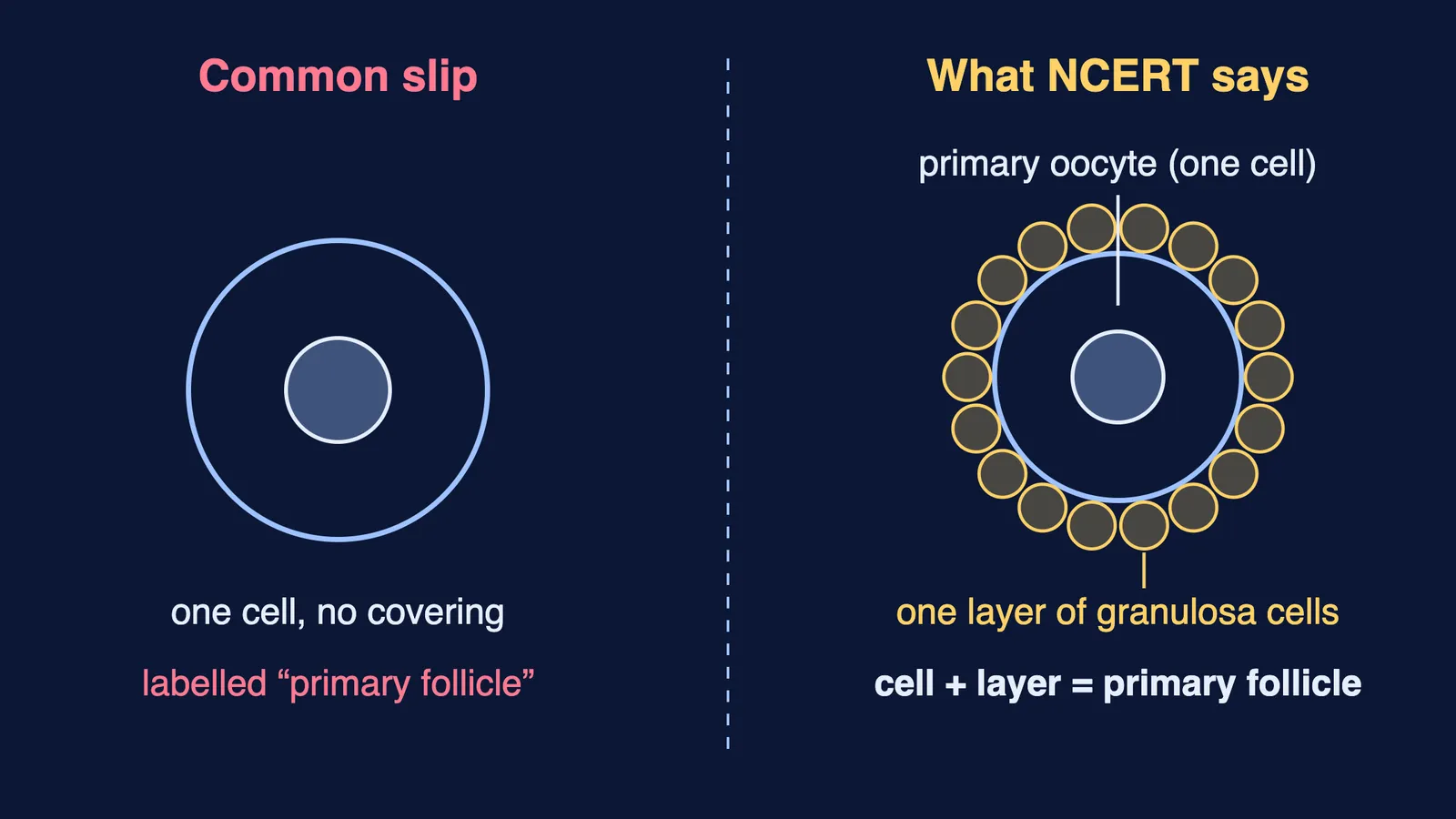
"A primary follicle and a primary oocyte are the same thing."
Why it happens: both names start with "primary", and a label line on a figure can seem to point at the central cell alone.
What NCERT says (2.3): the primary oocyte is one cell, held in prophase I. Once one layer of granulosa cells wraps it, the whole package is a primary follicle. Follicle names cover the cell plus its layers; oocyte names, the cell alone.
Check: does a secondary follicle hold a secondary oocyte? (No. It still holds a primary oocyte; the first meiotic division finishes only in the tertiary follicle.)
Habit: read "-cyte" as one cell and "follicle" as a cell with layers around it.
"Cleavage is the zygote finishing meiosis."
Why it happens: the oocyte finishes its second meiotic division at sperm entry, just before cleavage, so the divisions seem continuous.
What NCERT says (2.5): meiosis ends with a haploid ootid and a second polar body, and the haploid nuclei of sperm and ovum then fuse into a diploid zygote. Cleavage is a series of mitotic divisions that begins in the isthmus and produces 2, 4, 8 and 16 blastomeres.
Check: how many chromosomes are in each cell of a four-cell embryo? (46. Mitosis keeps the zygote's diploid count.)
Habit: label every division you write as mitosis or meiosis, with the chromosome count beside it.
Which numbers get swapped?
"60 per cent is the motility cut-off for sperms."
Why it happens: section 2.3 puts two percentages in one sentence, and they swap.
What NCERT says (2.3): of roughly 200 to 300 million sperms per ejaculation, normal fertility needs a normal shape and size in at least 60 per cent, and vigorous motility in at least 40 per cent.
Check: fix this statement: "normal fertility needs at least 40 per cent of sperms with normal shape and size and at least 60 per cent with vigorous motility." (Swap the numbers: 60 goes with shape and size, 40 with vigorous motility.)
Habit: say "shape 60, movement 40" to yourself before answering: the shape bar is the higher one.
"Each ovary holds 60,000 to 80,000 follicles at birth."
Why it happens: it is the one oogenesis number students remember, so it gets pinned to the obvious moment, birth.
What NCERT says (2.3): each fetal ovary forms a couple of million oogonia, and none are added after birth. Many follicles degenerate before puberty, so each ovary is left with just 60,000 to 80,000 primary follicles by then.
Check: what two things are wrong in "each ovary holds 60,000 to 80,000 primary follicles at birth, and the count rises by puberty"? (The figure belongs to puberty, and the count falls between birth and puberty as follicles degenerate.)
Habit: tie every number to a time stamp (before birth, at birth, at puberty) and to "each ovary" or "both".
What should you check in the last 60 seconds?
To test the follicle slip, label the lettered follicle in our diagram-based questions on human reproduction.
Not sure which of these slips is yours? Fermi's AI tutor works out what you already know and builds a plan for the session.