On this page
These are the key terms of Chapter 7 of NCERT Class 10 Science, How do Organisms Reproduce? (2026-27 reprint), which the CBSE Class X Science syllabus for 2026-27 covers as reproduction in animals and plants and reproductive health. For a chapter plan, see our How do Organisms Reproduce? Class 10 guide. Tissue culture is left out: it sits in a "More to Know" box, and the syllabus says box content "would not be assessed in the year-end examination".
Why do organisms reproduce, and why does variation matter?
Reproduction: making new individuals of the same kind. An individual does not need it to stay alive, but a species needs it to continue.
DNA copying: the basic event in reproduction. A cell makes a copy of its DNA and builds extra cell machinery, then divides so each new cell gets one full set.
Variation: small differences between offspring, because DNA copying is never perfectly accurate. Example: if water warms, a few heat-resistant bacteria survive while most die.
Niche: the place a population fills in its ecosystem. Because DNA is copied fairly accurately, offspring keep body designs that suit their niche, so populations stay stable.
What are the modes of asexual reproduction?
NCERT calls every mode in which a new generation comes from a single individual asexual reproduction.
Binary fission: a single cell splits into two. Example: Amoeba splits in any plane; Leishmania (which causes kala-azar) splits in a definite orientation. Don't confuse with: multiple fission.
Multiple fission: one cell divides into many daughter cells at once. Example: Plasmodium, the malarial parasite.
Fragmentation: a simple many-celled organism breaks into pieces when mature, and each piece grows into a new individual. Example: Spirogyra.
Regeneration: a whole organism grows from a cut body piece. Example: Planaria, Hydra. Don't confuse with: reproduction; most organisms do not rely on being cut up.
Budding: an outgrowth forms by repeated cell division at one spot, matures and detaches. Example: Hydra, yeast.
Vegetative propagation: new plants grow from a root, stem or leaf. Example: buds on a Bryophyllum leaf margin; layering and grafting for sugarcane, roses and grapes.
Spore formation: reproduction through thick-walled spores held in sporangia, which grow on reaching a moist surface. Example: bread mould, Rhizopus. Don't confuse sporangia with hyphae, the thread-like parts that are not reproductive.
Which terms describe sexual reproduction in flowering plants?
Sexual reproduction: reproduction involving two individuals, combining their DNA to create new combinations of variations.
Germ cells (gametes): reproductive cells; the male gamete is smaller and motile, the female gamete larger with stored food.
Meiosis: the division that gives germ cells half the chromosomes and DNA of body cells, so fusion restores the full amount.
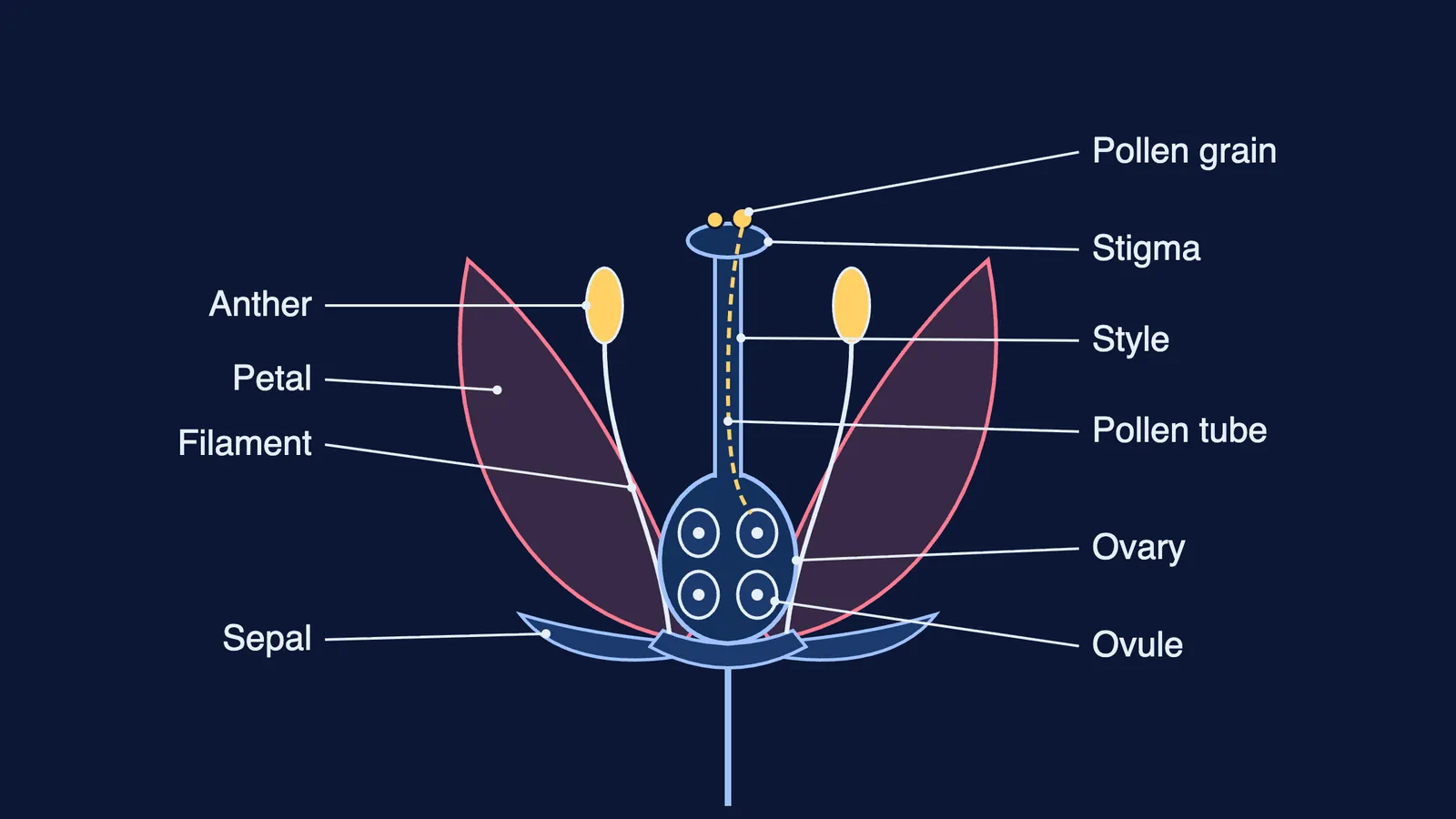
Unisexual and bisexual flowers: unisexual flowers have only stamens or only a pistil (papaya, watermelon); bisexual flowers have both (Hibiscus, mustard).
Stamen: the male part; its anther makes yellowish pollen grains.
Pistil: the female part: ovary (swollen base), style (middle) and stigma (tip, which can be sticky).
Ovule: a structure in the ovary containing an egg cell.
Self- and cross-pollination: pollination moves pollen from anther to stigma, within one flower (self) or to another flower (cross), carried by wind, water or animals.
Pollen tube: grows from a pollen grain on the stigma through the style to the ovary.
Fertilisation and zygote: fertilisation is the fusion of male and female germ cells; it forms a zygote, which divides into an embryo.
Seed and fruit: the ovule becomes a seed with a tough coat; the ovary ripens into a fruit.
Germination: the embryo in a seed growing into a seedling. Example: soaked Bengal gram (chana).
Which terms name the parts of the human reproductive system?
From sections 7.3.3 (a) to (c) of the NCERT chapter:
Puberty: the stage in adolescence when, as body growth slows, reproductive tissues mature.
Testes: make sperms and the hormone testosterone, which also brings the changes boys see at puberty. They sit in the scrotum, outside the abdomen, because sperm formation needs a lower temperature.
Vas deferens: the tube carrying sperms; it joins a tube from the urinary bladder. Don't confuse with: the oviduct, which carries eggs.
Urethra: in males, the common passage for sperms and urine.
Seminal vesicles and prostate: glands adding a fluid that eases sperm transport and nourishes sperms.
Ovaries: make eggs and some hormones; after puberty one egg is released each month by one ovary.
Oviduct (fallopian tube): carries the egg to the uterus; fertilisation happens here.
Uterus and cervix: the uterus is the elastic, bag-like womb; the cervix opens it into the vagina.
Implantation: the embryo settling into the thickened uterine lining.
Placenta: a disc in the uterine wall, with villi on the embryo's side, that passes glucose and oxygen to the embryo and removes its wastes.
Menstruation: if the egg is not fertilised, the thick uterine lining breaks down and leaves as blood and mucus, roughly every month, usually for two to eight days.
What do the reproductive health terms mean?
Sexually transmitted diseases: infections passed on during sex: gonorrhoea and syphilis (bacterial), warts and HIV-AIDS (viral).
Barrier contraception: condoms or similar coverings stop sperm reaching the egg and also help prevent many of these infections to some extent.
Oral pills: change hormonal balance so eggs are not released; they can cause side-effects.
Copper-T: a device placed in the uterus to prevent pregnancy. Don't confuse with: protection from sexually transmitted diseases, which it does not give.
Surgical methods: blocking the vas deferens or fallopian tube so gametes cannot meet.
For questions about your own health, talk to a doctor or a trusted adult.
How to learn these terms
Learn look-alikes as pairs: binary and multiple fission, regeneration and reproduction, hyphae and sporangia, pollination and fertilisation, vas deferens and oviduct.
Tag each asexual mode with one organism; NCERT's first exercise asks which organism reproduces by budding.
Draw the longitudinal section of a flower, as NCERT's Exercise 7 asks, and trace the pollen tube from stigma to ovule. Our Class 10 science diagrams guide covers how to practise and label it.
Say both pathways aloud: ovary, oviduct, uterus; testes, vas deferens, urethra. If a term still feels hazy, the Fermi Concept Library gives each biology concept its own lesson.