On this page
Stir instant coffee or cocoa powder into a mug of hot water, then tap the bottom of the mug with a spoon a few times. The first taps give a dull, low note. Over the next few seconds the note climbs, tap after tap, until it settles at a clear, high pitch. This is the hot chocolate effect, and the cause is a cloud of tiny air bubbles that slows sound in the liquid by a factor of four or more.
What is the hot chocolate effect?
The physicist Frank Crawford measured it carefully in The hot chocolate effect, American Journal of Physics 50, 398 (1982). He filled a tall glass cylinder with hot tap water and tapped it on the bottom. The note he heard was the lowest mode of the water column, the one where the height of the water is one quarter of a wavelength. As the dissolved air came out of solution as bubbles, the pitch of that mode fell by nearly three octaves in the first few seconds, then rose slowly as the bubbles floated to the top. His simple formula for the pitch ratio agreed with experiment to within the 10% accuracy of his measurements.
So the note follows the speed of sound in the liquid. For a column of height h whose lowest mode is a quarter wavelength, f = v/4h. The height stays the same, so the pitch falls and rises in step with v. Powder and stirring bring in plenty of air, so cocoa and coffee show it clearly.
Why does a little air slow sound so much in water?
Sound in a fluid travels at v = √(B/ρ): it needs something springy (bulk modulus B) and something heavy (density ρ). The bulk modulus and the idea of compressibility 1/B are explained in bulk modulus and compressibility, with worked problems.
Now mix them. A bubbly liquid gets the worst of both:
Springiness from the air. When you squeeze the mixture, the bubbles give way first. Air is about 15,000 times more compressible than water, so even a tiny volume of air makes the whole mixture squashy.
Mass from the water. Air is about 830 times lighter than water, so the bubbles barely change the density.
A small B with a large ρ gives a small v.
What is Wood's equation for sound in a bubbly liquid?
Let φ be the fraction of the volume taken up by gas. Squeeze the mixture with a small extra pressure Δp. Each part shrinks by its own fraction, Δp/B, and the shrinkages add up by volume. So the compressibilities, not the bulk moduli, are averaged:
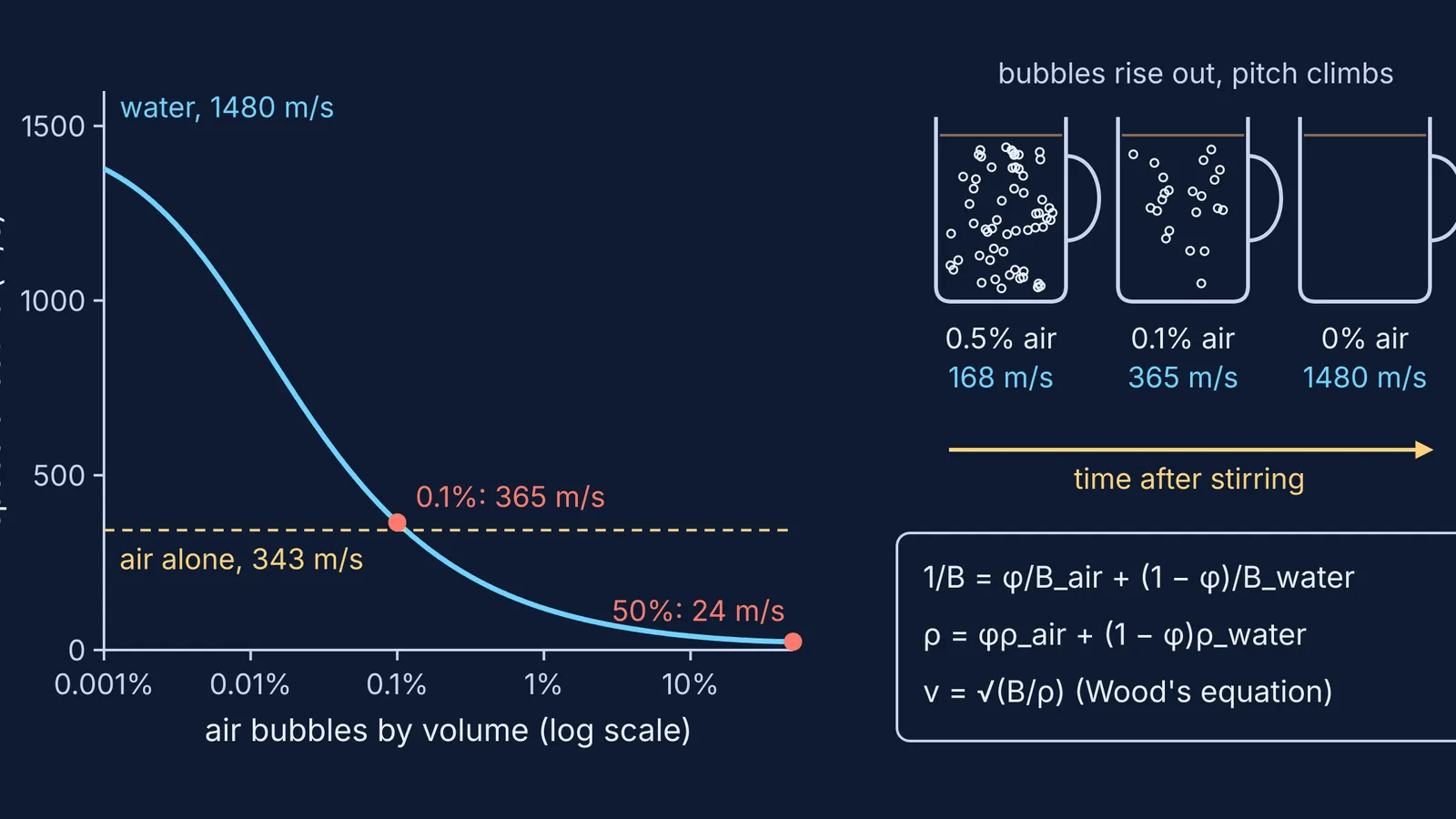
1/B_mix = φ/B_air + (1 − φ)/B_water
The density is a plain volume average:
ρ_mix = φρ_air + (1 − φ)ρ_water
Then v = √(B_mix/ρ_mix). This is Wood's equation. Wilson and Roy, American Journal of Physics 76, 975 (2008) confirmed it with air bubbled into a water-filled tube; at low frequencies the speed depends mainly on the gas fraction.
This is not the same as the gas-mixture rule in speed of sound in a gas mixture. There, both parts are ideal gases and you combine molar masses and γ. Here one part is a liquid and one a gas, so you must go through B and ρ.
Worked example: how slow is sound with 0.1% air?
Take water with v = 1,480 m/s and ρ = 1,000 kg/m³. Take air with ρ = 1.2 kg/m³ and adiabatic bulk modulus B = γp = 1.4 × 1.013 × 10⁵ = 1.42 × 10⁵ Pa. The gas fraction is φ = 0.1% = 1.0 × 10⁻³.
Bulk modulus of water. B_water = ρv² = 1,000 × 1,480² = 2.19 × 10⁹ Pa.
Air's share of the compressibility. φ/B_air = 1.0 × 10⁻³/1.42 × 10⁵ = 7.05 × 10⁻⁹ Pa⁻¹.
Water's share. (1 − φ)/B_water = 0.999/2.19 × 10⁹ = 4.56 × 10⁻¹⁰ Pa⁻¹.
Add them. 1/B_mix = 7.51 × 10⁻⁹ Pa⁻¹, so B_mix = 1.33 × 10⁸ Pa. The air, one thousandth of the volume, supplies 94% of the compressibility.
Density. ρ_mix = 0.001 × 1.2 + 0.999 × 1,000 = 999 kg/m³. Almost unchanged.
Speed. v = √(1.33 × 10⁸/999) = 365 m/s.
Units: Pa/(kg/m³) = m²/s², so v is in m/s. The speed has fallen by a factor of 1,480/365 = 4.05. Since f = v/4h with h fixed, the pitch falls by the same factor, which is log₂(4.05) = 2.0 octaves.
For an idealised 10 cm column with rigid walls, f = v/4h gives 3,700 Hz without bubbles and 913 Hz at φ = 0.1%. A real mug's walls flex and lower both, but the bubbles set the ratio.
The same formula gives the rest of the curve:
φ = 0.01%: 928 m/s, 0.67 octave down.
φ = 0.5%: 168 m/s, 8.8 times slower, about 3.1 octaves down.
φ = 1%: 119 m/s, 3.6 octaves down.
A drop of nearly three octaves, as Crawford heard, needs only about 0.4% air by volume.
Can sound in bubbly water be slower than in air?
Yes. Keep adding air and the speed keeps falling until φ = 50%, where Wood's equation gives about 24 m/s. That is slower than sound in pure air (343 m/s) and far slower than in pure water. At half and half the mixture has nearly half the compressibility of air but nearly half the density of water, and that pairing is the worst possible for speed. Past 50%, the density drops fast and the speed climbs back towards 343 m/s.
Does the pitch drop because the bubbles absorb the sound?
No. Bubbles damp sound, which makes the note duller, but the pitch change comes from the change in speed. Two limits to keep in mind:
The formula is for low frequencies. Wood's equation holds only for sound well below the ringing frequency of a single bubble. That single-bubble note is a different effect, worked in why a dripping tap goes plink. For bubbles about a millimetre across it is several kHz, well above the mug's note.
Small bubbles in warm water are nearer isothermal. Heat flows in and out of a tiny bubble during each cycle, so its stiffness is closer to p than γp. With B_air = p, the 0.1% speed is 311 m/s instead of 365 m/s. The trend is the same.
How is this asked in JEE?
JEE likes v = √(B/ρ) problems with a twist, and a two-part mixture is a typical one: find B_mix and ρ_mix first, then the speed, then a frequency or pitch ratio. The steps above are exactly that chain. If you want to work more problems of this shape, the Fermi Problem Library has a step-by-step solver that explains the reasoning. For a full plan, Fermi Test Prep offers personalised preparation for JEE Main & Advanced with an AI tutor, live classes, adaptive mocks, mentorship and a study plan that updates based on mastery.
Quick checklist
Speed of sound in a fluid: v = √(B/ρ).
In a bubbly liquid, average 1/B and ρ by volume (Wood's equation), never v.
At φ = 0.1% air, sound slows from 1,480 to about 365 m/s, two octaves down.
The lowest speed, about 24 m/s, is at half air, half water.
The note rises as bubbles leave because v rises.