

On this page
Listen to a tap dripping into a full sink at night and you hear a clear "plink", not a dull thud. That note is a short musical tone, and its pitch is set by a bubble of air only about a millimetre across. The bubble is a tiny spring-and-mass oscillator, and you can find its frequency with nothing more than Class 11 simple harmonic motion and the adiabatic gas law.
What actually makes the plink of a dripping tap?
High-speed filming shows it is not the drop smacking the surface. In 2018, Phillips, Agarwal and Jordan at the University of Cambridge filmed drops falling into a tank while recording above and below the water (Scientific Reports, 2018). In their typical run, a 4.0 mm drop falling 86 mm opened a small crater. As the crater closed, it pinched off an air bubble about 0.71 mm across. The sound began when that bubble broke away, and its pitch, about 8.7 kHz, matched the bubble's natural frequency.
They also found how the sound reaches your ear. The bubble's oscillation shakes the bottom of the collapsing crater, which pushes on the air like a small piston. Most of the underwater sound cannot cross the water surface, so this piston route is what you hear.
Why does a small air bubble in water behave like a spring and a mass?
A simple harmonic oscillator needs a spring and a mass. A bubble that "breathes" in and out, staying spherical, has both.
The spring is the gas. Let the bubble's radius be R and squeeze it by a small amount x. Its volume V = (4/3)πR³ falls by a fraction ΔV/V = 3x/R. The squeeze is fast, so no heat has time to flow and the gas follows pV^γ = constant. The pressure rises by
Δp = γp₀ × 3x/R
That extra pressure acts on the whole surface area 4πR², so the restoring force is 12πγp₀R × x. The effective spring constant is k = 12πγp₀R. This is the same γp stiffness you meet in the piston oscillating on a gas column in a cylinder, only spread over a sphere. Why γp₀ and not p₀ is explained in the isothermal and adiabatic bulk modulus of a gas.
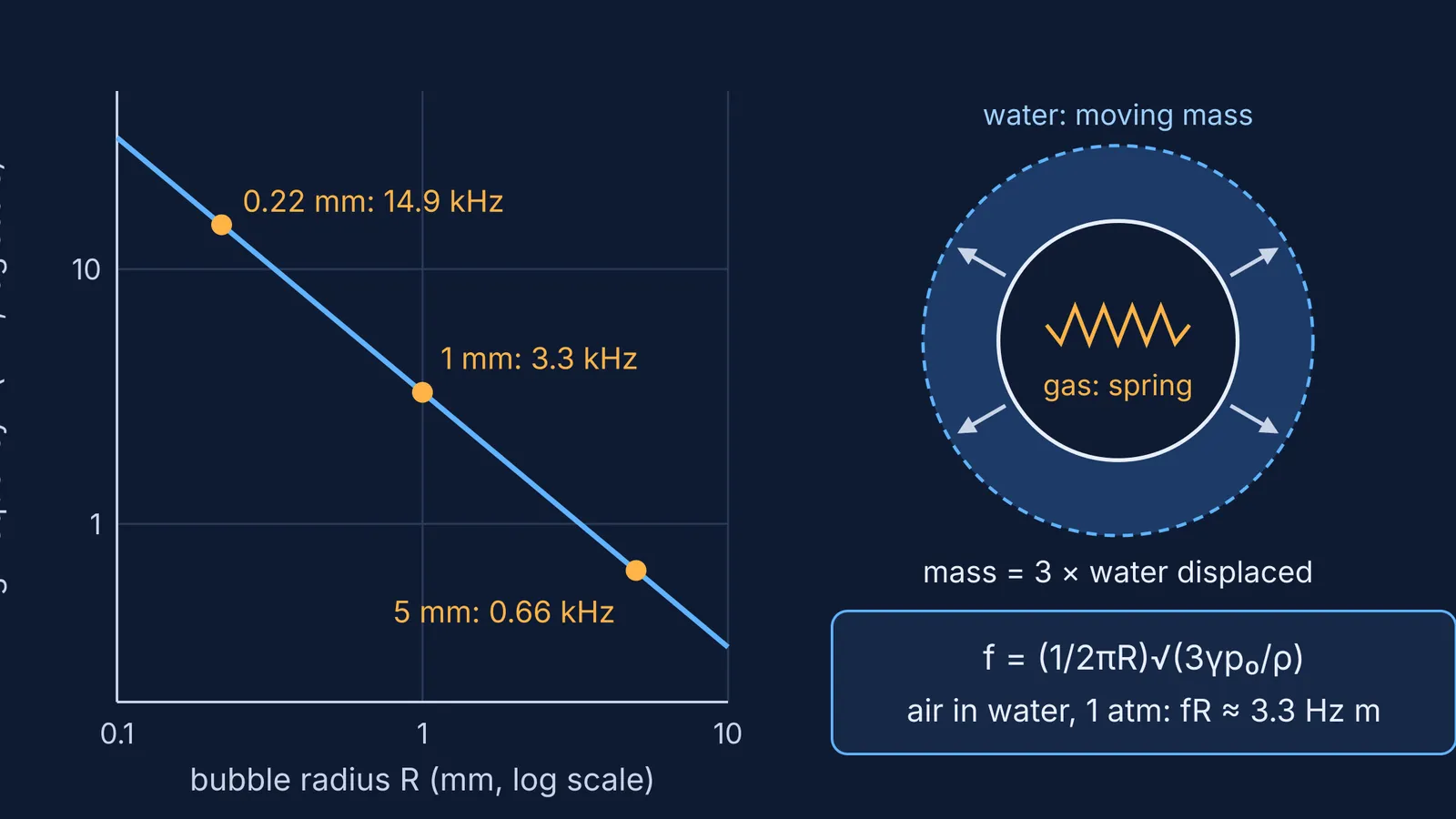
The mass is the water. The air inside has almost no mass. But when the bubble wall moves outward at speed u, all the water around it must move too. Water is nearly incompressible, so the flow through every sphere of radius r is the same: the water speed at radius r is u(R/r)². Add up the kinetic energy of every shell of water from R out to infinity and you get
KE = ½ × (4πρR³) × u²
So the water behaves like a mass m = 4πρR³. The water a sphere of radius R displaces has mass (4/3)πρR³, so the moving mass is exactly three times the mass of water the bubble displaces.
What is the Minnaert frequency formula?
Put the spring and mass into f = (1/2π)√(k/m):
f = (1/2π)√(12πγp₀R / 4πρR³) = (1/2πR)√(3γp₀/ρ)
This is the Minnaert frequency, named after Marcel Minnaert, who published it in 1933 in a paper on musical air bubbles and the sounds of running water (Philosophical Magazine, 1933). For air (γ = 1.4) in water (ρ = 1000 kg/m³) at atmospheric pressure (p₀ = 101,325 Pa), the square root is about 20.6 m/s, and
f × R ≈ 3.28 Hz m
The frequency is inversely proportional to the radius. Halve the bubble and the note goes up an octave.
Worked example: how high does a bubble ring at the surface and 10 m down?
Question. Find the ring frequency of an air bubble of radius 1.0 mm just under the surface of water. Then find it for the same radius at a depth of 10 m. Take γ = 1.4, ρ = 1000 kg/m³, p_atm = 1.013 × 10⁵ Pa and g = 9.81 m/s².
Stiffness term. 3γp₀/ρ = 3 × 1.4 × 101,325 / 1000 = 425.6 m²/s².
Square root. √425.6 = 20.63 m/s.
Frequency at the surface. f = 20.63 / (2π × 0.001) = 3,283 Hz, about 3.3 kHz.
Check the units. √(Pa / (kg/m³)) is m/s, and (m/s)/m is 1/s, so the answer is in hertz.
Pressure at 10 m. p₀ = 101,325 + 1000 × 9.81 × 10 = 199,425 Pa, about 1.97 atm.
Frequency at 10 m. f scales as √p₀, so f = 3,283 × √(199,425/101,325) = 3,283 × 1.403 = 4,606 Hz, about 4.6 kHz.
The same formula gives a feel for other sizes at the surface:
R = 5 mm: about 657 Hz, a low note.
R = 1 mm: about 3.3 kHz.
R = 0.5 mm: about 6.6 kHz.
R = 0.22 mm: about 14.9 kHz.
Now check the Cambridge result. A measured pitch of 8.66 kHz gives R = 3.283 / 8,660 = 0.38 mm, a diameter of about 0.76 mm, close to the 0.71 mm bubble they filmed. A bubble rising through a lake also grows as the pressure drops, as in the air bubble that doubles in volume as it rises, so both its size and the pressure term lower its note on the way up.
Why does rain on a lake hiss near 14 kHz?
Underwater microphones in rain pick up a sharp peak in the noise spectrum near 14 kHz. Prosperetti, Crum and Pumphrey traced it to small raindrops, which trap bubbles in a narrow size range when they land (Journal of Geophysical Research, 1989). Turn the Minnaert formula round: R = 3.28 / 14,000 = 0.23 mm. So every one of those tiny bubbles rings near the same pitch, and millions of them together make a steady hiss. Change the surface and the sound changes too: the Cambridge team reported that a drop of washing-up liquid in the sink, which lowers the surface tension, can stop a dripping tap's plink (University of Cambridge, 2018).
Where does the simple formula stop working?
Very small bubbles. Surface tension adds 2σ/R to the pressure inside. With σ ≈ 0.072 N/m, that is 0.14% of atmospheric pressure for R = 1 mm but 14% for R = 10 µm, so tiny bubbles are stiffer than the formula says.
Heat flow. Very small bubbles can exchange heat with the water during each cycle, so their gas behaves partway towards isothermal. Using p₀ instead of γp₀ would give 2.8 kHz for a 1 mm bubble instead of 3.3 kHz.
Damping. The ring dies away quickly, because the bubble radiates its energy as sound, loses heat to the water, and is slowed by viscosity. That is why you hear a short plink, not a long note.
If you want to watch a spring–mass system and see how the period changes when you change k or m, try the Simulation Lab.
Quick checklist
The plink comes from a bubble trapped by the drop, not from the impact.
Spring: k = 12πγp₀R, from the adiabatic squeeze of the gas.
Mass: m = 4πρR³, three times the mass of water displaced.
Minnaert frequency: f = (1/2πR)√(3γp₀/ρ); fR ≈ 3.3 Hz m for air in water at 1 atm.
f ∝ 1/R and f ∝ √p₀: smaller or deeper bubbles ring higher.
Rain's 14 kHz underwater hiss points to bubbles about 0.23 mm in radius.


