

On this page
If you have used Cauchy-Schwarz in an olympiad inequality, you already know half of Hölder. Hölder lets you choose the exponents and handles three sequences at once, which makes it a short route through problems with roots in the denominators.
What is Hölder's inequality?
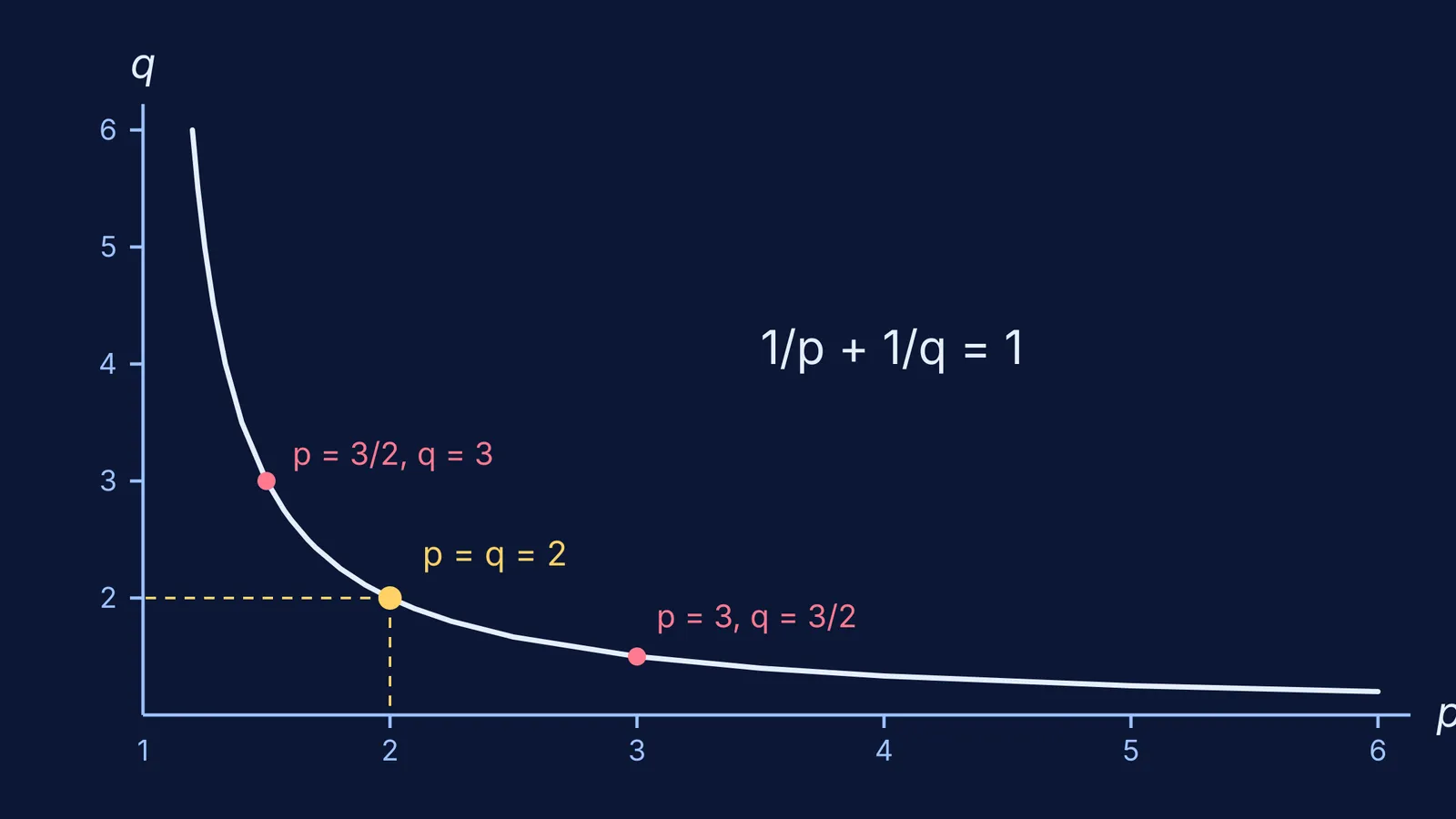
Take two exponents p and q, both greater than 1, with 1/p + 1/q = 1; such a pair is called Hölder conjugate. For real numbers x₁, …, xₙ and y₁, …, yₙ, Hölder's inequality states that |x₁y₁| + … + |xₙyₙ| ≤ (|x₁|ᵖ + … + |xₙ|ᵖ)^(1/p) · (|y₁|^q + … + |yₙ|^q)^(1/q).
The special case p = q = 2 is the Cauchy-Schwarz inequality: (x₁y₁ + … + xₙyₙ)² ≤ (x₁² + … + xₙ²)(y₁² + … + yₙ²). Other conjugate pairs are p = 3 with q = 3/2, and p = 4 with q = 4/3.
Leonard James Rogers first found the inequality, in a slightly different form, in 1888; Otto Hölder gave another proof in 1889, in work that also introduced what we now call Jensen's inequality. Lech Maligranda's 1998 paper on the credit is titled Why Hölder's inequality should be called Rogers' inequality. For the Jensen side, see our guide to using Jensen's inequality with olympiad examples.
What is the three-sequence form of Hölder's inequality?
The same Wikipedia article gives a version for more than two sums: with positive weights adding up to 1, the sum of aᵢ^λ · bᵢ^μ · … is at most (Σaᵢ)^λ · (Σbᵢ)^μ · …, with equality when the sequences are proportional. Give three sequences weight 1/3 each and cube both sides to get the product form for positive reals:
(p₁ + … + pₙ)(q₁ + … + qₙ)(r₁ + … + rₙ) ≥ (∛(p₁q₁r₁) + … + ∛(pₙqₙrₙ))³
Put pᵢ = aᵢ³, qᵢ = bᵢ³ and rᵢ = cᵢ³ and it turns into the cube form used in many olympiad solutions: (Σaᵢ³)(Σbᵢ³)(Σcᵢ³) ≥ (Σaᵢbᵢcᵢ)³.
A one-line warm-up: for positive a, b and c, (1 + a³)(1 + b³)(1 + c³) ≥ (1 + abc)³. The three sequences are (1, a), (1, b) and (1, c), and that is the whole proof.
How does Hölder solve IMO 2001 Problem 2?
The official IMO 2001 paper asks you to prove that a/√(a² + 8bc) + b/√(b² + 8ca) + c/√(c² + 8ab) ≥ 1 for all positive real numbers a, b and c. Call the left side S.
Choose the helper sum T = a(a² + 8bc) + b(b² + 8ca) + c(c² + 8ab), which simplifies to a³ + b³ + c³ + 24abc.
Apply the product form to the sequences of S, of S again, and of T. The first term under the cube root is a²/(a² + 8bc) multiplied by a(a² + 8bc), which is exactly a³. Its cube root is a, so S · S · T ≥ (a + b + c)³.
It remains to show (a + b + c)³ ≥ a³ + b³ + c³ + 24abc. Expand the left side as a³ + b³ + c³ + 3(a + b)(b + c)(c + a).
By AM-GM, a + b ≥ 2√(ab), and likewise for the other two brackets, so (a + b)(b + c)(c + a) ≥ 8abc. Multiply by 3 and step 3 is done.
Now S² · T ≥ (a + b + c)³ ≥ T, so S² ≥ 1, and since S is positive, S ≥ 1.
Equality holds at a = b = c, where each term equals 1/3. If the AM-GM step feels rusty, revise it in our Class 11 sequences and series guide to G.P. and A.M.-G.M.
If step 2 is where you lose the thread, the Fermi Problem Library has worked problems with a step-by-step solver that explains the reasoning rather than printing an answer.
When should you use Hölder instead of Cauchy-Schwarz?
Use this checklist before you start writing:
One square root per term, and squaring the sum is enough: try Cauchy-Schwarz first.
Square roots in the denominators, but Cauchy-Schwarz leaves a bound that is too weak: try Hölder with S, S and a helper sum.
Cube roots, or a product of three sums: three-sequence Hölder.
A symmetric cubic in a, b and c with an abc term: consider Schur's inequality and its olympiad forms.
The same convex function applied to every term: Jensen.
To practise, redo the IMO proof with a different helper sum and see where it fails, then do one inequality a day, naming your tool before you start.
If conjugate exponents or convexity feel shaky, the Fermi Concept Library gives every concept in mathematics its own lesson.


