

On this page
Look at the FSSAI standard for honey and, among moisture, sugars and pollen count, you will find one line about a single molecule: hydroxymethylfurfural (HMF), not more than 80 mg/kg. Fresh honey contains very little HMF. The number climbs when honey is overheated, stored warm for a long time, or mixed with syrup made by boiling sugar with acid. So HMF works as a freshness and heat marker, and the way labs measure it is a neat use of a reaction you already know from NCERT: the bisulphite addition to an aldehyde.
What is HMF and where does it come from in honey?
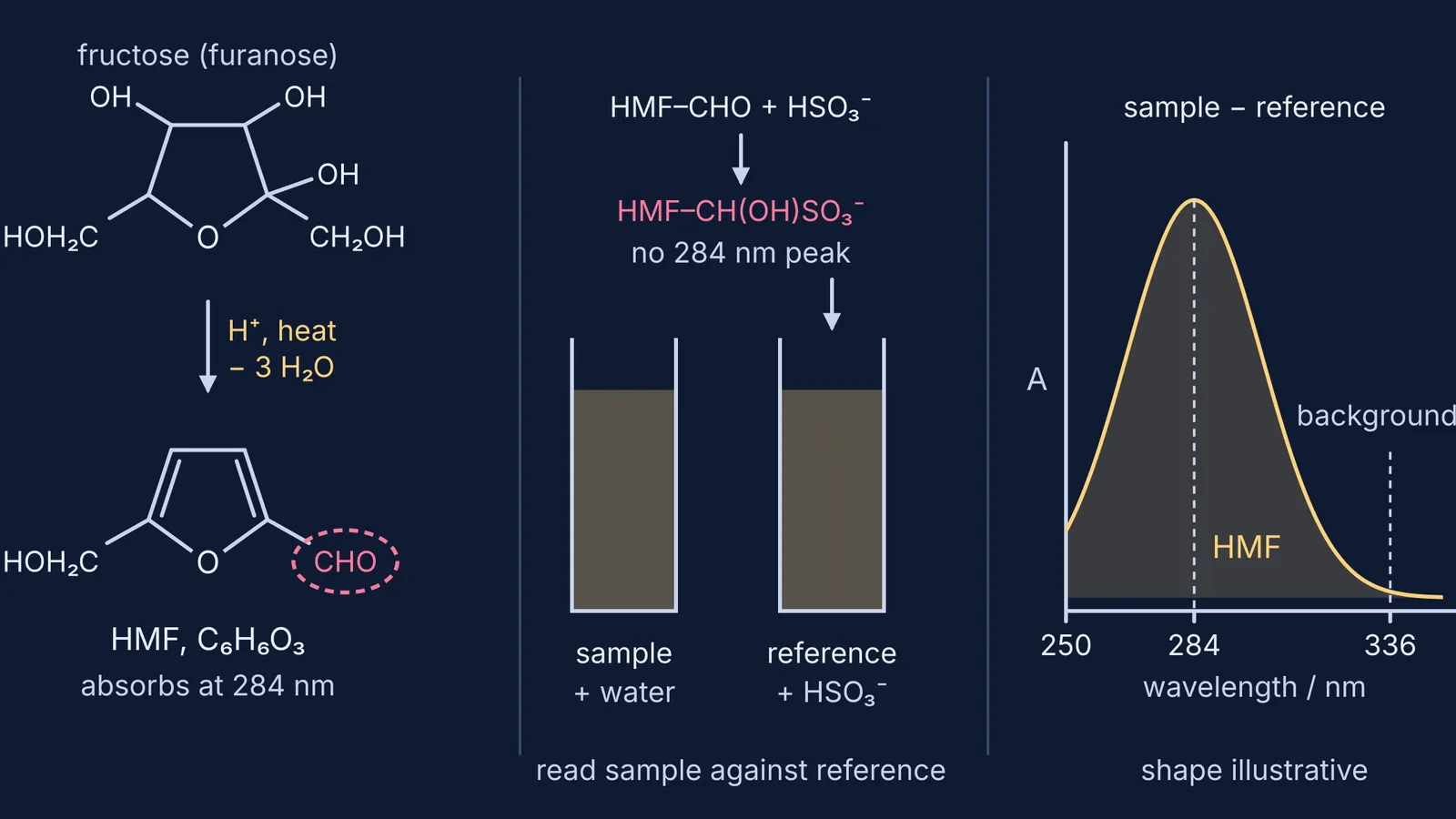
HMF (5-hydroxymethylfurfural) is a furan ring carrying a –CH₂OH group on one side and a –CHO group on the other. It forms when a hexose loses three molecules of water in acid:
C₆H₁₂O₆ → C₆H₆O₃ + 3H₂O
Check the balance: C 6 = 6; H 12 = 6 + 6; O 6 = 3 + 3. HMF's molar mass is about 126 g/mol.
Fructose does this much faster than glucose. It is the same step that makes Seliwanoff's test work: hot acid turns fructose into HMF quickly, and HMF then gives the red colour with resorcinol. In honey there is no strong acid, but honey is naturally acidic (pH around 4) and about 38% fructose, so the same reaction creeps along slowly. Sugar–amino acid (Maillard) reactions add a little more HMF.
Three things speed it up:
Heat during processing. Warming honey to make it flow or to dissolve crystals.
Warm storage. Months on a hot shelf.
Acid-made invert syrup. Boiling cane sugar with acid splits sucrose into glucose and fructose (the inversion you study in NCERT), and the hot acid also turns some fructose into HMF. Honey mixed with such syrup carries extra HMF.
What limit does FSSAI set for HMF in honey?
The FSSAI standard for honey sets HMF at not more than 80 mg/kg. The international Codex honey standard is stricter for most honey, 40 mg/kg, and allows 80 mg/kg for honey from tropical regions, where warm storage is hard to avoid.
HMF alone does not prove adulteration. Syrups made with enzymes instead of acid, such as some rice and corn syrups, can be low in HMF, so a honey cut with them could still pass this line. That is why the same FSSAI table also lists other markers: a marker for rice syrup (2-AFGP), foreign oligosaccharides, C4 sugar and carbon isotope ratios. A high HMF says "heated, old or mixed with acid-made syrup". A low HMF does not say "pure".
At these levels HMF is a quality marker, not a reason to fear a jar of honey.
How does White's method measure HMF with bisulphite?
HMF absorbs ultraviolet light strongly at 284 nm. The trouble is that other things in honey absorb there too. White's method, described in the International Honey Commission's harmonised methods, removes that problem with a chemical blank:
About 5 g of honey is dissolved in water, clarified with Carrez solutions I and II (potassium hexacyanoferrate(II) and zinc acetate, which bring down proteins and colloids), and made up to 50 mL. The solution is filtered.
5.0 mL of filtrate goes into each of two tubes.
Tube 1, the sample, gets 5.0 mL of water.
Tube 2, the reference, gets 5.0 mL of 0.2% sodium bisulphite.
The sample is read against the reference at 284 nm and at 336 nm.
The trick is in tube 2. Bisulphite adds to HMF's aldehyde group, just as in the sodium bisulphite addition test:
R–CHO + HSO₃⁻ → R–CH(OH)SO₃⁻
Once the C=O is gone, the conjugated system that absorbs at 284 nm is broken, so HMF in the reference no longer absorbs there. Everything else in the honey is the same in both tubes. Reading one against the other cancels all of it and leaves only HMF's absorbance.
The 336 nm reading is a background correction. HMF absorbs little there, so any absorbance difference at 336 nm comes from something else, and it is subtracted.
Worked example: how much HMF is in this honey?
A lab weighs 5.00 g of honey and follows the method. The readings are A₂₈₄ = 0.452 and A₃₃₆ = 0.050.
(a) HMF content
The method's formula is HMF (mg/kg) = (A₂₈₄ − A₃₃₆) × 149.7 × 5 ÷ W, where W is the honey mass in g.
Corrected absorbance = 0.452 − 0.050 = 0.402.
HMF = 0.402 × 149.7 × 5 ÷ 5.00 = 60.2 mg/kg.
Where does 149.7 come from? Work it out from Beer–Lambert, A = εcl:
ε for HMF at 284 nm is 16 830 L mol⁻¹ cm⁻¹ and l = 1 cm. So c = 0.402 ÷ 16 830 = 2.39 × 10⁻⁵ mol/L.
In mass: 2.39 × 10⁻⁵ × 126 g/mol = 3.01 × 10⁻³ g/L = 3.01 mg/L.
Honey in the cuvette: 5.00 g in 50 mL is 100 g/L, then diluted 1:1 in the tube, so 50 g/L, or 0.050 kg/L.
HMF per kg of honey = 3.01 ÷ 0.050 = 60.2 mg/kg.
The constant packs these steps together: 126 × 1000 × 1000 ÷ (16 830 × 10 × 5) = 149.7.
Verdict: 60.2 mg/kg passes the FSSAI limit of 80, but would be over the Codex 40 mg/kg limit for non-tropical honey.
Is there enough bisulphite? 5.0 mL of 0.2% NaHSO₃ holds about 0.096 mmol. The HMF in 5 mL of filtrate is about 0.24 µmol. Bisulphite is in roughly 400-fold excess, so all the HMF in the reference is tied up.
(b) How much fructose does that represent?
Fructose: 38% means 380 g/kg ÷ 180.16 g/mol = 2.11 mol/kg.
HMF: 60.2 mg/kg ÷ 126.1 g/mol = 0.477 mmol/kg.
Fraction converted = 0.477 ÷ 2110 × 100 ≈ 0.02%.
A change far too small for a sugar analysis shows up clearly in the UV.
(c) Why a warm shelf matters
Use the Arrhenius equation with an illustrative activation energy of 100 kJ/mol (published values for HMF formation in honey vary with the honey and the study, so treat this as a round number):
k₄₀ ÷ k₂₅ = exp[(Ea ÷ R)(1/T₁ − 1/T₂)], with T₁ = 298.15 K, T₂ = 313.15 K.
Ea ÷ R = 100 000 ÷ 8.314 = 12 028 K.
1/298.15 − 1/313.15 = 1.607 × 10⁻⁴ K⁻¹.
Ratio = exp(1.93) ≈ 6.9.
HMF builds up roughly seven times faster at 40 °C than at 25 °C, so a jar in a hot shop window ages far faster than one in a cool cupboard.
If the Beer–Lambert and Arrhenius steps feel shaky, the Fermi Concept Library gives each concept its own lesson and shows its place in the map. For sugar totals rather than HMF, see how Fehling's titration measures sugar in honey.
Quick checklist
HMF forms when fructose loses 3H₂O in acid; heat, warm storage and acid-made invert syrup raise it.
FSSAI: HMF not more than 80 mg/kg; Codex: 40 mg/kg, or 80 for tropical honey.
Low HMF does not prove purity; enzyme-made syrups need other markers.
White's method: sample against a bisulphite reference at 284 nm, minus the 336 nm background.
HMF (mg/kg) = (A₂₈₄ − A₃₃₆) × 149.7 × 5 ÷ W, and you can rebuild 149.7 from A = εcl.
Arrhenius explains why a few degrees of storage temperature matter.


