On this page
The sodium bisulphite test is a carbonyl reaction that works both as a test and as a purification method. It picks out aldehydes and uncrowded ketones, and it lets a chemist lift them out of a mixture and get them back unchanged.
What is the sodium bisulphite addition test?
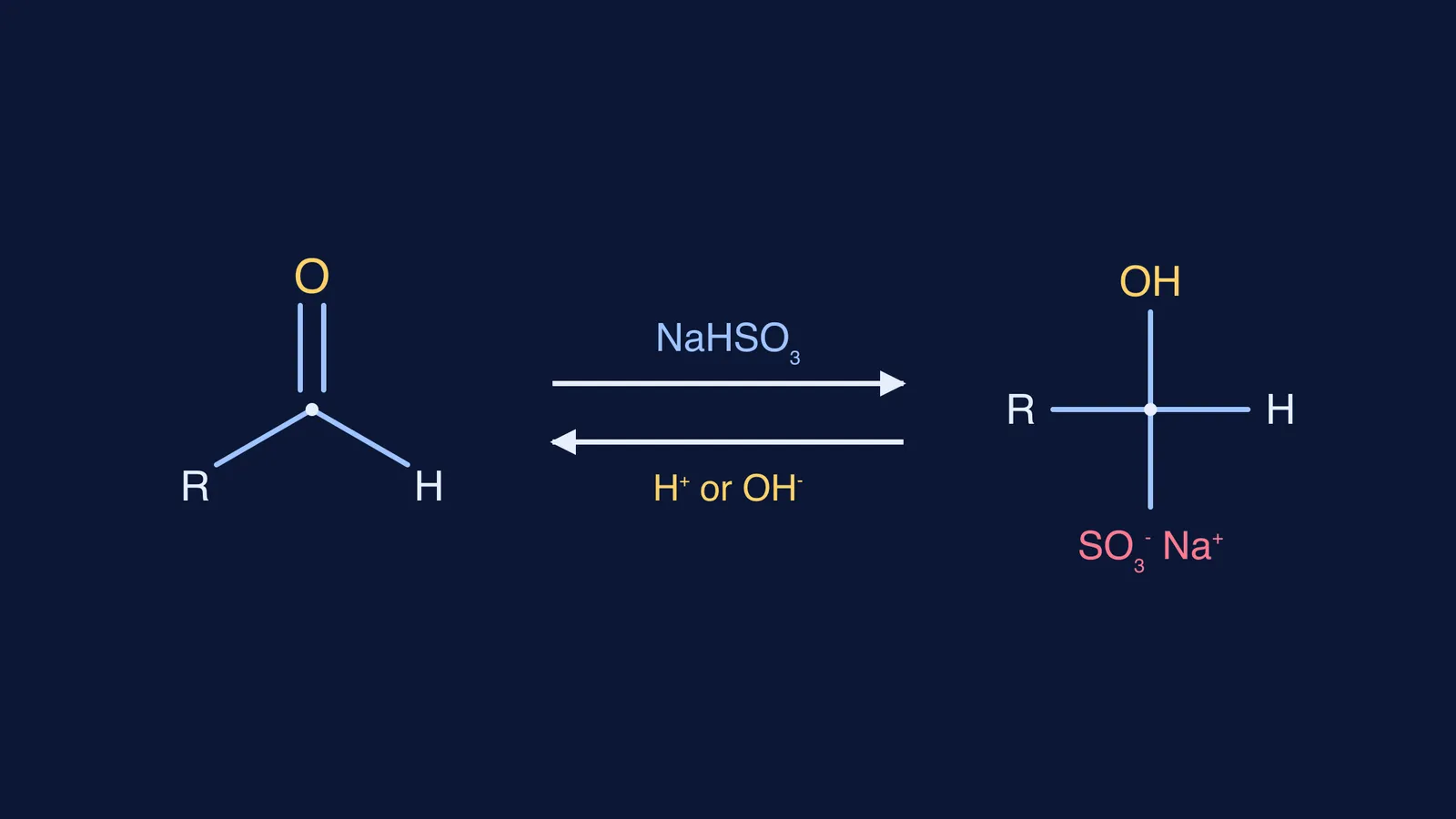
As Jim Clark's Chemguide page on carbonyl addition describes it, the aldehyde or ketone is shaken with a saturated solution of sodium hydrogensulphite in water. Sodium hydrogensulphite (NaHSO₃) used to be known as sodium bisulphite, and the LibreTexts chemistry module notes you may still meet the older name in textbooks.
Where the reaction works, the addition product separates as white crystals, according to Chemguide. These products are rarely named systematically and are usually just called hydrogensulphite (or bisulphite) addition compounds.
It is a nucleophilic addition across the C=O bond, like the addition of HCN. The difference is the product: a bisulphite adduct is charged. The authors of a 2018 bisulfite extraction protocol use exactly that charge to pull aldehydes and reactive ketones into a water layer, away from the other organic compounds in a mixture. If arrows in this mechanism still feel shaky, our walkthrough on why benzaldehyde is less reactive than propanal covers how structure affects attack at the carbonyl carbon.
Which aldehydes and ketones form bisulphite adducts?
The rule is about crowding around the carbonyl carbon. For ketones, one of the two groups on the carbonyl carbon needs to be a methyl group, according to Chemguide. The 2018 protocol paper by Furigay, Boucher, Mizgier and Brindle in the Journal of Visualized Experiments reports that ketones can be separated if they are sterically unhindered cyclic or methyl ketones, while ethyl ketones and α-substituted cyclic ketones are hindered enough to stay behind.
Aldehydes (methanal, ethanal, propanal, benzaldehyde): react
Methyl ketones such as propanone (acetone) and butanone: react
Sterically unhindered cyclic ketones: react
Ethyl ketones such as pentan-3-one: do not react usefully
Cyclic ketones with a group next to the C=O: do not react usefully
How do you get the aldehyde back from the bisulphite adduct?
The addition is reversible. The adduct can be split to regenerate the aldehyde or ketone by treating it with either dilute acid or dilute alkali, according to Chemguide. That reversibility is what makes the test useful: the crystals are a temporary parking place, not a dead end.
Modern labs still use this. In the JoVE protocol, the aldehyde is re-isolated by adding ethyl acetate and then 50% sodium hydroxide until a pH strip reads 12, and the authors report typical purities and recoveries greater than 95%. Brindle's group at Trinity College had described the liquid-liquid extraction method a year earlier in Organic Process Research and Development. The JoVE protocol also warns that sodium bisulfite can generate sulfur dioxide gas, so the work belongs in a fume hood.
Worked example: separating butanal from pentan-3-one
Suppose you must separate butanal (an aldehyde) from pentan-3-one (an ethyl ketone). Using the rules above:
Shake the mixture with saturated aqueous sodium hydrogensulphite.
Butanal reacts and forms its bisulphite addition compound; pentan-3-one, with an ethyl group on each side of the C=O, does not.
Filter off the crystalline adduct (or separate the aqueous layer that holds it). Pentan-3-one stays in the organic liquid.
Wash the adduct, then treat it with dilute acid or dilute alkali to split it.
Butanal is released and can be extracted or distilled off.
Write one sentence of reasoning at step 2. The why is the part worth showing: the adduct forms only where the carbonyl carbon is not crowded. For more practice choosing between two reagents on a similar pair, see how to distinguish benzaldehyde and acetophenone.
What mistakes do students make with this test?
Calling every ketone reactive. Check for a methyl group or an unhindered ring first.
Forgetting the reverse step. A separation answer is incomplete until the carbonyl compound is recovered with acid or alkali.
Mixing up the names. Bisulphite, hydrogensulphite and NaHSO₃ are one reagent.
Leaving out the layers. If the adduct dissolves rather than crystallises, it sits in the water layer; the method from our differential extraction guide applies.
If you can follow the rule but keep picking the wrong compound in mixed problems, the Fermi Problem Library has worked problems with a step-by-step solver that explains the reasoning rather than printing an answer. If the gap is nucleophilic addition itself, the Fermi Concept Library gives each concept its own lesson and shows its place in the map.