

On this page
Drive along a good highway and you will notice that bends never start suddenly. The road begins to turn gently, the turn tightens over the next few seconds, and only then do you settle into the steady curve. That easing-in section is a transition curve, and its length is not a matter of taste. It comes straight from circular motion and from how fast the sideways acceleration on you is allowed to change.
Why can't a straight road join a circular curve directly?
On a straight road at constant speed, your acceleration is zero. On a curve of radius R at speed v, you need a centripetal acceleration v²/R towards the centre. If the straight joined the arc directly, that acceleration would jump from zero to v²/R at one point on the road.
Two things go wrong at that point:
The passengers lurch. Your body is pushed sideways all at once instead of gradually.
The driver cannot follow the line. To go from straight to curved in an instant, the steering wheel would have to turn through its whole angle in zero time. A real driver turns it over a few seconds, so the car drifts outward across the lane at the start of every bend.
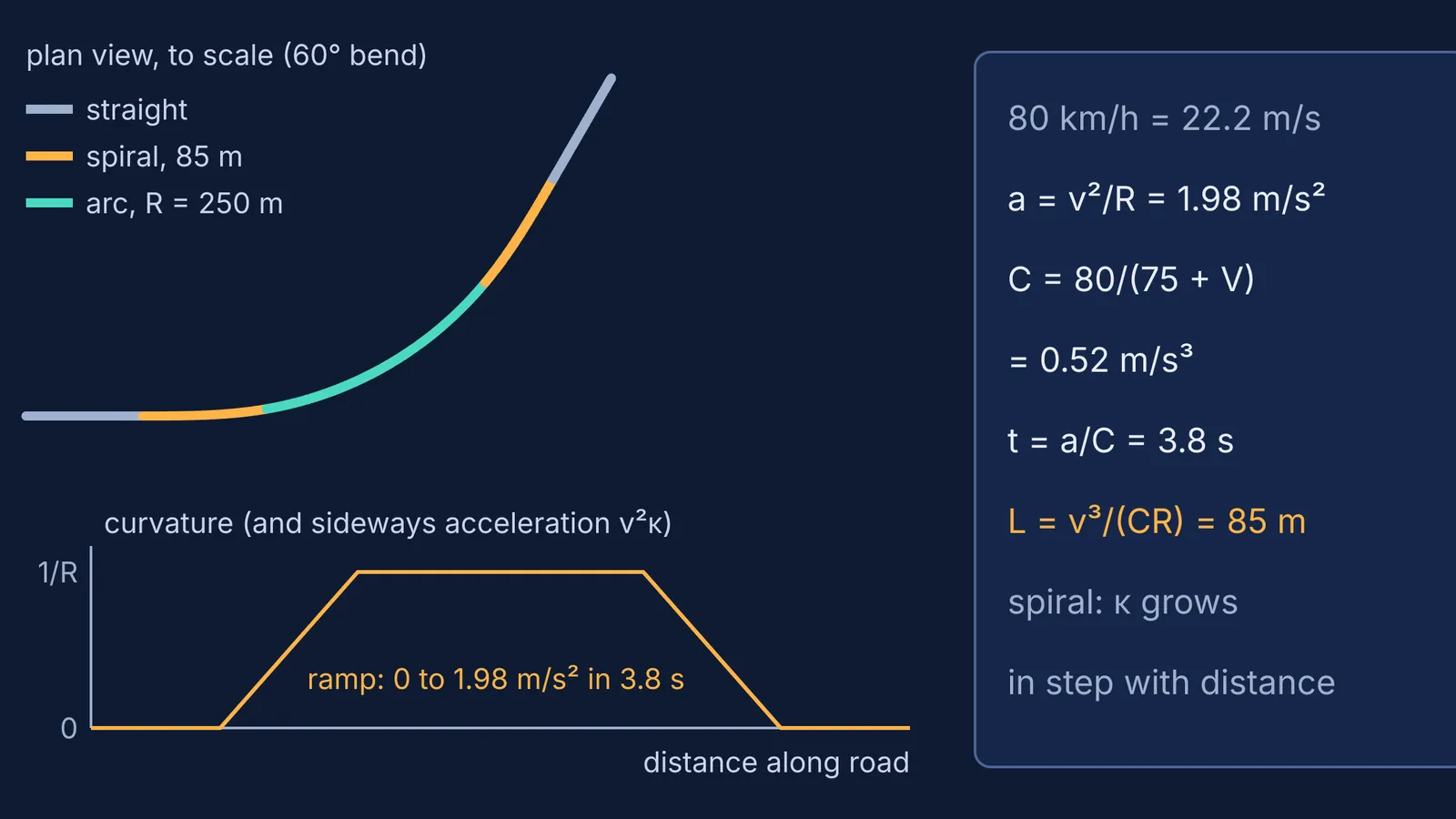
A transition curve fixes both. Its curvature starts at zero where it leaves the straight and grows steadily until it equals 1/R where it meets the arc. A driver turning the wheel at a steady rate follows it naturally.
What does the rate of change of acceleration mean here?
At constant speed v, the sideways acceleration at any point is v²κ, where κ is the curvature (1 divided by the local radius). On a transition curve κ grows in step with distance s along the road:
κ = s / (RL),
where L is the length of the transition. A curve with this property is called a clothoid, also known as an Euler spiral. It is not a parabola. A cubic parabola is close to it near the start and is sometimes used for setting out on the ground, but the defining rule is curvature proportional to distance.
Because you cover distance at a steady rate (s = vt), the sideways acceleration grows at a steady rate too. Call that rate C, measured in m/s³:
Acceleration at the end of the transition: a = v²/R.
Time spent on the transition: t = L/v.
Rate of change: C = a/t = (v²/R)/(L/v) = v³/(RL).
Rearrange for the length: L = v³/(CR).
Check the units: (m/s)³ / (m/s³ × m) = m. The quantity C is often called jerk in physics. It is simply the rate at which acceleration changes, not a medical term and not a sudden shock.
What value of C do Indian highway engineers use?
The Indian Roads Congress sets C from an empirical rule, C = 80/(75 + V), with V in km/h, and keeps it between 0.5 and 0.8 m/s³. If the formula gives less than 0.5, you use 0.5. These values, and the equation L = v³/(CR), are given in the NPTEL lecture notes on horizontal alignment (written there with v in m/s, as c = 80/(75 + 3.6v)). The formula lowers C at higher speeds, so faster roads get gentler, longer transitions.
Many textbooks write the length directly in km/h as L = 0.0215V³/(CR). The constant comes from the unit change: (1/3.6)³ = 0.02143, which they round up to 0.0215. That rounding is why the km/h formula gives a slightly longer answer than the m/s one.
Worked example: how long is the transition at 80 km/h into a 250 m curve?
Speed in m/s. v = 80/3.6 = 22.22 m/s.
Final sideways acceleration. a = v²/R = 22.22² / 250 = 493.8/250 = 1.98 m/s². That is about 0.2g.
Allowed rate. C = 80/(75 + 80) = 80/155 = 0.516 m/s³. It lies between 0.5 and 0.8, so you keep it.
Time to build up. t = a/C = 1.98/0.516 = 3.8 s.
Length. L = v³/(CR) = 22.22³ / (0.516 × 250) = 10,974/129.0 ≈ 85.0 m.
Check. Distance = v × t = 22.22 × 3.83 = 85.0 m. Same answer.
Textbook km/h form. 0.0215 × 80³ / (0.516 × 250) = 11,008/129.0 ≈ 85.3 m. The 0.3 m difference is only the rounded constant.
Two more cases:
65 km/h on a 150 m curve. v = 18.06 m/s, a = 2.17 m/s², C = 80/140 = 0.571 m/s³, so L = 18.06³ / (0.571 × 150) ≈ 68.7 m.
100 km/h on a 400 m curve. v = 27.78 m/s and a = 1.93 m/s². The formula gives C = 80/175 = 0.457 m/s³, below the 0.5 minimum, so you use 0.5. Then L = 27.78³ / (0.5 × 400) ≈ 107 m. Using 0.457 unclamped would give about 117 m, a common slip.
Is the rate-of-change length the final design length?
Not always. The same NPTEL notes list two other checks, and the designer takes the largest of the three:
Superelevation run-off. The road is tilted (banked) gradually along the transition, so the transition must be long enough for the outer edge to rise at a gentle slope.
An empirical minimum, 35v²/R with v in m/s for plain and rolling terrain. At 80 km/h on 250 m this is 35 × 493.8 / 250 ≈ 69 m, less than 85 m, so 85 m stands. At 65 km/h on 150 m it is about 76 m, which beats the 68.7 m above.
How much the road should be banked in the first place is the same idea as the raised outer rail in how high the outer rail is on a railway curve. Railway curves also have transitions, along which the cant is raised gradually. On hill roads, where space is short and bends are tight, the trade-offs change; see why mountain roads zigzag. The same clothoid shape also turns up in why roller coaster riders don't fall out of a loop.
If you want more circular-motion problems with each step explained, the Fermi Problem Library has a step-by-step solver that explains the reasoning.
Quick checklist
Straight to curve directly means sideways acceleration jumps from 0 to v²/R.
A transition curve is a clothoid: curvature grows in step with distance, κ = s/(RL).
Rate of change of acceleration C = v³/(RL), so L = v³/(CR).
IRC rule: C = 80/(75 + V), kept between 0.5 and 0.8 m/s³.
80 km/h into 250 m: a = 1.98 m/s², C = 0.516 m/s³, t = 3.8 s, L ≈ 85 m.
Design length is the largest of the rate, superelevation and empirical checks.


