

On this page
Upside down at the top of a loop, it feels as if gravity should win. It doesn't, and the reason is a core idea in school physics: motion in a vertical circle. Once you see it, a whole family of board and JEE Main questions follows.
Why don't people fall out of a roller coaster loop?
Falling out is about whether gravity curves your path faster than the track does.
Anything moving in a circle needs a net force pointing towards the centre. In the words of the OpenStax University Physics textbook, any net force causing uniform circular motion is called a centripetal force, and its size is F = mv²/r. It is not a new kind of force, just the job done by real forces such as gravity, tension or a track's push.
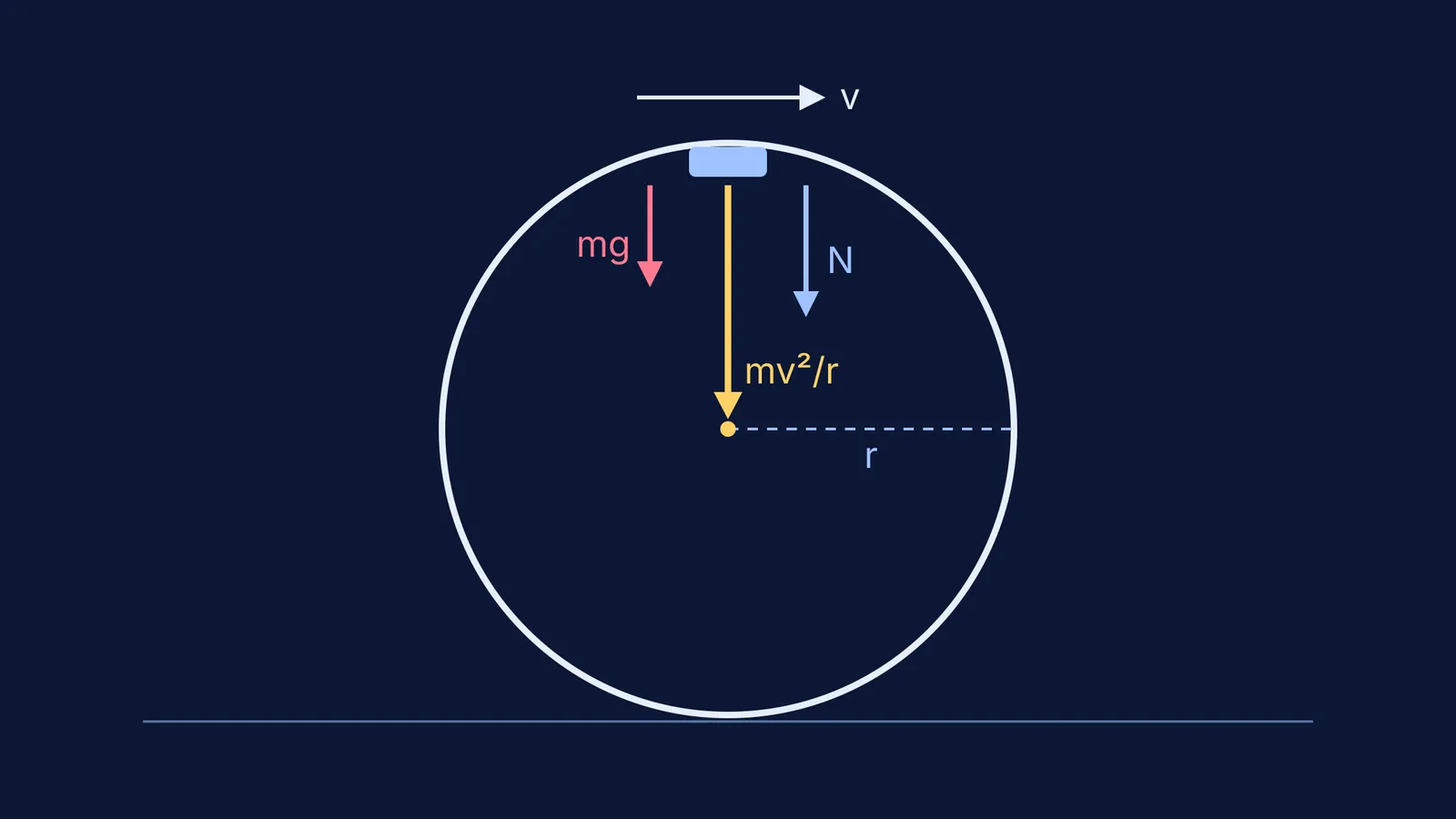
At the top of a loop the centre is below you, so gravity points towards the centre and helps. If the car is fast, mv²/r is bigger than your weight, mg. Gravity alone cannot bend your path tightly enough, so the track has to push you down too, with a normal force N:
N + mg = mv²/r
That push is what you feel as being pressed into your seat. Without the track, you would move away from the centre, not towards it.
What is the minimum speed at the top of a loop?
A seat can push you but cannot pull you. The slowest the car can go is the speed at which the track's push drops to zero and gravity does the whole job: mg = mv²/r, so v = √(gr).
Mass cancels, so a child and a parent need the same speed. Using g = 9.8 m/s², the rounded value OpenStax uses for gravity near Earth's surface, a loop whose top has a radius of 10 m needs at least √98 ≈ 9.9 m/s at the top, about 36 km/h. Any slower and gravity curves your path more tightly than the track, so you would drop away from the seat. On most inverting coasters the forces alone would keep riders in, but most coasters still use restraints (Wikipedia: physics of roller coasters).
A worked example you can check
Take a 60 kg rider at the top of a loop of radius 10 m, moving at 15 m/s, ignoring friction:
Acceleration needed towards the centre: v²/r = 225 ÷ 10 = 22.5 m/s².
Gravity supplies 9.8 m/s² of that.
The track supplies the rest, 12.7 m/s², so N = 60 × 12.7 = 762 N.
The rider's weight is 60 × 9.8 = 588 N, so the seat pushes with about 1.3 times their weight.
Upside down, this rider feels pressed into the seat a little harder than when sitting on a chair.
Why are roller coaster loops teardrop-shaped?
Now follow the same car to the bottom of a perfectly circular loop. By conservation of mechanical energy, kinetic plus potential energy stays constant when friction does no work. Dropping 2r = 20 m gives v² = 225 + 4 × 9.8 × 10 = 617, so v ≈ 24.8 m/s.
At the bottom the centre is above you, so the track must supply mg as well as mv²/r. N = 60 × (9.8 + 61.7) ≈ 4,290 N, about 7.3 times the rider's weight. Even at the bare minimum speed at the top, a circular loop gives exactly 6 times your weight at the bottom (v² = 5gr there, so N = mg + 5mg).
That is why the Flip Flap Railway at Sea Lion Park, with its fully circular loop, caused neck injuries, according to Wikipedia's article on the vertical loop. The fix, pioneered in 1976 on The New Revolution at Six Flags Magic Mountain by Werner Stengel, was the clothoid loop: wide at the bottom, tight at the top. A large radius at the bottom shrinks v²/r where you are fastest, and a small radius at the top lowers the √(gr) you need.
How do you solve vertical circle problems in exams?
The same method works for a bucket swung overhead or a stone on a string:
Draw the body at the point the question asks about, and mark the centre.
Draw only real forces: gravity, normal force, tension.
Take towards the centre as positive and set their sum equal to mv²/r.
Link speeds at two points with energy conservation.
For "just completes the loop", set N or the tension to zero at the top.
If your signs keep coming out wrong, the Fermi Problem Library has worked problems with a step-by-step solver that explains the reasoning rather than printing an answer.
A diagram shows one instant, but the balance between N and mg changes all the way round. Ideas like this are easier to see than to read, which is what the interactive simulations in the Fermi Simulation Lab are for. Next time you watch a coaster, look for the tighter curve at the top: that is v²/r built in steel.


