On this page
If you have taken a bus up to Ooty or Shimla, you have counted the hairpins. The Kalhatti ghat into Ooty alone has 36 hairpin bends. A straight road up the hillside would be far shorter, so why do engineers build all those turns?
The answer is a chapter you already study: the inclined plane. A hairpin bend is a turn of about 180 degrees, and such turns are often used to decrease the steepness of the grade where a road climbs a steep slope. The zigzag is a very long, very gentle ramp folded to fit on a hillside.
Why does a gentler slope need less force?
Put a vehicle of mass m on a slope at angle θ. Its weight splits into two parts. The part pressing into the road is mg cos θ, and the part pulling it back down the slope is mg sin θ, as the OpenStax physics textbook sets out in its section on inclined planes.
To climb at a steady speed, the engine has to supply at least mg sin θ through the tyres, plus whatever it needs to overcome rolling resistance and air drag. Make θ smaller and sin θ falls, so the force falls with it.
The catch is the rule behind every simple machine. OpenStax explains that a simple machine can reduce the force you apply only if you exert that force over a greater distance, because the product of force and distance does not change. For a ramp, the ideal mechanical advantage is length divided by height, L/h. The hill does not get any lower. You pay for the smaller force with extra kilometres.
How steep are Indian hill roads allowed to be?
Indian hill roads follow Indian Roads Congress (IRC) codes. A project report from Arunachal Pradesh's Public Works Department lists the IRC gradients for steep terrain up to 3,000 m above sea level: a ruling gradient of 6% (1 in 16.7), a limiting gradient of 7% and an exceptional gradient of 8%. Exceptional gradients are allowed only on stretches of up to 100 m. The NPTEL highway engineering notes give the same 6, 7 and 8 per cent figures for steep terrain.
A 6% gradient means the road rises 6 m for every 100 m of horizontal run. Most hillsides are steeper, so the road wanders across them.
How much force does a hairpin road save on a 600 m climb?
Take a 1,200 kg car, passengers included, gaining 600 m of height. Use g = 9.8 m/s² and ignore friction for now.
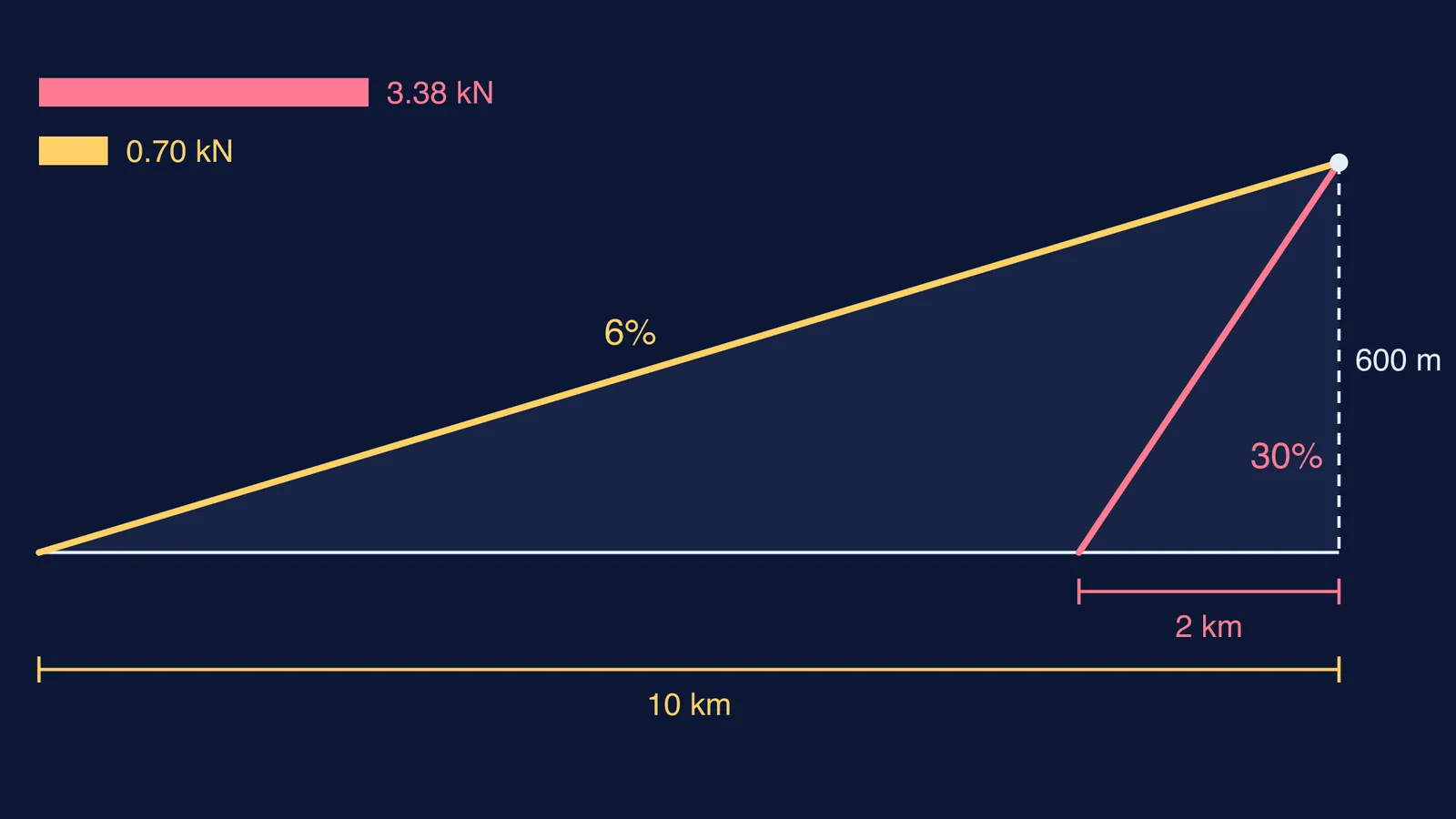
Route A goes straight up a 30% slope:
Gradient tan θ = 0.30, so θ ≈ 16.7° and sin θ ≈ 0.287.
Horizontal run = 600 / 0.30 = 2,000 m. Road length = √(2,000² + 600²) ≈ 2,088 m.
Force along the slope = mg sin θ = 1,200 × 9.8 × 0.287 ≈ 3,380 N.
Route B uses hairpins to hold the 6% ruling gradient:
Gradient tan θ = 0.06, so θ ≈ 3.4° and sin θ ≈ 0.0599.
Horizontal run = 600 / 0.06 = 10,000 m. Road length ≈ 10,018 m, about 10 km.
Force along the slope = 1,200 × 9.8 × 0.0599 ≈ 704 N.
Here is what the numbers tell you:
The pull needed drops from about 3,380 N to about 704 N, close to 4.8 times less.
The road is about 4.8 times longer, so force × distance is the same: roughly 7.06 MJ on both routes, which is exactly mgh = 1,200 × 9.8 × 600.
At 30 km/h (8.33 m/s), the power to beat gravity alone is about 28 kW on Route A but under 6 kW on Route B. That gap matters most for a loaded bus or truck.
The gentle slope helps on the way down too. The same mg sin θ you fight going up is what the brakes must hold back going down, so a smaller slope asks less of brakes and tyres. Our earlier post on the steepest hill a car can climb before its tyres slip works through that friction limit.
How to use this in your exam
Board and JEE questions rarely mention ghats, but they test the same steps:
Resolve the weight first: mg sin θ along the slope, mg cos θ into it. Our guide to resolving forces on an incline shows the standard mistakes.
Convert a percentage gradient to an angle using tan θ, not sin θ.
Check your answer with energy: the work against gravity must equal mgh whatever the path.
Add friction only after the frictionless case is clear; see how friction lowers the efficiency of an inclined plane.
If the split of mg into two components still feels abstract, the Fermi Simulation Lab has interactive simulations for ideas that are easier to see than to read. To try a ramp numerical of your own, the Fermi Problem Library has a step-by-step solver that explains the reasoning rather than printing an answer.
Next time your bus swings round another hairpin, you will know it is doing what every ramp does: trading distance for force.