On this page
Try to brush every fibre of a fuzzy tennis ball flat, with no parting and no tuft standing up. You will fail, and topology says why. The hairy ball theorem states that there is no continuous tangent vector field on an ordinary sphere that is non-zero everywhere.
What does the hairy ball theorem say?
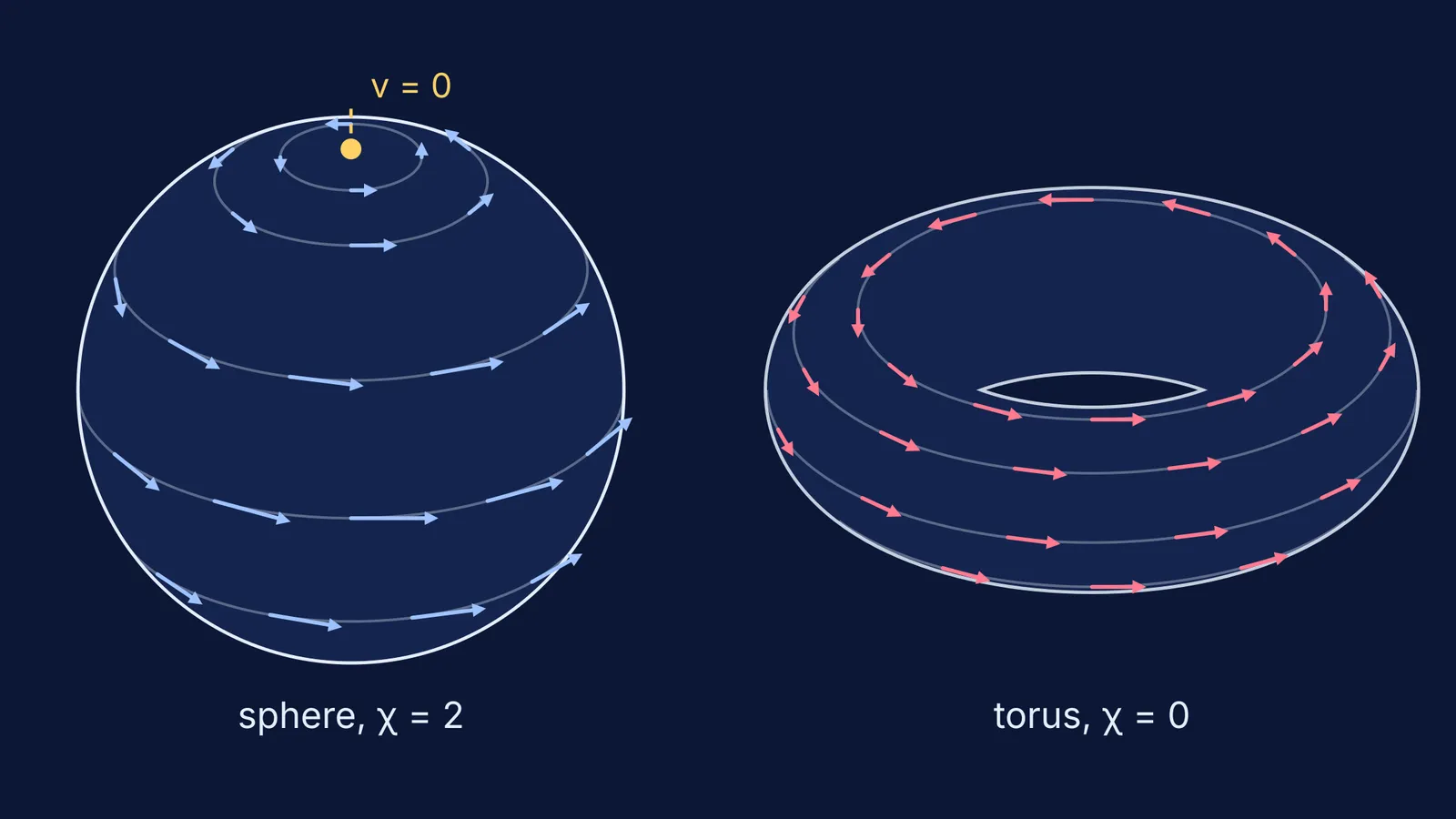
Attach a small arrow to every point of a sphere, lying flat in the surface (tangent) and changing smoothly as you move (continuous). That collection of arrows is a tangent vector field. The theorem says at least one arrow must have zero length. In hair language, somewhere there is a crown or cowlick where the hair cannot lie flat.
Henri Poincaré proved the theorem for the ordinary sphere in 1885, and L. E. J. Brouwer extended it to higher even-dimensional spheres in 1912, according to the hairy ball theorem article. In 1978 John Milnor published analytic proofs of the hairy ball theorem and the Brouwer fixed point theorem in The American Mathematical Monthly.
Why must there be a zero?
Every isolated zero of a vector field has a whole-number index that measures how the arrows turn around it. The Poincaré–Hopf theorem says the indices of all the zeros add up to the surface's Euler characteristic. For the sphere that number is 2, so a field with no zeros, whose indices add to 0, is impossible (hairy ball theorem).
The Euler characteristic of a polyhedron's surface is χ = V − E + F, vertices minus edges plus faces (Euler characteristic). Every convex polyhedron has χ = 2, a formula Euler stated in 1758, and because such a surface is a sphere in disguise, the sphere's χ is 2 as well (same source).
Worked example: count it yourself
A cube has V = 8, E = 12 and F = 6, so χ = 8 − 12 + 6 = 2.
Spin a globe. The velocity of each surface point is a tangent field that vanishes at the North and South Poles. Arrows circle round each pole, which gives index +1 each: 1 + 1 = 2.
Let hair flow from the North Pole to the South Pole along the meridians. The North Pole is a source (+1) and the South Pole a sink (+1): again 2.
Whatever field you draw, the indices add to 2. You can move or merge the zeros, never remove them.
If index or tangent field are new words, the Fermi Concept Library gives each concept its own lesson and its place in the map.
Why can you comb a torus flat?
A torus, the surface of a doughnut, has Euler characteristic 0, like every toroidal polyhedron (Euler characteristic), so the count demands no zeros. You can also do it directly: point every arrow the long way round the ring. Every arrow has the same length and none vanishes, which is why it is possible to comb a hairy doughnut flat (hairy ball theorem).
Check χ = 0 by counting. Draw an n by m grid of squares on the torus, wrapping round both ways. There are nm vertices, nm faces and 2nm edges (one going each way from every vertex), so V − E + F = nm − 2nm + nm = 0. For the idea behind this, see why a coffee mug and a doughnut are the same to a topologist.
Is the wind speed zero somewhere on Earth?
Treat the wind on one shell of air around the Earth as a continuous tangent vector field. The theorem says that at every moment there is a point on that shell where the air is not moving horizontally. The hairy ball theorem article adds a caveat: air also moves vertically, so the popular claim that a cyclone must exist somewhere is not meteorologically sound.
The same article gives a corollary you can test with JEE vectors. You want a non-zero vector perpendicular to any non-zero vector a. The formula a × î works until a points along î, where it gives zero. No single continuous formula works for every non-zero a, which is why this is a known problem in computer graphics.
How do you decide whether a surface can be combed?
Confirm the surface is closed (compact, with no edge) and the field is continuous and tangent. A field allowed to jump, or to stick out of the surface, is not covered.
Find χ by gridding or triangulating the surface and computing V − E + F.
If χ is not 0, every continuous tangent field has a zero (Poincaré–Hopf; see the hairy ball theorem article).
If χ is 0, the count does not force a zero; look for an explicit combing, as on the torus.
Vector fields are easier to see than to read; the Fermi Simulation Lab has interactive simulations for ideas like this.
For another theorem that promises a special point must exist, read how the contraction mapping theorem forces cos x to settle at 0.739.