

On this page
If you open the NCERT chapter on chemical kinetics, 2HI → H₂ + I₂ is the example given for a bimolecular reaction, and H₂ + I₂ ⇌ 2HI is the main worked equilibrium in the Class 11 book. For about seventy years chemists believed the forward reaction really was one H₂ molecule hitting one I₂ molecule. Experiments in 1959 and 1967 showed that most of the reaction, perhaps all of it, goes through free iodine atoms instead. It teaches the most useful rule in mechanism questions: a rate law can agree with a mechanism, but it cannot prove one.
Why was H₂ + I₂ called a bimolecular reaction?
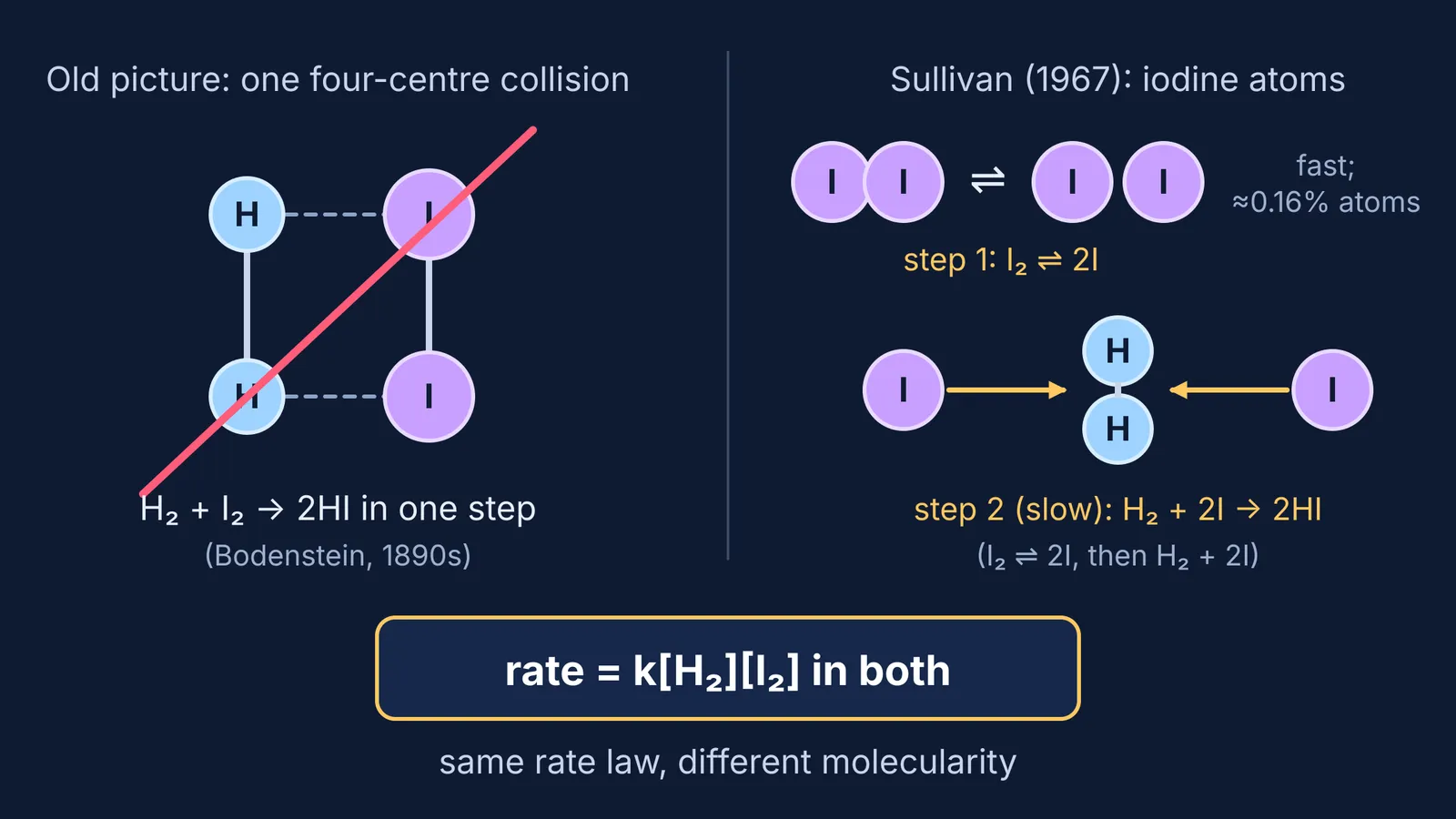
Max Bodenstein measured this reaction in the 1890s and found rate = k[H₂][I₂]: first order in each reactant, second order overall. The simplest picture that gives this law is one collision between one H₂ and one I₂, with the four atoms swapping partners in a single step. That is the bimolecular step textbooks drew for decades, and its reverse, 2HI → H₂ + I₂, is the example NCERT still lists. Our post on order vs molecularity sets out the definitions. First order in each reactant is exactly what a bimolecular step predicts, so the data looked like a perfect fit.
What did Sullivan's experiments show?
J. H. Sullivan first measured the thermal reaction very carefully between 633 K and 738 K. His 1959 paper reported that a route through iodine atoms already accounted for about 10% of the reaction at 633 K and 27% at 738 K, on the assumption that the molecular step also ran (Sullivan, J. Chem. Phys. 30, 1292, 1959).
In 1967 he did the decisive experiment. He shone yellow light of wavelength 578 nm on the mixture at 418 K to 520 K. Light of this colour splits I₂ into atoms, so he could raise the iodine atom concentration without changing [I₂]. The rate of HI formation rose as the square of the iodine atom concentration, [H₂][I]². He then reanalysed his thermal data with a termolecular atom step in place of H₂ + I₂ and got the same Arrhenius parameters as from the light experiments. His abstract ends: "The bimolecular reaction, H₂+I₂→2HI, does not occur" (Sullivan, J. Chem. Phys. 46, 73, 1967).
The mechanism he proposed:
I₂ ⇌ 2I (fast, stays at equilibrium)
H₂ + 2I → 2HI (slow)
or, equally consistent with his data, H₂ + I ⇌ H₂I followed by H₂I + I → 2HI.
Is the bimolecular path proved impossible?
Not quite, and it is fair to say so. Computer studies of how the atoms move on the potential energy surface found the molecular four-centre path "dynamically forbidden" and the atom path in good agreement with the measured rate (Raff and co-workers, J. Chem. Phys. 56, 5998, 1972). A 1974 study using a different surface upheld Sullivan's main conclusion, that the iodine species which react are the same ones that recombine to I₂, but found that pairs of iodine atoms just below and just above the dissociation energy both react, so the line between "bimolecular" and "termolecular" is hard to draw by experiment (Anderson, J. Chem. Phys. 61, 3390, 1974). The safe summary: the reaction goes mostly, perhaps entirely, through iodine atoms, and the simple four-centre collision is not the main route.
By microscopic reversibility, the reverse reaction 2HI → H₂ + I₂ mostly runs through the same atom steps backwards. At higher temperatures other routes, such as HI splitting into atoms, also contribute.
Why does the atom mechanism give the same rate law?
Write the rate from the slow step and remove the intermediate using the fast equilibrium, the same three moves as in finding the rate law from a reaction mechanism.
Slow step: rate = k₂[H₂][I]².
Fast equilibrium: K_c = [I]²/[I₂], so [I]² = K_c[I₂].
Substitute: rate = k₂K_c[H₂][I₂].
That is Bodenstein's law exactly, with the observed constant k = k₂K_c. A thermal experiment varies [H₂] and [I₂] and sees first order in each, whichever mechanism is true. To tell them apart, Sullivan had to change [I] independently of [I₂], and light was the only way to do that.
Worked example: how many iodine atoms, and does the atom route add up?
Use the CODATA key values for the gases at 298 K (CODATA Key Values for Thermodynamics): I(g) ΔfH° = 106.76 kJ/mol, S° = 180.79 J/K mol; I₂(g) ΔfH° = 62.42 kJ/mol, S° = 260.69 J/K mol. Take a mixture at 700 K with p(I₂) = 0.10 bar.
Enthalpy and entropy of I₂(g) → 2I(g). ΔH° = 2(106.76) − 62.42 = 151.1 kJ/mol. ΔS° = 2(180.79) − 260.69 = 100.9 J/K mol.
ΔG° at 700 K (using 298 K values, so approximate): ΔG° = 151.1 − 700 × 0.1009 = 80.5 kJ/mol.
Equilibrium constant. Kp = e^(−80,500/(8.314 × 700)) ≈ 9.9 × 10⁻⁷ bar.
Atom pressure. p(I)² = Kp × p(I₂), so p(I) = √(9.9 × 10⁻⁷ × 0.10) ≈ 3.1 × 10⁻⁴ bar. Only about 0.16% of the iodine atoms present are free atoms.
Does the rate add up? Sullivan's termolecular constant is k₂ = 6.66 × 10⁷ e^(−5310 cal/RT) L² mol⁻² s⁻¹, an activation energy of 22.2 kJ/mol. At 700 K, k₂ ≈ 1.5 × 10⁶ L² mol⁻² s⁻¹. Converting Kp to K_c = Kp/(RT) with R = 0.08314 L bar K⁻¹ mol⁻¹ gives K_c ≈ 1.7 × 10⁻⁸ mol/L. So k = k₂K_c ≈ 0.025 L mol⁻¹ s⁻¹.
Compare with the measured value. The NIST Chemical Kinetics Database lists Sullivan's 1959 thermal data (633–738 K) as k = 1.73 × 10⁻¹⁰ (T/298)^0.5 e^(−170 kJ/RT) cm³ molecule⁻¹ s⁻¹. At 700 K that is 5.5 × 10⁻²³ cm³ molecule⁻¹ s⁻¹, or 0.033 L mol⁻¹ s⁻¹ (× 6.022 × 10²³, ÷ 1000). The atom route gives about 75% of the measured rate, close agreement given that step 2 used 298 K data.
Energy bookkeeping. For a pre-equilibrium, Ea(observed) ≈ ΔH°(I₂ → 2I) + Ea(H₂ + 2I) = 151 + 22 = 173 kJ/mol, against about 170 kJ/mol measured. Breaking the I–I bond pays for almost all of the barrier; the atom step itself needs only about 20 kJ/mol. Our post on why 2NO + O₂ slows down when heated uses the same Ea = ΔH + Ea₂ link for a pre-equilibrium with a negative ΔH.
If you want more practice turning a mechanism into a rate law and an observed Ea, the Fermi Problem Library has worked problems with a step-by-step solver that explains the reasoning.
What should you write in a board, JEE or NEET exam?
The textbook example still shows what molecularity means; only the evidence about this reaction changed. If the idea of an elementary step itself feels shaky, the Concept Library gives each concept in chemistry its own lesson.
Quick checklist
Bodenstein's rate law: rate = k[H₂][I₂], first order in each.
Sullivan (1967): rate of HI formation ∝ [H₂][I]²; main route I₂ ⇌ 2I, then H₂ + 2I → 2HI.
Pre-equilibrium: [I]² = K_c[I₂], so the atom route gives the same rate law.
At 700 K and 0.10 bar I₂, only about 0.16% of the iodine is atoms.
Ea(observed) ≈ 151 (I–I dissociation) + 22 (atom step) ≈ 173 kJ/mol; measured about 170.
Same rate law, different molecularity: data can rule out, not prove.


