

On this page
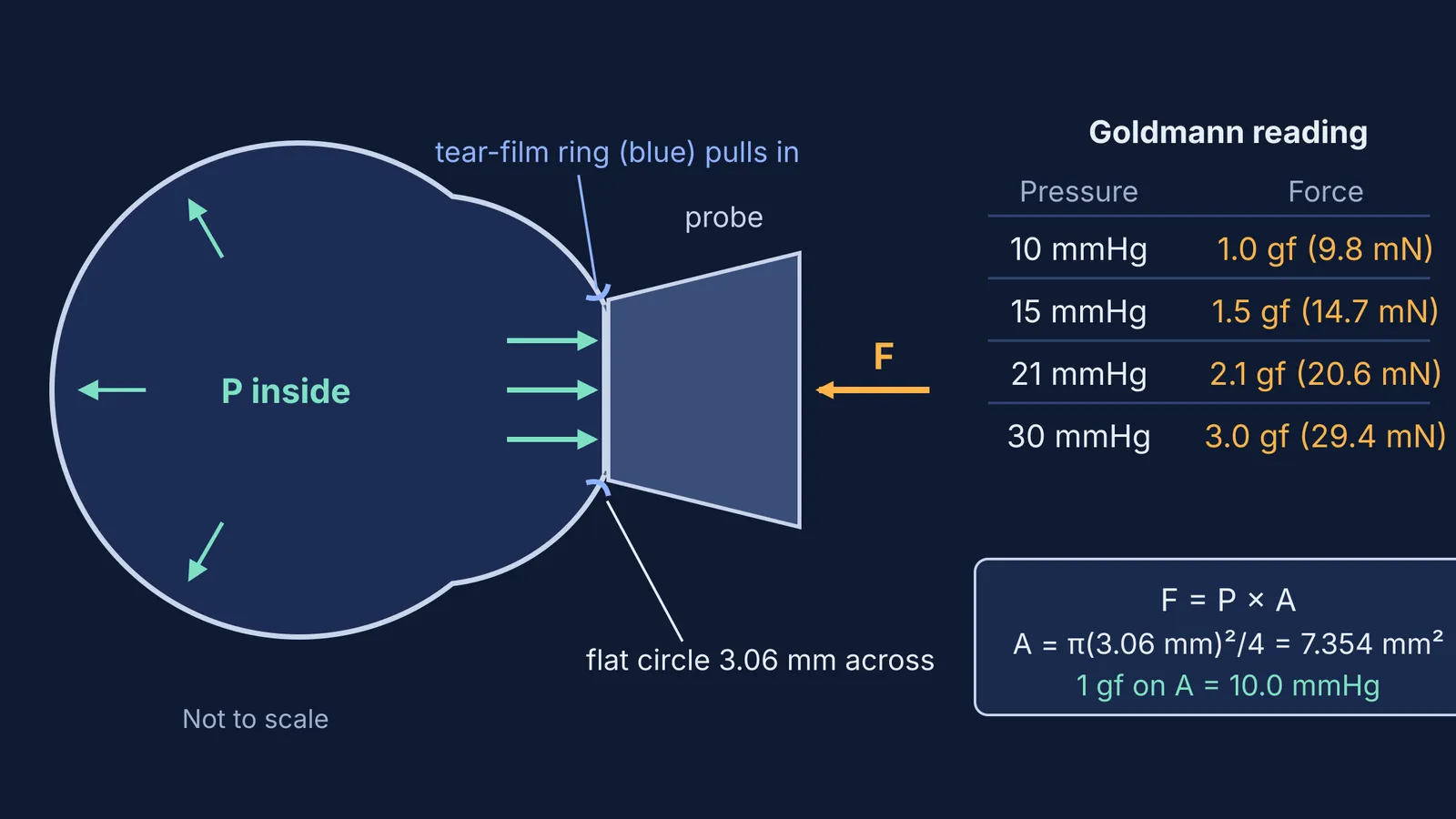
Your eye is a ball of fluid kept slightly above atmospheric pressure, which keeps it firm and round. To measure that pressure without a needle, eye clinics use a tonometer. The most widely used reference design, the Goldmann applanation tonometer, presses a small flat-tipped probe against the front of the eye until it flattens a circle exactly 3.06 mm across. The force needed then reads the pressure directly: every gram of force means 10 mmHg. The whole instrument rests on one line of Class 11 fluids, P = F/A.
This post explains the physics of the measurement only. It is not medical advice. What a particular reading means for a particular person is for an eye doctor to judge.
How can pressing on the eye measure the pressure inside it?
Imagine pushing a flat plate against a balloon. Where the balloon's skin is flat, it has no curvature, so the skin's tension has no component pushing outwards on the plate. The only thing pushing back on the flat part is the gas inside, with force P × A, where A is the flattened area. Measure the force F needed to keep a known area flat and you have P = F/A.
This idea is called the Imbert–Fick principle. "Applanation" just means flattening. The eye is not a perfect thin balloon, so two extra forces creep in, and the clever part of the design is how it handles them.
Why is the flattened circle exactly 3.06 mm across?
Two real-world effects disturb P = F/A at the cornea:
Surface tension of the tear film. A thin ring of tear fluid forms round the probe tip, and its surface tension pulls the probe towards the eye. This makes the force you need smaller.
Stiffness of the cornea. The cornea is a tough, curved layer with its own resistance to bending. Flattening it takes extra force, which pushes the probe away.
A review in the journal Eye explains that Goldmann chose a flattened area of 7.35 mm², a diameter of 3.06 mm, because at that size the tear film's pull and the cornea's push are almost equal and opposite (Aziz and Friedman, Eye, 2018). The same review states the working rule: the flattening force in grams, multiplied by 10, gives the pressure in mmHg.
There is a second, neat reason for 3.06 mm. Work out the area that makes one gram-force equal exactly 10 mmHg:
A = (9.807 × 10⁻³ N)/(10 × 133.3 Pa) = 7.356 mm², which needs a diameter of 3.060 mm.
So the same diameter both roughly cancels the two disturbing forces and turns the dial into a simple ×10 scale.
How many grams of force does a 15 mmHg eye need?
Use 1 mmHg = 133.3 Pa and 1 gram-force = 9.807 mN.
Flattened area. A = π(3.06 mm)²/4 = 7.354 mm² = 7.354 × 10⁻⁶ m².
One gram-force on that area. P = 9.807 × 10⁻³/7.354 × 10⁻⁶ = 1,333 Pa.
Convert. 1,333/133.3 = 10.0 mmHg. So 1 gram-force on this area reads 10 mmHg.
Pressure of 15 mmHg. P = 15 × 133.3 = 2,000 Pa. F = P × A = 2,000 × 7.354 × 10⁻⁶ = 0.0147 N = 14.7 mN, which is 1.50 gram-force.
The same calculation gives a short table:
10 mmHg needs 9.8 mN, about 1.0 gram-force.
15 mmHg needs 14.7 mN, about 1.5 gram-force.
21 mmHg needs 20.6 mN, about 2.1 gram-force.
30 mmHg needs 29.4 mN, about 3.0 gram-force.
Units check: Pa × m² = (N/m²) × m² = N. These are forces of a few millinewtons, the weight of one to three small paper clips, spread over a circle smaller than a grain of rice is long.
Does a tonometer measure absolute or gauge pressure?
Gauge pressure. Air at atmospheric pressure presses on the outside of the cornea and on the probe, so only the excess pressure inside the eye pushes back on the probe. A reading of 15 mmHg means 15 mmHg above atmospheric, the same convention as a blood pressure reading of 120/80. For how those figures are measured and what they mean, see systolic and diastolic blood pressure.
For scale, 15 mmHg is about 2,000 Pa, the pressure under a column of water about 20 cm tall.
How much tension does eye pressure put in the eye's wall?
Treat the eyeball as a thin spherical shell of radius about 12 mm (an illustrative round value). For a single curved membrane, the pressure difference and the wall tension T are linked by ΔP = 2T/R, the one-surface version of the result in excess pressure in a drop and a soap bubble. So:
T = PR/2 = 2,000 × 0.012/2 = 12 N/m
That is about 170 times the surface tension of water (0.072 N/m), carried by the tough outer coat of the eye rather than a liquid film. The same tension is what the tonometer sidesteps: on the flattened patch the wall is not curved, so its tension cannot push on the probe.
What makes a tonometer reading less accurate?
The cancellation at 3.06 mm assumes an average cornea. A thicker or stiffer cornea resists flattening more and reads high; a thinner one reads low. The review in Eye reports one study in which the reading rose by about 0.15 to 0.19 mmHg for every 10 µm of extra central corneal thickness, and it notes that a Goldmann tonometer's calibration needs to be checked monthly (Aziz and Friedman, Eye, 2018). Air-puff tonometers use the same flattening idea, with a jet of air in place of the probe.
The US National Eye Institute notes that many people with glaucoma have high eye pressure, but some people with high pressure never develop it, glaucoma can occur at normal pressure, and normal pressure varies from person to person (National Eye Institute: glaucoma). A number on the dial is one input an eye doctor weighs, not a diagnosis. The optics of the eye, rather than its pressure, are the subject of Harold Ridley and the intraocular lens.
If pressure, surface tension or Laplace's law still feel shaky, the Concept Library explains each concept on its own.
Quick checklist
Applanation: flatten a known area, measure the force, P = F/A.
Goldmann's circle: 3.06 mm across, area 7.354 mm².
At that size tear-film pull and corneal stiffness roughly cancel, and 1 gram-force reads 10 mmHg.
15 mmHg needs 14.7 mN, or 1.5 gram-force.
The reading is gauge pressure, like blood pressure.
Wall tension for a 12 mm eye at 15 mmHg: T = PR/2 = 12 N/m.
Corneal thickness and calibration affect readings; an eye doctor interprets them.


