

On this page
Is the excess pressure 2T/r or 4T/r? In JEE Main and NEET-UG surface tension questions, the answer depends on one thing: how many surfaces the curved liquid has. Get that habit right and drop, bubble and joined-bubble questions all follow. Here T is surface tension and r is radius. NCERT writes S for T.
What is the excess pressure inside a liquid drop?
In NCERT Class 11 Physics, Chapter 9 (Mechanical Properties of Fluids), section 9.6.4 shows that the pressure inside a spherical drop exceeds the pressure outside by 2S/r (NCERT, Chapter 9).
The textbook uses energy. Let the radius grow by a small Δr:
The surface area grows from 4πr² to 4π(r + Δr)², an increase of about 8πrΔr, so the surface energy rises by 8πrΔr × T.
The pressure difference does work (Pi − Po) × 4πr²Δr as the volume grows.
At equilibrium these are equal, so Pi − Po = 2T/r.
A force balance agrees. Cut the drop in half: pressure pushes the halves apart with ΔP × πr², and surface tension pulls them together along the cut edge with T × 2πr. Setting these equal gives ΔP = 2T/r.
The textbook's general rule: across any curved liquid-gas surface, the concave side (inside) is at higher pressure than the convex side (NCERT, Chapter 9).
Why is it 4T/r for a soap bubble?
A soap bubble is not a ball of liquid. It is a thin film of liquid with air on both sides, so it has an outer surface and an inner surface. NCERT notes that a bubble "has two interfaces" and gives (Pi − Po) = 4S/r (NCERT, Chapter 9). In the force picture, both surfaces pull along the cut edge, so the pull is 2 × T × 2πr. That doubles the result.
HyperPhysics gives the same reason: around the circumference, "two surfaces contribute to the force" (HyperPhysics, Georgia State University).
How to count surfaces: a 10-second checklist
Liquid drop in air: one surface, so 2T/r.
Air bubble or cavity inside a liquid: one surface, so 2T/r.
Soap bubble in air (a film): two surfaces, so 4T/r.
Air bubble at depth h in a liquid: 2T/r on top of the outside pressure, which is atmospheric pressure plus the liquid column above. Our guide to hydrostatic pressure and depth problems covers that step.
Worked example: drop, bubble and two joined bubbles
NCERT's Table 9.3 gives the surface tension of water at 20 °C as 0.0727 N/m (NCERT, Chapter 9).
A water drop of radius 1 mm: ΔP = 2 × 0.0727 / 0.001 = 145.4 Pa. That is about 0.14% of atmospheric pressure, which is 1.01 × 10⁵ Pa in NCERT's examples. NCERT's Example 9.10 gets 146 Pa for a hemispherical air bubble of radius 1 mm blown in water, using 0.073 N/m.
A film bubble of the same radius, made from a liquid with the same T, has twice that: about 291 Pa.
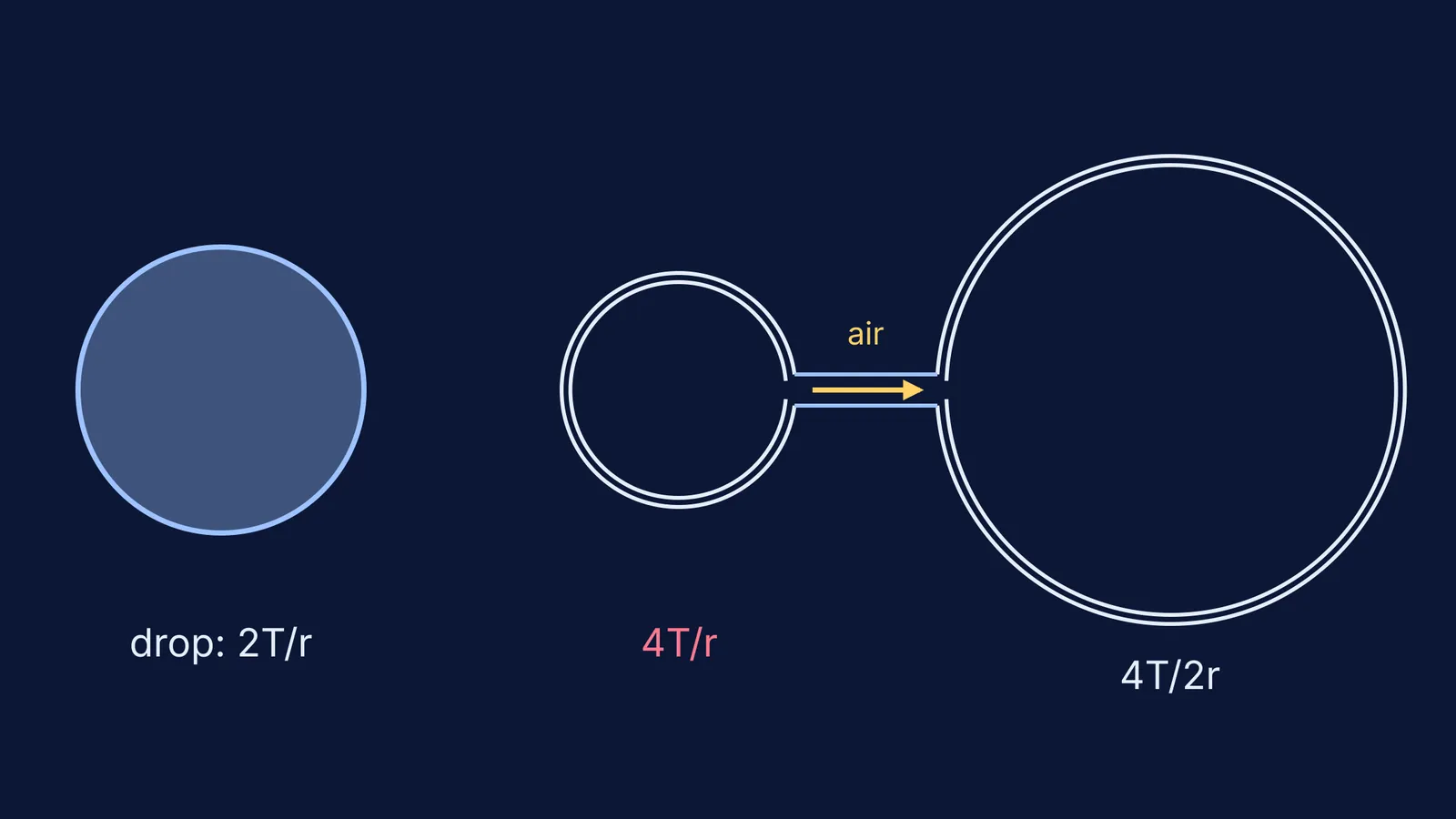
Two soap bubbles, radii 2 cm and 3 cm. Their excess pressures are 4T/0.02 and 4T/0.03, a ratio of 3 : 2. The small bubble has the higher pressure.
What happens when a small and a large bubble are joined?
Join them with a tube and air flows from high pressure to low, so from the small bubble into the large one. A University of Maryland lecture demonstration describes the result: "The smaller bubble will get even smaller and the bigger bubble will get even bigger" (UMD Physics Lecture Demonstrations). The difference keeps growing, because as the small bubble shrinks its pressure rises even more.
In the ideal textbook picture, the flow stops when the small bubble has shrunk to a shallow cap over the mouth of its tube, with the same radius of curvature as the large bubble. At that point the two pressures are equal.
If the two bubbles touch instead, they share a wall. The pressure difference across that wall is 4T/a − 4T/b, so its radius is R = ab/(b − a), and it bulges into the larger bubble. A JEE Main paper from 17 March 2021 (Shift 1) asked exactly this (question and answer key on Cracku). For our 2 cm and 3 cm bubbles, R = 6/1 = 6 cm.
Real soap films are messier. Foams coarsen in a similar way. Combining a two-bubble experiment with modelling, Salonen and colleagues showed that surface elasticity can arrest this coarsening, and related the bubbles' initial and final size ratio to the surface tension and the surface elasticity (EPL, 2016).
Where to practise next
For capillary rise and viscosity, read our explainer on surface tension and viscosity. If the reasoning feels shaky, the Fermi Concept Library has a lesson for each physics concept. When a joined-bubble question goes wrong and you can't see why, the Fermi Problem Library has worked problems with a step-by-step solver that explains the reasoning rather than printing an answer.


