

On this page
Before 1949, cataract surgery meant removing the eye’s clouded natural lens and leaving the patient to rely on thick, heavy glasses to see. Source) The idea of placing an artificial lens directly inside the eye was considered dangerous by the medical establishment.
Then a wartime observation changed everything.
What is a cataract?
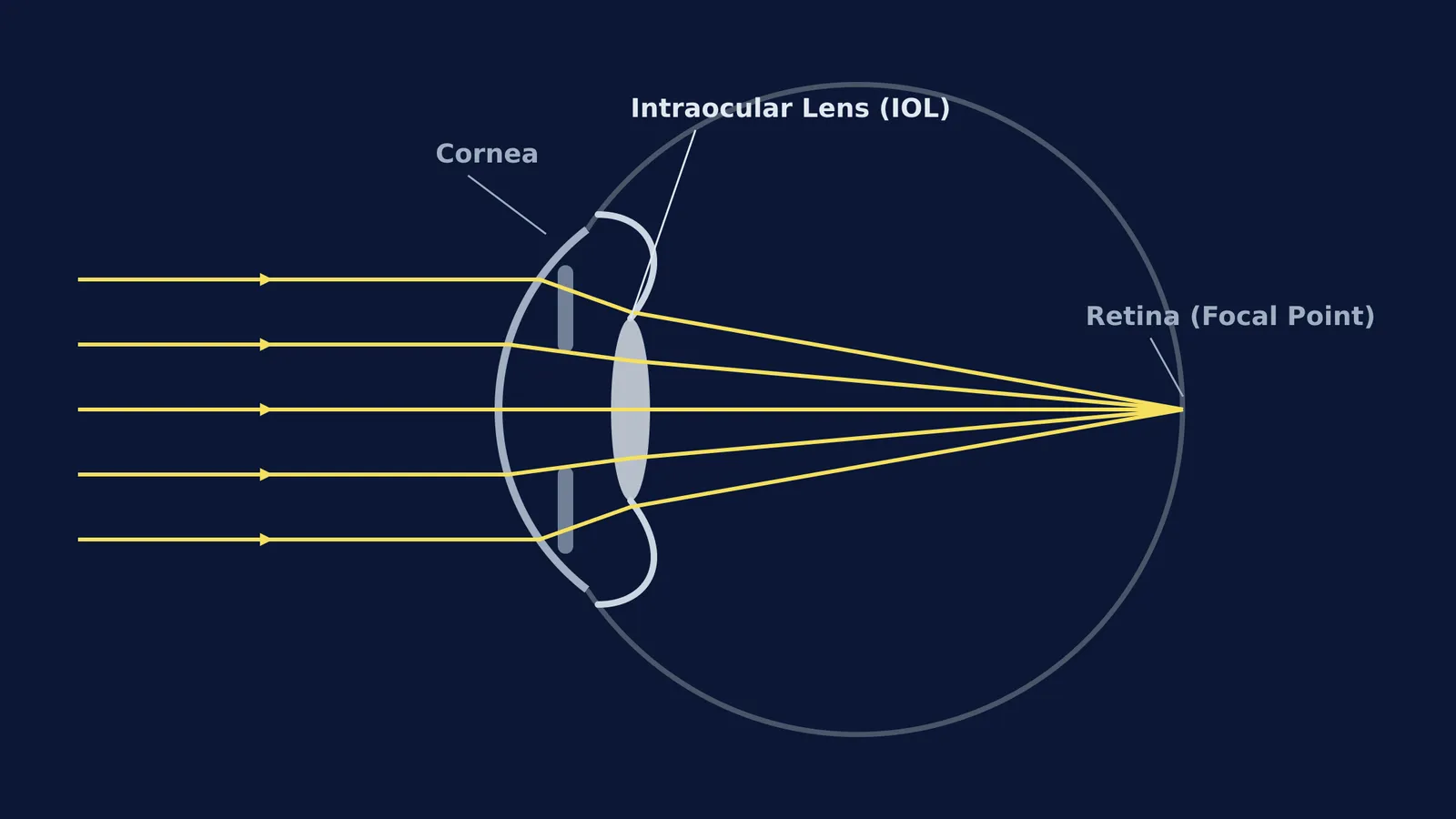
The eye's natural lens is made of water and proteins arranged in a precise, transparent structure that lets light focus on the retina. As a person ages, these proteins can break down and clump together, creating a cloudy area known as a cataract. This clouding scatters the light, causing blurred vision.
When Harold Ridley first started practicing, the only treatment was to surgically remove the opaque natural lens. Patients were left without a lens and had to wear extremely thick glasses to compensate for the lost refractive power, which severely distorted their peripheral vision. Ridley's colleagues believed this was the best that could be done, fearing that leaving any foreign object inside the eye would inevitably lead to immune rejection.
How did Harold Ridley invent the intraocular lens?
During the Battle of Britain in 1940, British ophthalmologist Harold Ridley treated Royal Air Force (RAF) pilots who had sustained severe eye injuries. When bullets shattered the cockpits of Spitfire and Hurricane fighter planes, fragments of the canopy would often lodge in the pilots' eyes. Source)
Ridley noticed something unusual about these injuries. When metal or glass splinters entered an eye, they triggered a severe inflammatory rejection. But the pilots with plastic splinters in their eyes showed no such reaction. The canopy material was polymethyl methacrylate (PMMA), an acrylic plastic often called Perspex. Because this material was inert and biocompatible, the pilots' immune systems did not attack it.
One of his most notable patients was Squadron Leader Gordon Cleaver, whose eyes were filled with acrylic splinters after an attack in 1940. Ridley saw that Cleaver’s eyes tolerated the plastic for years.
This sparked an idea: if the eye could tolerate acrylic plastic indefinitely, could the same material be used to create a permanent artificial lens?
On November 29, 1949, at St Thomas' Hospital in London, Ridley performed the first successful implant of an intraocular lens. He used a high-quality acrylic called Transpex I, manufactured by Imperial Chemical Industries. Source)
How can you learn from anomalies like Ridley?
Ridley's breakthrough was not the result of a deliberate search for a cataract cure, but of paying attention to something that broke the expected rules. You can apply this same observation loop to your studies in science:
Know the baseline: Ridley knew that foreign bodies in the eye normally cause massive inflammation. Without knowing the rule, you cannot spot the exception.
Spot the anomaly: He noticed that one specific material—acrylic plastic—did not cause this reaction.
Ask the right question: Instead of just removing the plastic, he asked what else it could be used for.
When you study optics or biology, look for the exceptions. If you are struggling to picture how light bends through different materials, the Fermi Simulation Lab provides interactive simulations for the ideas that are easier to see than to read. You can manipulate variables and watch the rays change in real time.
For the underlying principles of refraction, reviewing Tracing a ray through a glass slab: the Class 10 practical is a great starting point. If you need to understand how lenses form images at different distances, our guide on Concave mirror images for all six object positions applies similar geometric rules to reflection.
What was the legacy of the first implant?
Ridley faced decades of intense criticism from the medical community before his invention was finally accepted as the global standard of care. Today, cataract surgery with an intraocular lens is one of the most common eye surgeries in the world. Source)
The next time you face a difficult problem, remember Ridley's pilots. The solution might be hiding in the exact place you least expect it, waiting for you to notice. If you find yourself stuck on a tricky physics or biology question, Fermi's AI tutor can help. It works out what you already know, builds a plan for the session, and teaches through it—noticing where you are stuck and deciding whether to explain, ask, or show.


