

On this page
The Gamma Knife has no blade and makes no cut. It is a machine that aims about two hundred narrow beams of gamma rays from cobalt-60 so that they all cross at one small point. Each beam on its own is weak. Where they meet, their doses add up. That simple idea of adding many small doses at one place is the physics this post explains. It is a physics explainer only: whether and how anyone is treated is decided by their doctors, not by a formula.
How does the Gamma Knife focus radiation without a lens?
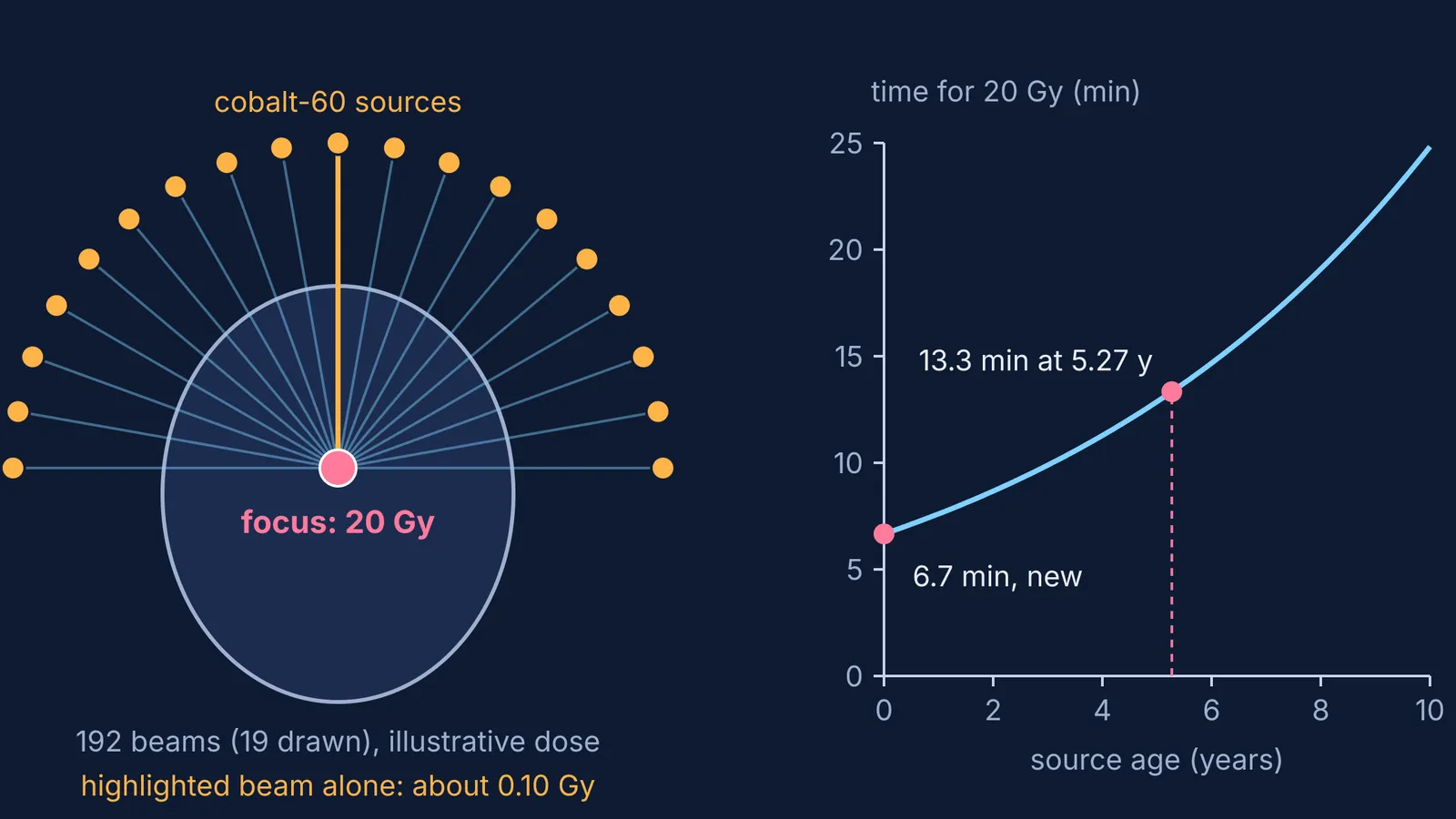
Gamma rays cannot be bent by a lens the way light can. So instead of focusing one beam, the machine uses geometry. Many small radioactive sources are fixed around the head, and each one sits behind a thick metal collimator with a narrow hole that lets out only a thin pencil of rays. Every hole points at the same spot, called the focus or isocentre.
The source count depends on the model. Older Leksell Gamma Knife models (U, B, C and 4C) used 201 cobalt-60 sources, fixed in a hemisphere about 400 mm from the focus. The newer Perfexion model uses 192 sources arranged in five rings, with the source-to-focus distance between 374 mm and 433 mm. These figures come from a comparison of the Perfexion and 4C models by Bhatnagar and colleagues in the Journal of Medical Physics (2009).
Each cobalt-60 nucleus decays by β⁻ emission to an excited nickel-60 nucleus, which then gives out two gamma rays of 1.17 MeV and 1.33 MeV, average about 1.25 MeV. These photons are energetic enough to pass through the skull and reach deep inside the head.
Why does each beam deliver so little on its own?
Dose is measured in gray. One gray (1 Gy) means 1 joule of energy absorbed per kilogram of tissue. It is not a count of rays. A dose of 20 Gy deposits 20 J in each kilogram, which would warm water by only 20/4186 = 0.0048 K. Radiation damages cells through ionisation, not heating, which is why such a small energy matters.
If 192 beams each carry the same dose to the focus, a dose D at the focus needs only D/192 from each beam. Tissue that lies on just one beam's path, away from the focus, receives about that one-beam share, not the full dose. A point where no beam passes receives very little, mostly scattered radiation. The dose falls off steeply just outside the target, because only there do the beams stop overlapping.
The dose along a single path is small, but it is not zero. That is the honest version of "the beams only add up at the focus".
Worked example: dose at the focus and along one beam
The numbers below are illustrative, chosen to show the physics. They are not a treatment plan.
Problem. A unit has 192 sources. With new sources, the dose rate at the focus is 3.0 Gy per minute. (Bhatnagar and colleagues report that the manufacturer's acceptance test requires at least 3.000 Gy per minute for new sources, and they measured 3.633 Gy per minute on their unit.) Find (a) the time to give 20 Gy at the focus, (b) each beam's share at the focus, and (c) the rough dose from one beam at a point 8 cm before the focus, on that beam's path. Take the source-to-focus distance as 400 mm.
Time at the focus. t = 20 Gy ÷ 3.0 Gy/min = 6.7 min.
Share per beam at the focus. 20 ÷ 192 = 0.10 Gy.
Inverse square. The point 8 cm before the focus is 320 mm from the source instead of 400 mm. Intensity goes as 1/r², so it gets (400/320)² = 1.56 times more.
Less tissue to cross. The beam reaches this point before crossing the last 8 cm of tissue. For water at 1.25 MeV, the NIST attenuation table for water gives μ/ρ = 0.0632 cm²/g, so μ ≈ 0.063 per cm. Transmission through 8 cm is e^(−0.063 × 8) = 0.60, so the point gets 1/0.60 = 1.66 times more than the focus does from this beam.
One-beam dose at the point. 0.104 × 1.56 × 1.66 ≈ 0.27 Gy.
So a point on one beam's path, 8 cm from the focus, gets roughly 0.3 Gy while the focus gets 20 Gy, about 70 times less. Real planning software also includes scattered radiation and build-up, so treat this as an order-of-magnitude result. Units check: Gy ÷ (Gy/min) gives minutes, and the two correction factors are pure numbers.
If you want to practise more dose, decay and inverse-square problems step by step, the Fermi Problem Library has a solver that explains the reasoning at each stage.
Why does the treatment take longer as the sources age?
Cobalt-60 has a half-life of 5.27 years. The dose rate is proportional to the activity, so it falls by the same factor: R(t) = R₀ × 2^(−t/5.27). In one year it drops to 2^(−1/5.27) = 0.877 of its value, a fall of 12.3%.
The dose prescribed does not change, so the time on the machine grows as the sources decay:
New sources: 3.0 Gy/min, 20 Gy takes 6.7 min.
After 2 years: 2.31 Gy/min, 8.7 min.
After 5.27 years (one half-life): 1.5 Gy/min, 13.3 min.
After 7 years: 1.19 Gy/min, 16.7 min.
The same arithmetic of half-lives used in how a cobalt-60 food irradiator delivers its dose in gray applies here. A study by Niranjan and colleagues in the Journal of Radiosurgery and SBRT (2012) notes that Gamma Knife installations replace their cobalt-60 sources every 5 to 10 years, about one to two half-lives. The source activity itself, measured in becquerel, follows A = λN as explained in activity of a radioactive sample: becquerel and curie.
How is this different from ordinary radiotherapy?
Ordinary external-beam radiotherapy, described in how radiotherapy works and how chemo is different, usually splits the dose into many small daily sessions. The Gamma Knife instead concentrates the dose at a small, precisely located point by crossing many beams. Which approach suits which person is a medical question. Doctors weigh it case by case, and this post makes no claim about results.
Quick checklist
No knife: about two hundred narrow cobalt-60 gamma beams cross at one point.
Perfexion model: 192 sources; older models such as the 4C: 201.
Gray = J/kg. The focus gets the sum of all beams; each path gets roughly one beam's share, not zero.
Inverse square and attenuation (μ ≈ 0.063 per cm in water at 1.25 MeV) change the dose along a path.
Half-life 5.27 years: the dose rate falls 12.3% a year, so treatment time grows.
Treatment decisions are made by doctors, not by physics alone.


