On this page
If you know the cell cycle from Class 11 and radiation from Class 12 physics, you can understand both treatments. They go after the same weakness: cancer cells keep dividing, and dividing needs intact DNA.
Why are cancer cells a target at all?
A tumour is a group of cells that has escaped the normal controls on division (see benign vs malignant tumours). Before dividing, a cell copies its DNA in S phase and passes the G1 and G2 checkpoints; you can revise these by asking AI to quiz you on G1, S, G2 and M. Break the DNA, or stop division, and the cell cannot multiply.
How does radiotherapy work?
Radiotherapy kills cancer cells or slows their growth by damaging their DNA, according to the US National Cancer Institute (NCI). Cancer cells whose DNA is damaged beyond repair stop dividing or die.
A 2012 review in the International Journal of Medical Sciences describes two routes to that damage:
Direct action: the radiation interacts with the DNA itself.
Indirect action: the radiation ionises the water in the cell, and the free radicals it makes then attack the DNA.
The same review says DNA double-strand breaks, where both strands of the helix are cut, are responsible for most of the cell killing. It also reports that about 50% of all cancer patients receive radiotherapy during their illness.
In external beam radiotherapy, a machine aims radiation at the cancer; each session delivers radiation for 1 to 5 minutes, and it does not make the patient radioactive (NCI, external beam). In internal radiotherapy (brachytherapy), seeds, ribbons or capsules containing a radiation source are placed in or near the tumour.
It is not instant: NCI notes that it takes days or weeks of treatment before cancer cells die, and they keep dying for weeks or months after treatment ends.
Why is radiotherapy given in small daily doses?
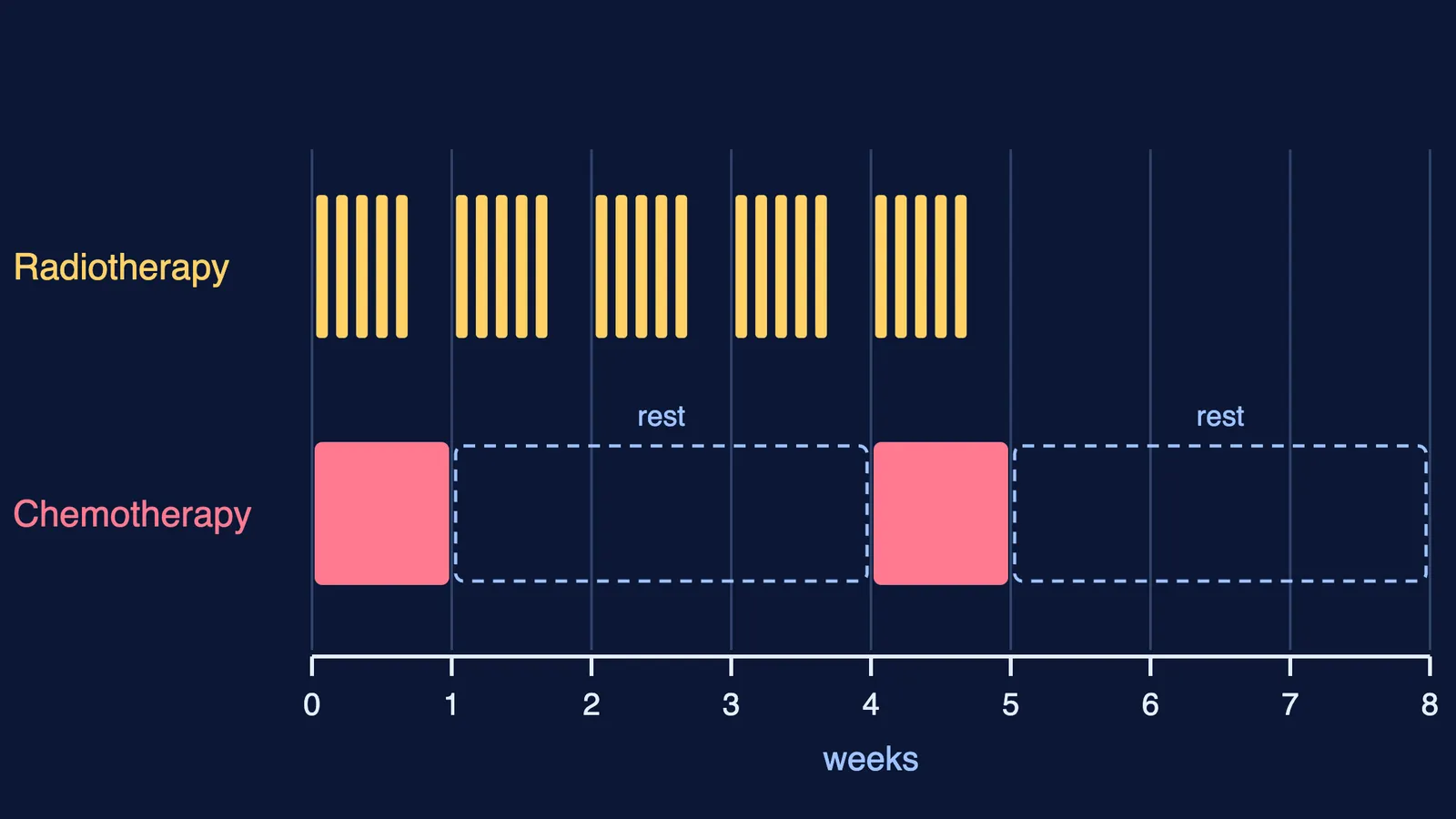
The total dose is split into small doses called fractions. Most people have external beam radiotherapy once a day, five days a week, Monday to Friday (NCI, external beam). A typical schedule uses daily fractions of 1.5 to 3 gray (Gy) over several weeks (Baskar et al., 2012).
Why not one big dose? NCI says the series of treatments lets healthy cells recover and makes radiation more effective. Cancer cells are in general less efficient than normal cells at repairing radiation damage (Baskar et al.).
There is also a ceiling: an area of the body can safely receive only a limited amount of radiation over a lifetime, so it may not be possible to treat the same area a second time (NCI).
How does chemotherapy work?
Chemotherapy uses drugs that kill or stop the growth of cancer and other fast-growing cells (NCI, chemotherapy). Unlike a beam aimed at one region, the drugs are most often given into a vein (IV); some are swallowed.
It is often given in cycles: a period of treatment followed by a period of rest. NCI's example is treatment every day for one week followed by three weeks with no chemotherapy. The rest period gives the body a chance to recover and build new healthy cells.
Why do radiotherapy and chemotherapy cause side effects?
Both treatments reach healthy cells. Chemotherapy can harm fast-growing healthy cells, such as those lining the mouth and intestines and those that make hair grow, and that damage may cause mouth sores, nausea and hair loss; the most common side effect is fatigue (NCI, chemotherapy). For radiotherapy, side effects depend on the part of the body treated; damaged healthy cells usually recover within a few months after treatment, while some late effects show up months or years later (NCI, radiation side effects).
If someone in your family is having treatment, their oncology team is the right place for questions about their plan and symptoms.
A three-question frame for exam answers
Three questions, in order, cover most school answers:
What is damaged? Radiotherapy: DNA, directly or through free radicals from ionised water. Chemotherapy: drugs kill or stop the growth of fast-growing cells.
Which cells suffer most? For chemotherapy, fast-growing cells: tumour cells, plus healthy cells in the mouth, gut lining and hair roots. For radiotherapy, cells in the treated area.
Why is it spread out? Fractions (radiotherapy) and cycles (chemotherapy) give healthy cells time to recover between doses.
Worked example. Question: why is radiotherapy given in fractions rather than one large dose? (3 marks)
Radiation kills cells by damaging their DNA, mainly through double-strand breaks.
Normal cells are in general more efficient than cancer cells at repairing this damage.
Splitting the dose lets normal tissue recover between fractions while tumour damage builds up.
If ionisation or the cell cycle still feels shaky, the Fermi Concept Library has a lesson for every concept in physics, chemistry and biology. When you have written your three-point answer, Fermi's AI tutor can work through it with you, noticing where you are stuck and checking understanding as it goes.