On this page
Many Class 11 cell cycle questions ask you to track two numbers, DNA content (C) and chromosome number (n), which do not change together. Here is a prompt that makes an AI quiz you on this, an answer key from NCERT Class 11 Biology, Chapter 10, and a way to catch the AI's mistakes.
What happens to DNA content and chromosome number in G1, S, G2 and M?
NCERT splits the cell cycle into interphase and M phase, and interphase into G1, S and G2 (NCERT Class 11 Biology, Chapter 10). Here is what happens in each:
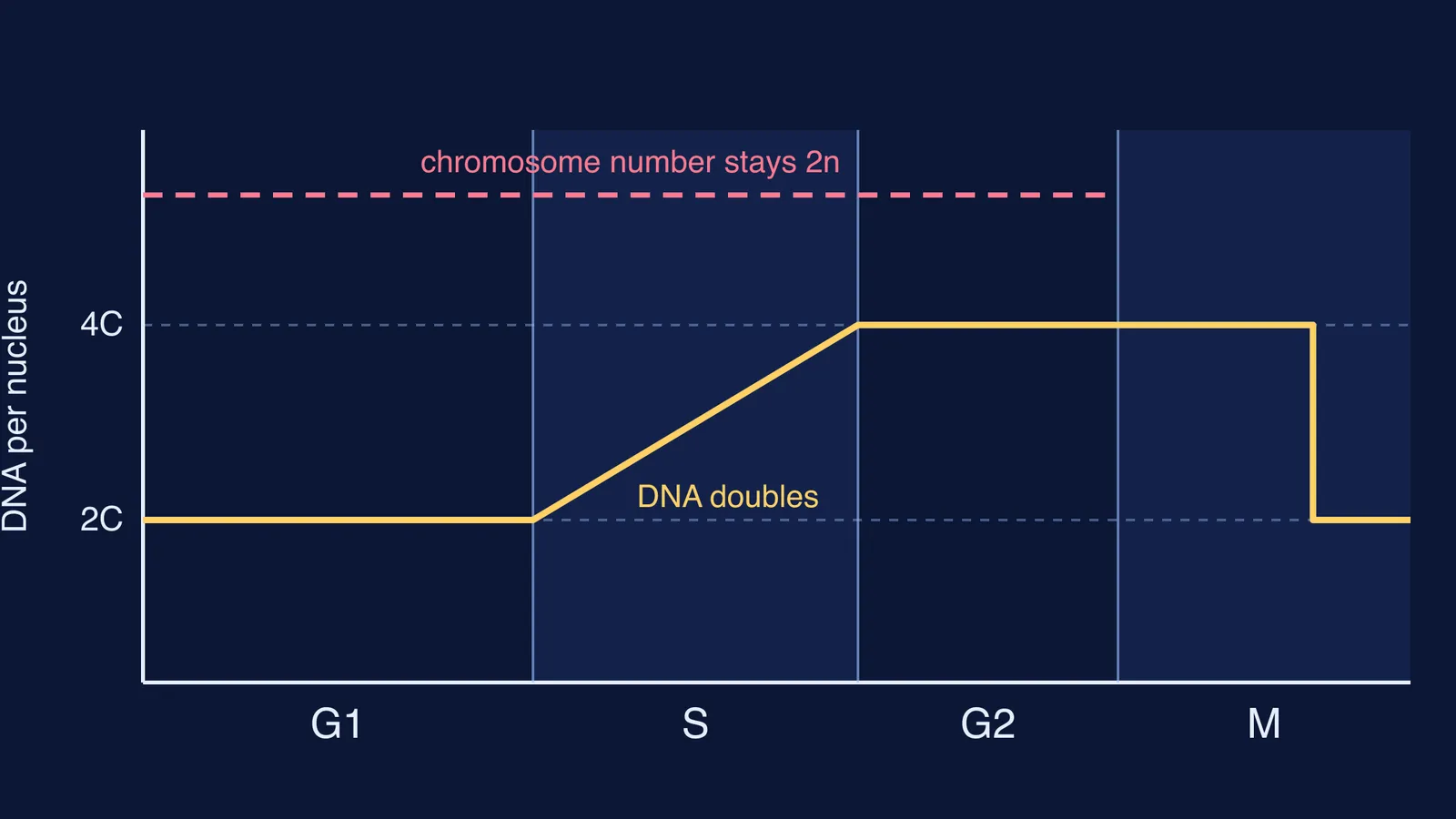
G1 (Gap 1): the cell is metabolically active and grows continuously, but does not replicate its DNA.
S (Synthesis): DNA replication takes place and the amount of DNA per cell doubles, from 2C to 4C. Chromosome number does not increase: a cell that was 2n in G1 is still 2n after S.
G2 (Gap 2): the cell makes proteins in preparation for mitosis and keeps growing. DNA stays at 4C.
M (mitosis): chromosomes condense, each seen as two chromatids joined at the centromere, and are shared out so that parent and daughter cells have the same chromosome number. That is why NCERT calls mitosis equational division.
In human cells in culture, one cycle takes about 24 hours and interphase lasts more than 95% of it (NCERT, Chapter 10). Cells that stop dividing leave G1 for an inactive quiescent stage, G0.
Worked example: the onion root tip
NCERT's own margin question uses onion root tip cells, which have 16 chromosomes each. It asks for the chromosome number at G1, after S and after M, and the DNA content at G1, after S and at G2, if the content after M phase is 2C (NCERT, Chapter 10). Working from the rules above:
G1: 16 chromosomes, 2C.
After S: 16 chromosomes, 4C.
G2: 16 chromosomes, 4C.
After M, in each daughter cell: 16 chromosomes, 2C.
One trap sits inside M phase. At anaphase, NCERT says each chromosome splits and the two daughter chromatids are now referred to as daughter chromosomes. So if a question asks how many chromosomes an onion root tip cell has at anaphase, counting daughter chromosomes gives 32, while the DNA is still 4C until the cell divides. For the full stage-by-stage picture, see our posts on DNA content 2C and 4C through the cell cycle and chromosome number and DNA content through the stages of mitosis.
How do you get an AI to quiz you on cell cycle phases?
In a study by Henry Roediger and Jeffrey Karpicke, students who took recall tests on prose passages remembered more on final tests given 2 days or 1 week later than students who restudied the passages the same number of times; on a test after 5 minutes, restudying did better (Psychological Science, 2006).
Paste this into any chatbot:
"Quiz me on the cell cycle using only NCERT Class 11 Biology, Chapter 10. Ask one question at a time and wait for my answer. Each question should give an organism's chromosome number and a phase (G1, S, G2 or a stage of mitosis) and ask for both the chromosome number and the DNA content in C. Include anaphase and G0 questions. Do not reveal the answer until I reply. If I am wrong, say which number and why, in one sentence. After 10 questions, list the ones I missed."
Three habits make the quiz worth more:
Answer before looking anything up, even if guessing.
Give both numbers every time, for example "16, 4C".
Redo missed questions the next day, not straight away.
For more rules that stop a chatbot giving answers away, see how to make an AI chatbot quiz you properly.
How do you check the AI's answers against NCERT?
Chatbots can be confidently wrong, so keep the NCERT chapter open and check each answer against four points from section 10.1:
During S phase, the amount of DNA per cell doubles, from 2C to 4C.
After S phase, there is no increase in chromosome number.
In G1, the cell grows but does not replicate its DNA.
Cells that stop dividing exit G1 to enter G0.
Watch for the AI saying chromosome number doubles in S, giving G2 as 2C, or mixing up C with n. If the AI and the textbook disagree, go with the textbook.
Your quiz may also bring up checkpoints. Leland Hartwell and Ted Weinert described checkpoints in 1989 as controls that make late cell cycle events depend on early ones being complete, so that in eukaryotes mitosis waits for DNA synthesis to finish (Science, 1989). NCERT says it more simply: these events are coordinated and under genetic control.
Still mixing up C and n? Fermi's AI tutor notices where a student is stuck and decides whether to explain, ask or show, and the Fermi Concept Library gives every concept in biology its own lesson.
Start with the onion example tonight: four stages, two numbers each, answered before you check.