

On this page
You bite into kulfi and one tooth answers with a sharp jolt. On the leading explanation, the cold did not have to reach the nerve. It moved a tiny column of fluid, and the nerve noticed the movement.
What is inside a tooth?
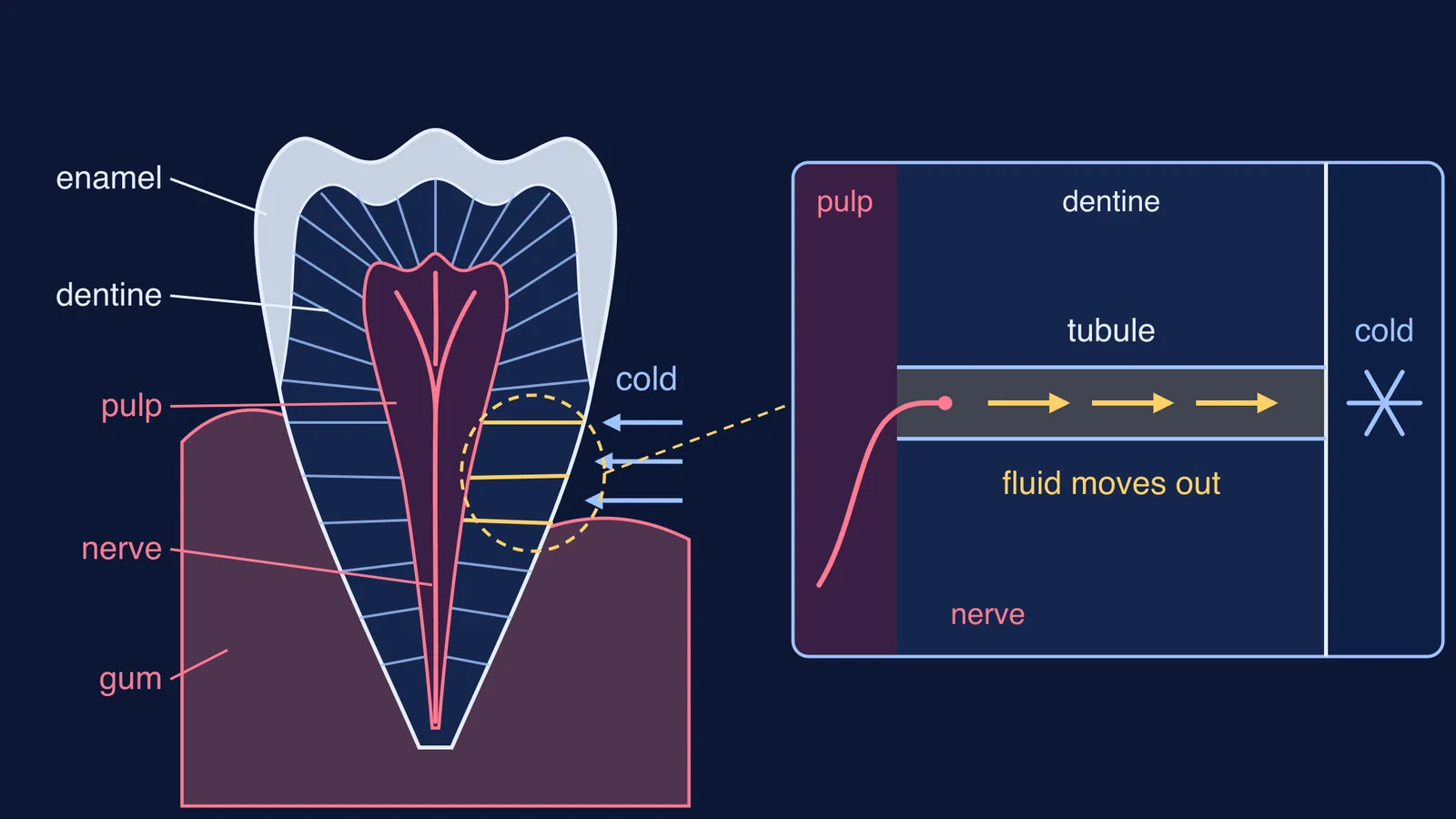
Enamel, the hard outer shell of the crown, has no nerves. Under it sits dentine, and in the middle is the pulp, which holds blood vessels and nerves. Our post on the structure of a tooth: enamel, dentine, pulp and cementum walks through each layer.
Dentine is not solid. It is full of microscopic tubes called dentinal tubules that run from the pulp out towards the surface, and each one holds fluid. A scanning electron microscope study counted about 46,800 tubules per square millimetre in the dentine near the top of the root canal (Lo Giudice et al., BioMed Research International, 2015).
While enamel covers the crown and gums cover the root, those tubes are sealed off. Trouble starts when either cover wears away.
Why do teeth hurt when you eat ice cream?
The usual explanation is the hydrodynamic theory: hot, cold, touch and chemical changes move the fluid inside dentinal tubules, and that movement stimulates the nerve endings at the pulp end (Liu et al., BMC Oral Health, 2020). Swedish dentist Martin Brännström gathered experimental evidence for the idea in the 1960s (summary of the hydrodynamic theory).
Cold is thought to increase the outward flow of tubule fluid, away from the pulp (Liu et al., 2020). A 2026 review adds that human and animal studies both find outward flow triggers stronger nerve responses than inward flow (Kádár et al., Temperature, 2026). The same review discusses cold-sensing ion channels: TRPM8 switches on below about 25°C and TRPA1 below about 17°C, so fluid flow may not be the whole story.
Open tubules make the difference. In a 1987 scanning electron microscope study of teeth with exposed roots that were due to be extracted, sensitive teeth had about 8 times as many tubules per unit area at the exposed root surface as non-sensitive teeth, and the tubules were about 2 times wider (Absi, Addy and Adams, Journal of Clinical Periodontology, 1987).
Fluid in a narrow tube is easier to picture when you can see it move. The Fermi Simulation Lab has interactive simulations for ideas that are easier to see than to read.
This jolt in one tooth is different from the ache behind your forehead after gulping something cold; that one has its own explainer on why eating ice cream fast gives you brain freeze.
What wears away enamel and gums?
The 2020 review lists the main ways dentine gets exposed (Liu et al., 2020):
Enamel loss from grinding (attrition), scrubbing (abrasion) and acid (erosion)
Gum recession, which uncovers the root, where there is no enamel at all
Acidic food and drinks, which drive erosion
Brushing too hard or too aggressively
Acid is the link to cavities too: our post on why tooth decay starts when mouth pH falls below 5.5 explains the chemistry.
How common are sensitive teeth?
A 2019 meta-analysis of 77 studies gave a best estimate of 11.5% for how many people have dentine hypersensitivity, with studies ranging from 1.3% to 92.1% (Favaro Zeola, Soares and Cunha-Cruz, Journal of Dentistry, 2019).
What should you do if your teeth hurt with cold?
Dentists usually confirm sensitivity partly by ruling out tooth decay, cracked teeth and inflamed pulp, which can feel similar (Liu et al., 2020). At home, the useful step is to collect good information for the dentist.
A one-week cold diary:
Note which tooth or side hurts, top or bottom, front or back.
Write the trigger: ice cream, cold water, cold air, sweets, brushing.
Count roughly how long the pain lasts: a second or two, or minutes.
Note anything that changed lately: a harder toothbrush, more lemon water or cola, grinding at night.
What to say at the appointment (fill in your own details): "For about two weeks, my lower left back tooth has hurt for a second or two with cold drinks. It does not hurt on its own. I started using a harder brush last month." Then ask: "Is this sensitivity or something else, and what should I change?"
On desensitising products, the review notes that most agents that plug the tubules, such as fluoride, strontium salts, oxalates and arginine with calcium, beat placebo in trials, while well-designed trials have not shown that potassium salts work (Liu et al., 2020). Whether any of them suits your teeth is a question for your dentist.
How to explain it in a biology answer
If an exam asks why exposed dentine hurts with cold, four steps cover it:
Enamel or gum loss exposes dentine.
Dentine has fluid-filled tubules that reach the pulp.
Cold makes the fluid move outward.
The movement stimulates nerve endings in the pulp, felt as sharp pain.
If any word in that chain is shaky, the Fermi Concept Library has a lesson for every concept in biology, physics and chemistry.


