

On this page
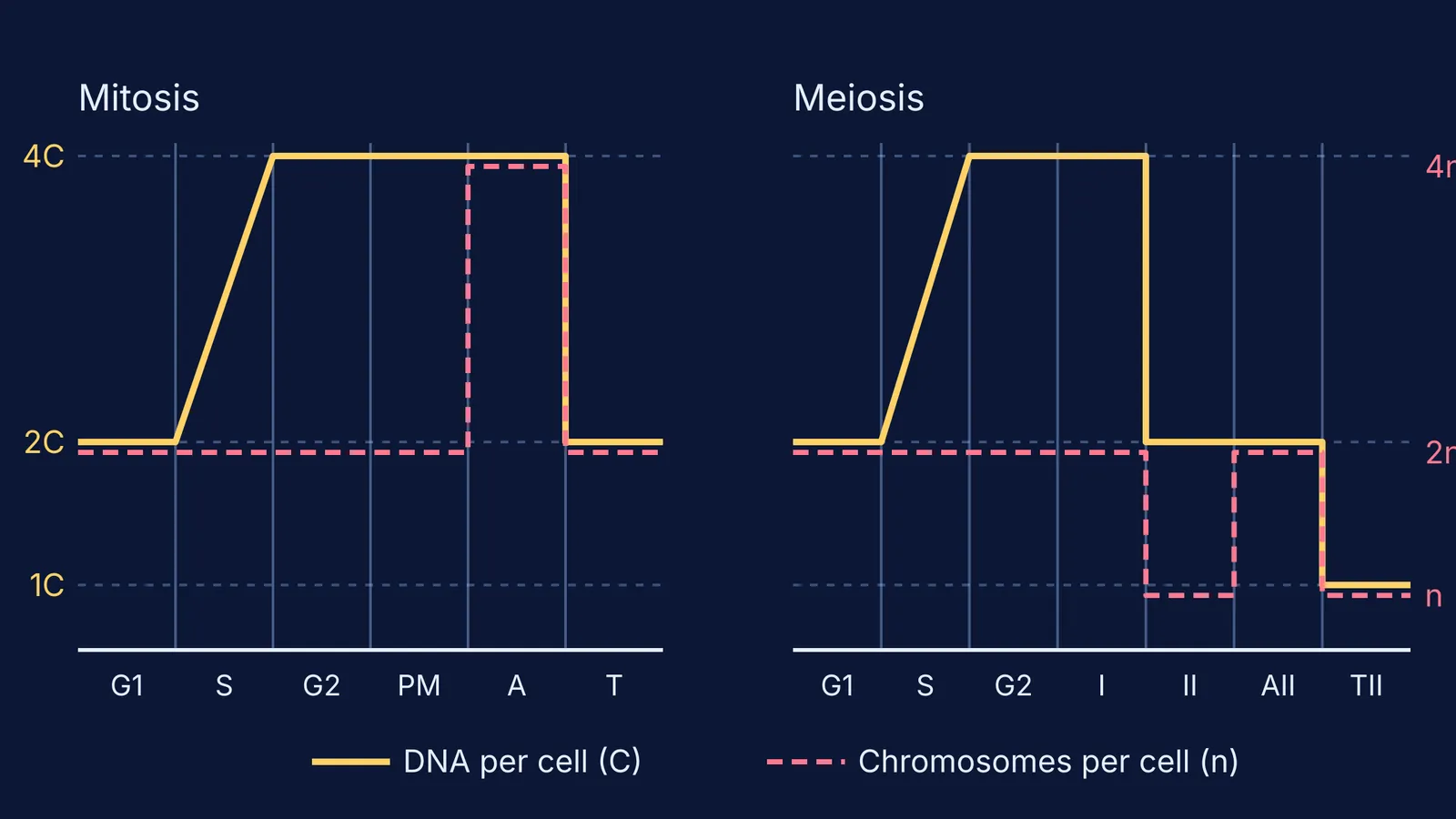
A common mistake on cell-cycle questions is treating DNA amount and chromosome number as the same count. DNA content changes when DNA is copied and when a cell splits. Chromosome number changes when centromeres split and when a cell splits. Keep them in two separate columns.
What does C value mean?
C is a unit of DNA amount, not a count of chromosomes. Hewson Swift introduced the "C" terminology in 1950, according to a 2005 review of the terms in Annals of Botany. The review says his paper did not make clear what C stood for; a later account, based on a personal communication from Swift, gives it as "constant", the amount of DNA characteristic of a particular genotype.
The same review defines the 1C-value as the DNA content of one unreplicated genome with chromosome number n. So a gamete is 1C, a diploid cell in G1 is 2C, and that same cell after copying its DNA is 4C.
The letter n counts chromosomes instead. A diploid cell has 2n. To count chromosomes, count centromeres: a chromosome made of two sister chromatids joined at one centromere is still one chromosome.
What is the DNA content in G1, S and G2?
The NCERT Class 11 Biology chapter on cell cycle and cell division states it directly: during S phase the amount of DNA per cell doubles, so "if the initial amount of DNA is denoted as 2C then it increases to 4C. However, there is no increase in the chromosome number."
G1: 2C, 2n. The cell grows but has not copied its DNA.
S: 2C rising to 4C, still 2n. Each chromosome now has two sister chromatids.
G2: 4C, 2n. Proteins are made for mitosis.
How do C value and chromosome number change in mitosis?
Prophase and metaphase: 4C, 2n. Each chromosome still has two chromatids held at one centromere.
Anaphase: 4C, 4n. The NCERT chapter describes how each chromosome splits and the two chromatids become daughter chromosomes, so the centromere count doubles while the cell is still undivided.
After telophase and cytokinesis: each daughter cell is 2C, 2n, the same as the parent in G1.
So DNA goes up in S and down at cytokinesis. Chromosome number goes up at anaphase and down at cytokinesis. To see these stages on a slide, read our guide to the onion root tip mitosis practical.
How do they change in meiosis I and meiosis II?
The NCERT chapter notes that meiosis has two divisions but only one round of DNA replication, and that DNA is not copied during interkinesis. That is why DNA content ends at a quarter of its peak.
Prophase I to anaphase I: 4C, 2n. In anaphase I homologous chromosomes separate, but sister chromatids stay joined, so no centromere splits and the count does not change.
After telophase I: each cell is 2C, n. This is the reduction step.
Prophase II and metaphase II: 2C, n.
Anaphase II: 2C, 2n. Centromeres split, as in mitotic anaphase.
After telophase II: four haploid cells, each 1C, n.
For the names of every stage in order, see our cell cycle, mitosis and meiosis overview.
Fill-in table: can you answer NCERT's onion question?
A margin box in the NCERT chapter says onion root tip cells have 16 chromosomes and asks for the chromosome number at G1, after S and after M, and the DNA content at G1, after S and at G2, if it is 2C after M. Cover the answers and fill in each row as "chromosomes, C value".
G1: ___ chromosomes, ___C
After S: ___ chromosomes, ___C
G2: ___ chromosomes, ___C
Metaphase: ___ chromosomes, ___C
Anaphase (one undivided cell): ___ chromosomes, ___C
After M (each daughter cell): ___ chromosomes, ___C
Now take the same 16-chromosome cell through meiosis instead:
After telophase I (each cell): ___ chromosomes, ___C
Anaphase II (each cell): ___ chromosomes, ___C
After telophase II (each cell): ___ chromosomes, ___C
Answers: (1) 16, 2C; (2) 16, 4C; (3) 16, 4C; (4) 16, 4C, with 32 chromatids; (5) 32, 4C; (6) 16, 2C; (7) 8, 2C; (8) 16, 2C; (9) 8, 1C.
Wrote 32 on row 4? You counted chromatids instead of centromeres. Wrong on row 5 or 8? You missed that splitting centromeres doubles the count. Wrong on row 2? You let the chromosome column follow the DNA column.
Where to practise next
Write the two columns from memory, starting from 2C and 2n in G1. If chromatid versus chromosome is still fuzzy, the Fermi Concept Library gives every concept in biology its own lesson and its place in the map. For practice, the Fermi Problem Library has worked problems with a step-by-step solver that explains the reasoning, so you can see where a count went wrong.


