

On this page
You know that 4! = 24. But what is (1/2)!? It has a precise answer, the answer contains π, and the integral behind it also powers the sin and cos reduction formulas you use in definite integrals.
What is the gamma function?
For z with positive real part, the gamma function is the integral Γ(z) = ∫₀^∞ e^(−t) t^(z−1) dt, as defined in the NIST Digital Library of Mathematical Functions, §5.2. Elsewhere it is extended by analytic continuation, with no zeros and with poles at z = 0, −1, −2 and so on.
Put z = 1 and the integral becomes ∫₀^∞ e^(−t) dt = 1, so Γ(1) = 1.
Why does Γ(n) = (n − 1)!?
Because one integration by parts turns Γ(z + 1) into zΓ(z). The whole proof, for real z > 0:
Write Γ(z + 1) = ∫₀^∞ t^z e^(−t) dt.
Take u = t^z and dv = e^(−t) dt, so du = z t^(z−1) dt and v = −e^(−t).
By parts: Γ(z + 1) = [−t^z e^(−t)] from 0 to ∞, plus z ∫₀^∞ t^(z−1) e^(−t) dt.
The bracket is 0 at both ends: t^z is 0 at t = 0, and e^(−t) beats any power of t as t grows.
What remains is zΓ(z).
So Γ(z + 1) = zΓ(z), the recurrence in DLMF §5.5. Climb from Γ(1) = 1: Γ(2) = 1, Γ(3) = 2 × Γ(2) = 2, Γ(4) = 3 × Γ(3) = 6. In general n! = Γ(n + 1), equation 5.4.1 in DLMF §5.4. The case n = 0 gives 0! = Γ(1) = 1, one more check for our post on why 0 factorial equals 1. If choosing u and dv feels shaky, it is the same move as in integrating x tan⁻¹x by parts.
Why is Γ(1/2) equal to √π?
The cleanest route is the beta function. Euler's beta integral is B(a, b) = ∫₀¹ t^(a−1) (1 − t)^(b−1) dt = Γ(a)Γ(b) / Γ(a + b), and it has the trigonometric form ∫₀^(π/2) sin^(2a−1)θ cos^(2b−1)θ dθ = ½B(a, b), both for a, b > 0 (DLMF §5.12).
Now set a = b = 1/2. Both powers become 0, so the left side is ∫₀^(π/2) 1 dθ = π/2, which means B(1/2, 1/2) = π. On the gamma side, B(1/2, 1/2) = Γ(1/2)² / Γ(1) = Γ(1/2)². Γ(1/2) is the integral of a positive function, so it is positive, and Γ(1/2) = √π.
DLMF lists the value as Γ(1/2) = π^(1/2) = 1.77245 38509... (DLMF §5.4).
Two results follow:
Half-integers: Γ(3/2) = √π/2 and Γ(5/2) = 3√π/4. So the (1/2)! from the opening is Γ(3/2) = √π/2.
The Gaussian integral: put t = x² in Γ(1/2) and you get ∫₀^∞ e^(−x²) dx = √π/2.
How do gamma and beta solve Wallis-type integrals?
With p = 2a − 1 and q = 2b − 1, the beta form becomes one formula: ∫₀^(π/2) sinᵖx cos^q x dx = ½ Γ((p + 1)/2) Γ((q + 1)/2) / Γ((p + q + 2)/2), valid for p and q greater than −1 (DLMF §5.12).
Worked example: ∫₀^(π/2) sin⁶x cos⁴x dx.
Here p = 6 and q = 4, so you need Γ(7/2), Γ(5/2) and Γ(6).
Γ(7/2) = (5/2)(3/2)(1/2)√π = 15√π/8, and Γ(5/2) = 3√π/4.
Their product is 45π/32, and Γ(6) = 5! = 120.
The integral is ½ × (45π/32) / 120 = 45π/7680 = 3π/512.
The Wallis rule agrees: (5·3·1)(3·1) / (10·8·6·4·2) × π/2 = 3π/512. For whole-number powers, π appears only when both are even, because only then do two √π factors meet. Try ∫₀^(π/2) sin⁵x dx (p = 5, q = 0): you should get 8/15, with no π.
Before reaching for gamma, check three things:
Limits 0 to π/2, 0 to 1, or 0 to ∞?
Integrand a product of powers: sin and cos, t and (1 − t), or t and e^(−t)?
Powers greater than −1, so it converges?
Three yeses: match it to Γ or B. For where this fits in your preparation, see integral calculus for JEE Advanced: how to prepare. When a reduction goes wrong halfway, the Fermi Problem Library has worked problems with a step-by-step solver that explains the reasoning rather than printing an answer. To revisit integration by parts itself, the Fermi Concept Library gives each concept its own lesson and its place in the map.
What does the graph of the gamma function look like?
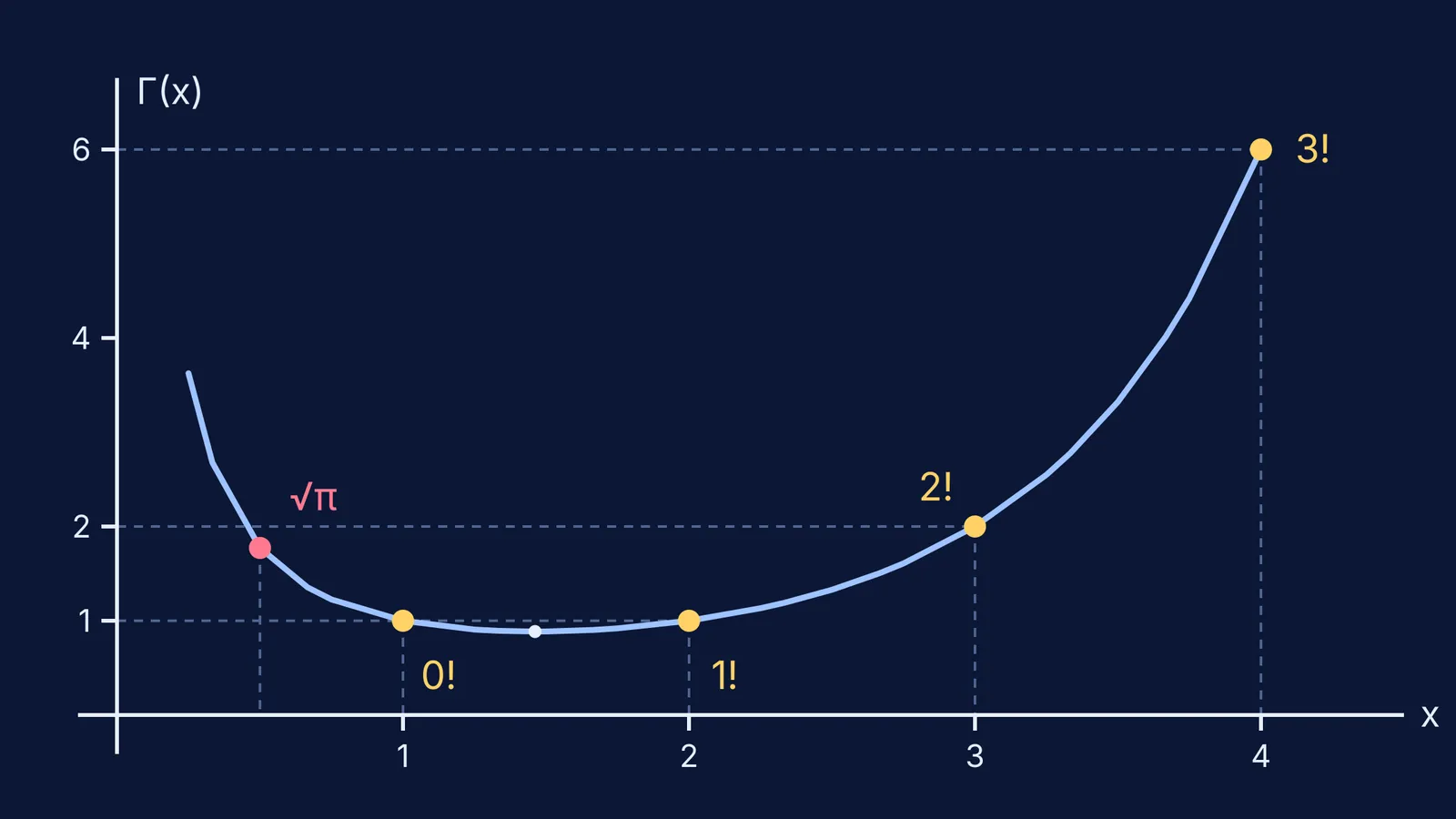
For positive x, the curve falls from very large values near 0, dips below 1 and then climbs steeply. Its turning point on the positive axis is at x = 1.46163..., where Γ(x) = 0.88560... (DLMF §5.4, Table 5.4.1). The diagram at the top marks 0!, 1!, 2!, 3! and √π on that one curve.


