On this page
Picture a party where any two guests have exactly one friend in common. That loose-sounding rule forces a rigid shape. Here is the theorem, a check on tiny parties, the proof outline and why the windmill is the only answer.
What does the friendship theorem say?
Turn the party into a graph: people are vertices, and an edge joins two friends. The condition is that every two vertices have exactly one common neighbour.
The friendship theorem says the finite graphs with this property are exactly the friendship graphs, a result of Erdős, Rényi and Sós in 1966 in Studia Scientiarum Mathematicarum Hungarica.
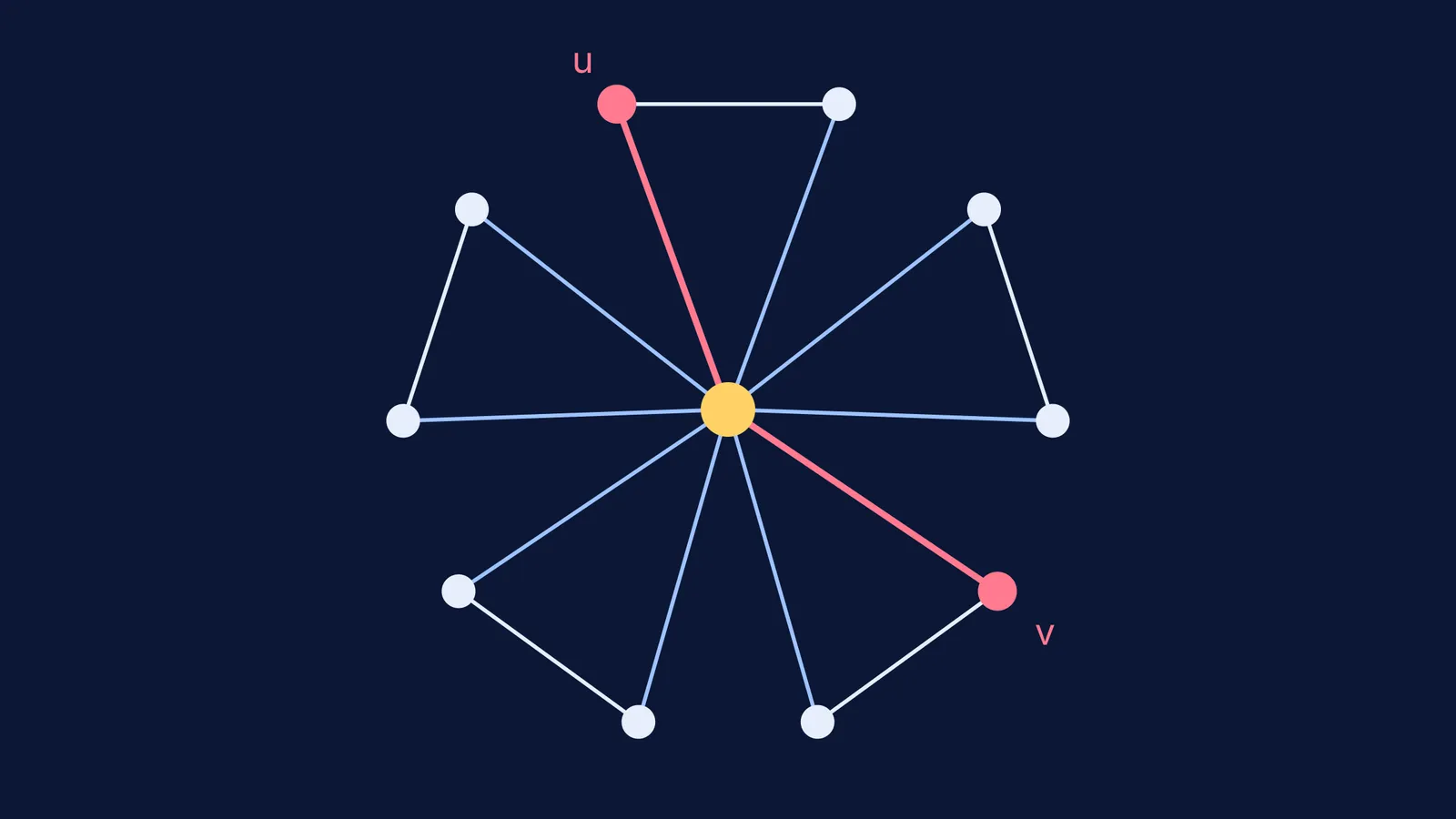
The friendship graph F_n is n triangles glued at one shared vertex, so it has 2n + 1 vertices and 3n edges, as described in the friendship graph entry. It is also called the Dutch windmill graph.
The word finite matters. Peter Cameron's lecture notes on eigenvalues in finite geometry give a construction of infinite graphs where every pair has a unique common friend but nobody knows everyone.
How do you check the friendship theorem on small cases?
A counting fact does most of the checking. Each pair of people has exactly one common friend, and a person with d friends is the common friend of d(d − 1)/2 pairs. So, adding over all N people, the sum of d(d − 1)/2 must equal N(N − 1)/2, the number of pairs.
3 people, a triangle: each pair's common friend is the third person. Degrees 2, 2, 2 give 1 + 1 + 1 = 3 pairs, and 3 people make 3 pairs. This is F_1.
4 people: the square fails, because opposite corners share two friends. Four people all friends with each other fails too, since every pair shares two. No four-person party works: as the theorem will show, everyone except the hub pairs off, so the party size must be odd.
5 people, the butterfly graph F_2: the hub has 4 friends and the other four have 2 each. The count gives 6 + 1 + 1 + 1 + 1 = 10, and 5 people make 10 pairs.
How does the proof of the friendship theorem work?
We follow the two-step outline in Cameron's notes.
Two people who are not friends have the same number of friends: you can match each friend of one with exactly one friend of the other.
If two people have different numbers of friends, this forces one person to know everyone. So either there is a hub, or everyone has k friends.
In the equal case, count pairs again: N(N − 1)/2 = N × k(k − 1)/2, so N = k² − k + 1.
Write the adjacency matrix A (1 where two people are friends, 0 elsewhere). The friendship rule says A² = (k − 1)I + J, where J is the all-ones matrix.
A is symmetric, so its eigenvalues are real: k once, and ±√(k − 1) for the rest.
The trace of A is 0, since nobody is their own friend, so the eigenvalues add to 0. That forces √(k − 1) to be a whole number s, and s must divide k = s² + 1. Only s = 1 works, so k = 2 and the graph is the triangle, which has a hub anyway.
Craig Huneke later published another short proof, The Friendship Theorem, in The American Mathematical Monthly in 2002.
Why is the windmill the only example?
Once there is a hub, look at any other person x. The hub and x must have exactly one common friend. The hub knows everyone, so every friend of x other than the hub is a common friend of the two. So x has exactly one friend besides the hub.
Those single friendships pair everyone off. Each pair plus the hub is a triangle, and the triangles share only the hub. That is the windmill. The equal-degree case gave only the triangle, which is the smallest windmill, so every finite example is a windmill graph.
How should you study a proof like this?
This proof uses four moves you will meet again in olympiad and university combinatorics:
Test small cases before reading the proof.
Look for a double count: one quantity counted two ways.
Turn the rule into a matrix equation.
Squeeze with whole numbers: multiplicities are counts, so they are integers.
If step 5 felt quick, our guide to the spectral theorem for symmetric matrices explains why A has real eigenvalues and orthogonal eigenvectors. For more counting with graphs, read Turán's theorem in extremal graph theory or the guide to the chromatic polynomial of a graph.
For adjacency matrices, eigenvalues or trace, the Fermi Concept Library covers every concept in mathematics, each with its own lesson. When you want to practise counting arguments, the Fermi Problem Library has worked problems with a step-by-step solver that explains the reasoning rather than printing an answer.
Next time a rule sounds loose, test it on three, four and five vertices first.