

On this page
Freeze-dried peas, coffee granules and strawberries keep their shape and most of their flavour because their water was never allowed to melt. The ice was turned straight into vapour under low pressure, a change called sublimation. Two numbers decide how a freeze-dryer is built. One is the heat that sublimation needs. The other is the enormous volume the vapour takes up at low pressure, which is why the machine traps the water on a very cold coil instead of pumping it away. Both follow from Class 11 thermal physics and the ideal gas law.
How does freeze-drying work?
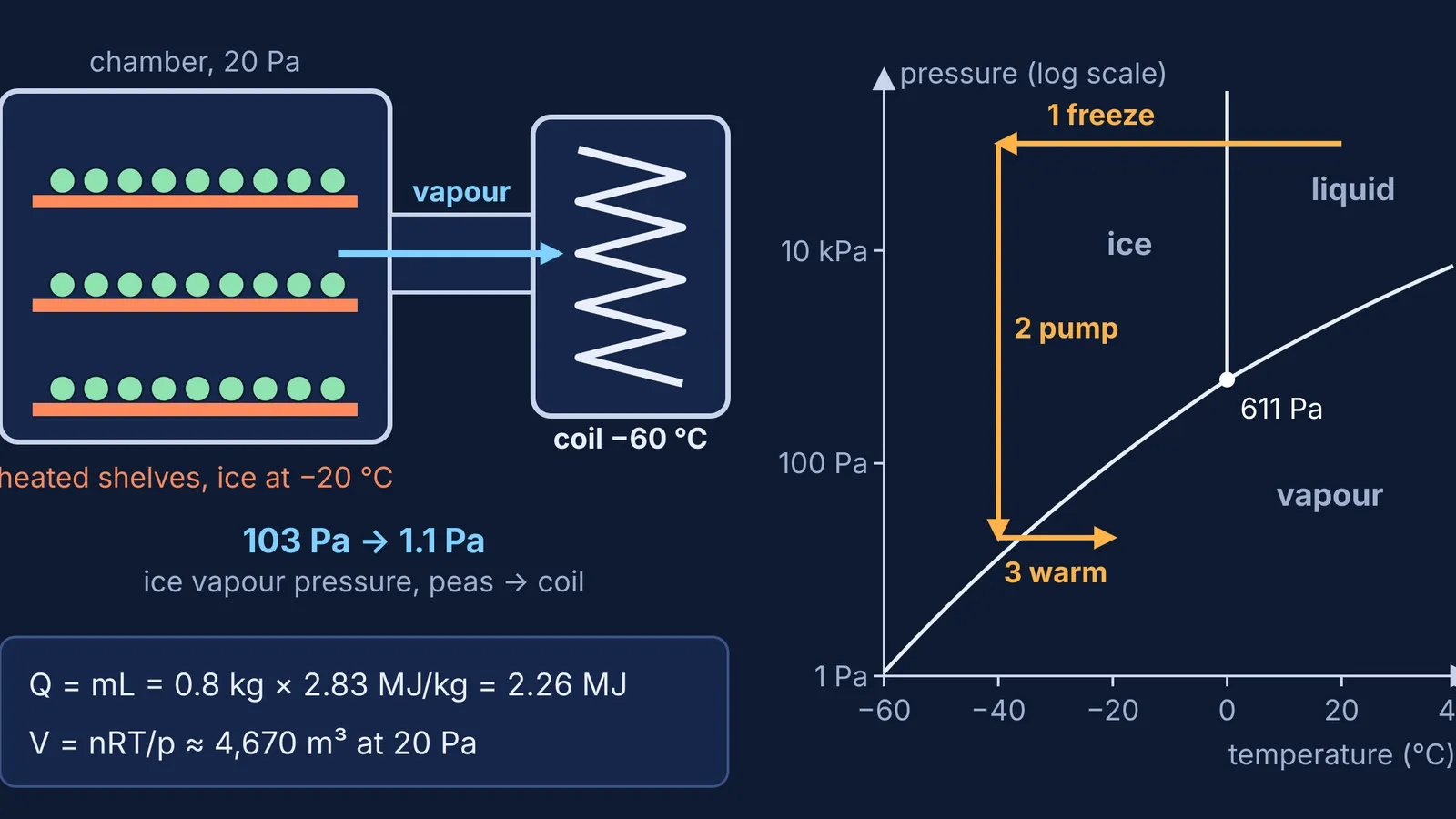
There are three steps, and each one is a move on the phase diagram of water.
Freeze the food at ordinary pressure, so its water becomes ice.
Lower the pressure in the chamber well below the triple-point pressure of water, 611 Pa. Below this pressure liquid water cannot exist, as explained in water's phase diagram and the triple point.
Warm the ice gently through heated shelves, so it crosses the sublimation curve and turns directly into vapour. This is primary drying. A secondary drying step at a higher temperature then removes water bound to the food.
A review of food freeze-drying by Nowak and Jakubczyk in Foods (2020) says the chamber pressure must stay below about 610 Pa, gives values around 63 to 124 Pa for plant materials and 5 to 20 Pa in pharmaceutical work, and lists studies that ran at 10 to 100 Pa. We use 20 Pa below.
Your freezer does the same thing very slowly and by accident. Freezer burn is ice subliming from food at atmospheric pressure over weeks. Freeze-drying speeds it up by removing the air and supplying heat.
Why does the ice not melt in the chamber?
On the phase diagram, the solid and vapour regions meet along the sublimation curve. Below 611 Pa there is no liquid region to pass through. At 20 Pa, the sublimation curve sits at about −36 °C. Ice warmer than that, at 20 Pa, turns to vapour.
The vapour pressures of ice used in this post come from the standard fit in Murphy and Koop's review of the vapour pressures of ice (2005):
0.01 °C: 611.7 Pa (the triple point)
−20 °C: 103 Pa
−36 °C: 20 Pa
−60 °C: 1.1 Pa
The shelves add heat, but the ice stays cold because sublimation takes heat away as fast as it comes in. It is the same balance that keeps a wet droplet at the wet-bulb temperature in a hot dryer. If the shelves add heat faster than sublimation can remove it, the ice warms, and food can shrink or collapse. That is why the heat supply is limited.
How much heat does it take to freeze-dry food? A worked example
Take an illustrative batch of 1 kg of frozen peas that is 80% water, held at −20 °C. The latent heat of sublimation of ice is about 2.83 MJ/kg; from the Murphy and Koop formula, it is 51.1 kJ/mol at −20 °C, which is 2.84 MJ/kg.
Mass of ice. m = 0.80 × 1 kg = 0.80 kg.
Heat needed. Q = mL_s = 0.80 × 2.83 × 10⁶ J = 2.26 × 10⁶ J, or 2.26 MJ.
Time from a 500 W shelf heater. t = Q/P = 2.26 × 10⁶ ÷ 500 = 4,530 s, about 75 minutes.
Check the units. J ÷ W = J ÷ (J/s) = s.
Seventy-five minutes is a floor, not a cycle time. Real cycles take many hours, and the table in the Nowak and Jakubczyk review lists runs of 18 to 72 hours. The vapour has to escape through the dry, porous layer that forms on the outside of each pea, and the heat must be kept low so the ice does not melt.
Sublimation costs more than evaporation because it does two jobs at once: melting (about 0.33 MJ/kg) and evaporating at a low temperature (about 2.50 MJ/kg at 0 °C), which add to about 2.83 MJ/kg.
Why can't a vacuum pump just remove the water vapour?
Now find the volume that vapour takes up at the chamber pressure, using the ideal gas law.
Moles of water. n = 0.80 kg ÷ 0.018015 kg/mol = 44.4 mol.
Volume at 20 Pa and −20 °C (253.15 K). V = nRT/p = 44.4 × 8.314 × 253.15 ÷ 20 ≈ 4,670 m³.
At 100 Pa. V ≈ 935 m³.
From less than one litre of ice (0.8 kg ÷ 917 kg/m³ = 0.87 L), you get nearly 4,700 cubic metres of vapour, about the volume of two Olympic swimming pools. To remove that in 10 hours, a pump would have to swallow 467 m³ of gas every hour, and then compress each cubic metre about 5,000 times (101,325 ÷ 20) to push it out at atmospheric pressure. That is impractical for every kilogram of food.
If you want to practise problems that mix the gas law with latent heat, the Fermi Problem Library has a step-by-step solver that explains the reasoning at each stage.
How does the cold condenser coil trap the vapour?
Vapour moves from where its pressure is high to where it is low. Above the ice in the peas, at −20 °C, the vapour pressure is about 103 Pa. On a coil at −60 °C, ice can hold only about 1.1 Pa of vapour above it. So vapour flows from the peas to the coil, a difference of roughly 100 times, and freezes onto it as frost. The 4,670 m³ of vapour shrinks back into under a litre of ice on the coil.
The Nowak and Jakubczyk review gives condenser surface temperatures of about −60 to −80 °C. The colder the coil, the lower its vapour pressure, and the faster it pulls vapour away. At −80 °C the vapour pressure of ice is only about 0.06 Pa.
This is the same physics as the frost that builds up inside your freezer: the coldest surface collects the ice.
Quick checklist
Freeze, lower the pressure below 611 Pa, then warm gently so ice sublimes without melting.
Heat: Q = mL_s; 0.8 kg of ice needs about 2.26 MJ, at least 75 minutes at 500 W.
Vapour volume: V = nRT/p; 0.8 kg at 20 Pa and −20 °C fills about 4,670 m³.
Vapour flows from ice at −20 °C (103 Pa) to a coil at −60 °C (1.1 Pa) and freezes there.
The pump removes air; the cold coil removes water.
Real cycles take hours, because vapour must escape through the dried layer.


