

On this page
At the foot of some dam spillways the concrete chute does not end flat. It curls upward into a lip, and in a flood the water leaves that lip as a huge jet, arcs through the air and crashes into the river far downstream. This curl is a flip bucket, also called a ski-jump or trajectory bucket. It is a projectile problem built in concrete, and you can work out where the jet lands with the same equations you use for a ball thrown off a cliff.
What is a flip bucket on a dam spillway?
Water coming down a spillway carries a huge amount of energy. Some dams destroy that energy in a concrete stilling basin with a hydraulic jump, which is explained in how a stilling basin burns off energy in a hydraulic jump. A flip bucket does something different: it throws the water away from the dam.
The US Bureau of Reclamation is blunt about this. In a 1959 paper, its engineers T. J. Rhone and A. J. Peterka wrote that flip buckets are not a substitute for energy dissipators, because a bucket "is inherently incapable of dissipating energy within itself". Its purpose is to throw the water downstream, where the damage to the riverbed, "which is usually certain to occur", does not endanger the dam, the powerhouse or the bucket itself (USBR, Improved tunnel-spillway flip buckets, 1959).
So the jet still digs a hole in the riverbed, called a scour hole or plunge pool. The flip bucket's job is to put that hole far enough from the dam's foundation that it cannot undermine it.
How fast does the water leave the lip?
If there were no friction, the water would leave the lip with the speed of a body falling through the full height H from the reservoir surface to the lip: v = √(2gH). On a real chute, friction and turbulence take some of that energy, so only part of the head is left as speed at the bucket. That part is called the velocity head, H′, and v = √(2gH′).
The USBR paper gives measured values for tunnel spillways: H′ was about 61% of the total head at low flows and about 75% at maximum discharge (USBR 1959). Those were tunnel spillways, so treat 75% as a reasonable illustrative value for a chute, not a design rule. Taking H′ = 0.75H means the water keeps √0.75 = 0.87 of its frictionless speed.
The same paper gives a sense of scale. At Flaming Gorge Dam the design flow was 28,800 cubic feet per second, leaving the tunnel at about 140 feet per second, and the authors put the energy in the jet at about 1,000,000 horsepower. You can check that: 28,800 ft³/s is 816 m³/s and 140 ft/s is 42.7 m/s, so the kinetic energy carried per second is ½ × 1000 × 816 × 42.7² = 742 MW, which is about 996,000 horsepower.
How far does a flip bucket throw the water?
Here is a fully worked example with illustrative round numbers.
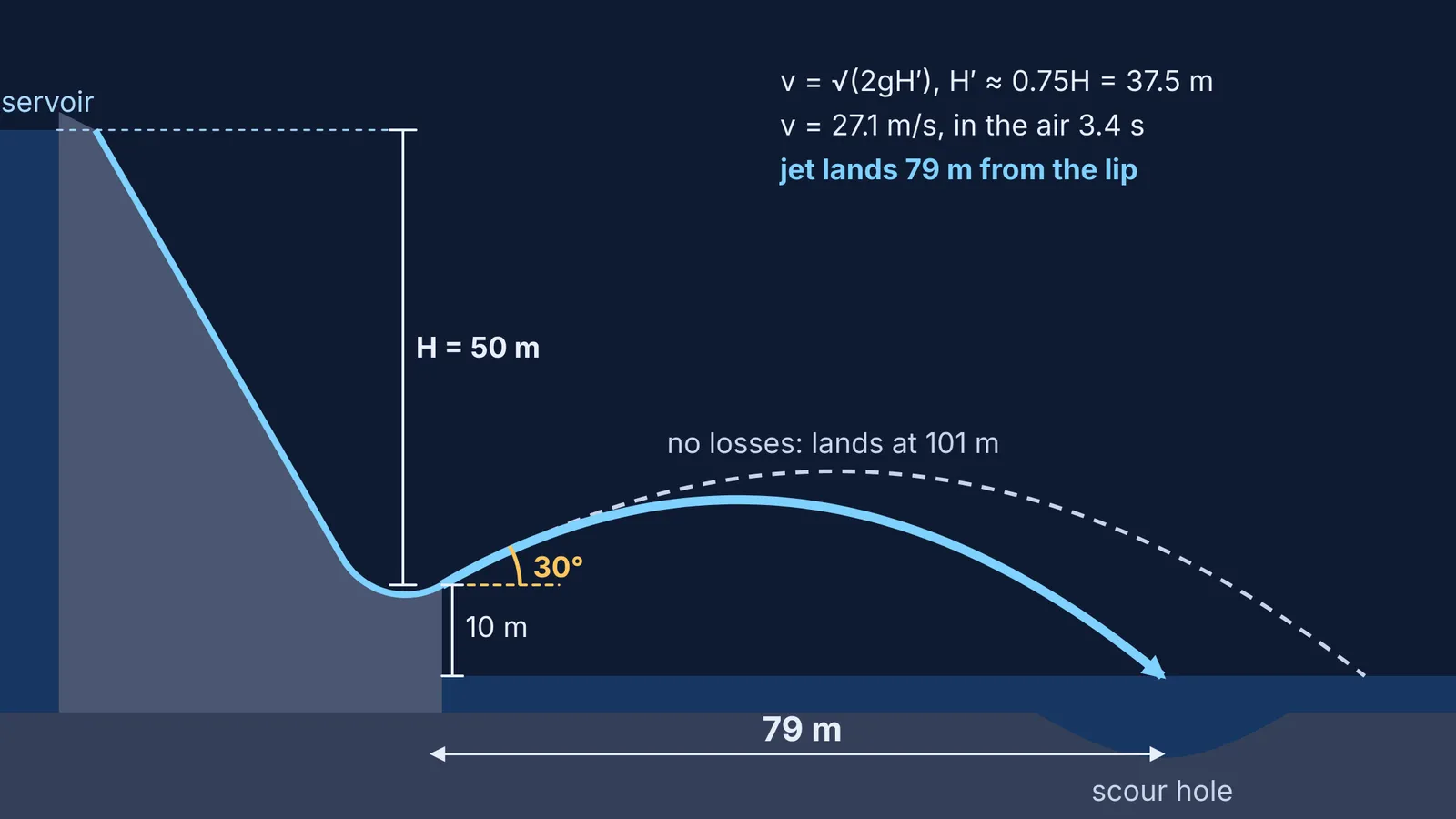
Given: reservoir surface H = 50 m above the lip, lip 10 m above the tailwater (the river surface below), lip angle 30°, H′ = 0.75H, g = 9.81 m/s².
Velocity head. H′ = 0.75 × 50 = 37.5 m.
Exit speed. v = √(2 × 9.81 × 37.5) = 27.1 m/s.
Components. vₓ = 27.1 cos 30° = 23.5 m/s; v_y = 27.1 sin 30° = 13.6 m/s upward.
Rise above the lip. v_y² / 2g = 13.6² / (2 × 9.81) = 9.4 m.
Time in the air. Taking up as positive, the jet lands when y = −10 m: −10 = 13.6t − 4.905t². The positive root is t = 3.37 s.
Throw distance. x = vₓt = 23.5 × 3.37 = 79 m from the lip.
Landing speed. √(v² + 2gh) = √(27.1² + 2 × 9.81 × 10) = 30.5 m/s, at about 40° below the horizontal.
Checks. Units: m/s × s = m. With no losses (H′ = 50 m, v = 31.3 m/s) the same steps give 101 m, so friction on the chute costs about 22 m of throw. If the lip were level with the tailwater, the range would be v² sin 2θ / g = 2H′ sin 2θ = 65 m; the extra 10 m of fall adds 14 m.
The steps 4 to 6 are the standard projectile from a height, worked in more detail in projectile from a building at an angle.
Why is the lip not set at 45°?
In a vacuum a steeper lip would throw a little further. In our example, 35° gives 83 m and 45° gives 84 m, against 79 m at 30°. Real designs stay lower. The USBR paper says bucket lip angles "are usually constructed from between 15° and 35°". Below 15° the jet does not get enough lift to clear the bucket structure, and little is gained by going beyond 35° (USBR 1959).
The reason is air. The same paper notes that the steeper the angle, the more the jet is broken up and slowed by air resistance. Both effects make the jet enter the river more steeply, and a steep jet with a large vertical velocity tends to dig into the channel bottom. A flatter jet keeps more forward speed.
So the vacuum calculation is an upper limit. A real jet spreads, takes in air and breaks into spray, and lands shorter than the projectile answer. The USBR authors say the spreading and trajectory of a given bucket can only be found reliably by testing a scale model, which is how real buckets are designed.
Where does the energy go if the bucket does not destroy it?
Flying through the air destroys very little energy. The jet in our example lands at 30.5 m/s, faster than it left the lip, because it fell another 10 m. Almost all the energy is given up where the jet hits the water and the rock: in turbulence in the plunge pool, in the scour hole, and finally as heat. That is why the landing point matters so much, and why the bucket is aimed to drop the jet where the riverbed can take the beating.
The head that drives this jet is the same head a hydropower station uses, as worked for two Indian dams in how a dam makes electricity at Bhakra and Tehri. A spillway in flood is that energy being thrown away on purpose.
If trajectories are easier for you to see than read, the Simulation Lab has interactive simulations for ideas like this one.
Quick checklist
A flip bucket throws spillway water clear of the dam; it does not destroy the energy.
Exit speed is v = √(2gH′), where H′ is the head left after chute losses (about 61% to 75% of H in USBR's tunnel data).
Worked example: 27.1 m/s at 30° from 10 m up lands 79 m away; with no losses, 101 m.
From a height, maximum range comes at an angle below 45°.
Real lip angles are about 15° to 35°, because steep jets break up and dig into the riverbed.
Air, spreading and break-up make real jets land short of the projectile answer.


