

On this page
A flea is nearly a thousand times shorter than you, yet it jumps several centimetres up to about 10 cm high, while a standing jump might lift your centre of mass by about 40 cm. On a size-for-size basis that looks like a superpower. The physics says the opposite: if energy per kilogram is about the same, all jumpers should reach roughly the same height. The flea's real problem is not height. It is time. It has to finish its whole push-off in about a millisecond, and no muscle can do that directly, so the flea uses a spring.
Why should jump height not depend on body size?
The work a muscle can do in one contraction is roughly force × shortening distance. Force goes with the muscle's cross-section (length²) and shortening distance with its length, so the work goes as length³, which is the same as its volume, and so its mass. A bigger animal has proportionally more muscle, so it has roughly the same jumping energy per kilogram, call it e.
If all of that energy becomes height, mgh = me, so
h = e/g
The mass cancels. To first order, a jump's height does not depend on size at all. That is why a flea does not jump a thousand times lower than you, and also why a flea scaled up to your size would not clear a building. It would jump to about the same height you do.
This is a different question from strength. How a muscle's force compares with body weight as size changes is the square–cube argument in Galileo's square–cube law, and the ant version is in how ants lift many times their weight. Here only the energy per kilogram matters.
How close are real jumpers to the same height?
The rule is rough, but the spread is small compared with the spread in size. Bennet-Clark and Alder fired insects from a spring gun to measure how much height they lose to air drag. In their 1979 study they report that most fleas jump to about 0.1 m, losing about 20% of their energy to air, while locusts jump to about 0.35 m and lose less than 10%. Drag matters most for the smallest jumpers, because a small body has more frontal area for each milligram.
Correcting for those losses, the take-off energy per kilogram is about g × 0.1/0.8 ≈ 1.2 J/kg for a flea and about g × 0.35/0.9 ≈ 3.8 J/kg for a locust. For a person whose standing jump raises the centre of mass by 0.40 m (an illustrative round value), it is g × 0.40 ≈ 3.9 J/kg. Body lengths differ by a factor of about a thousand; jump heights differ by a factor of about four.
How fast must a flea push off?
Height fixes the take-off speed: v = √(2gh). What size changes is the distance over which the legs can push, s. With a steady push over s,
acceleration a = v²/(2s)
take-off time t = 2s/v
A short leg means a tiny s, so a huge acceleration and a very short push.
Worked example: a person and a rabbit flea
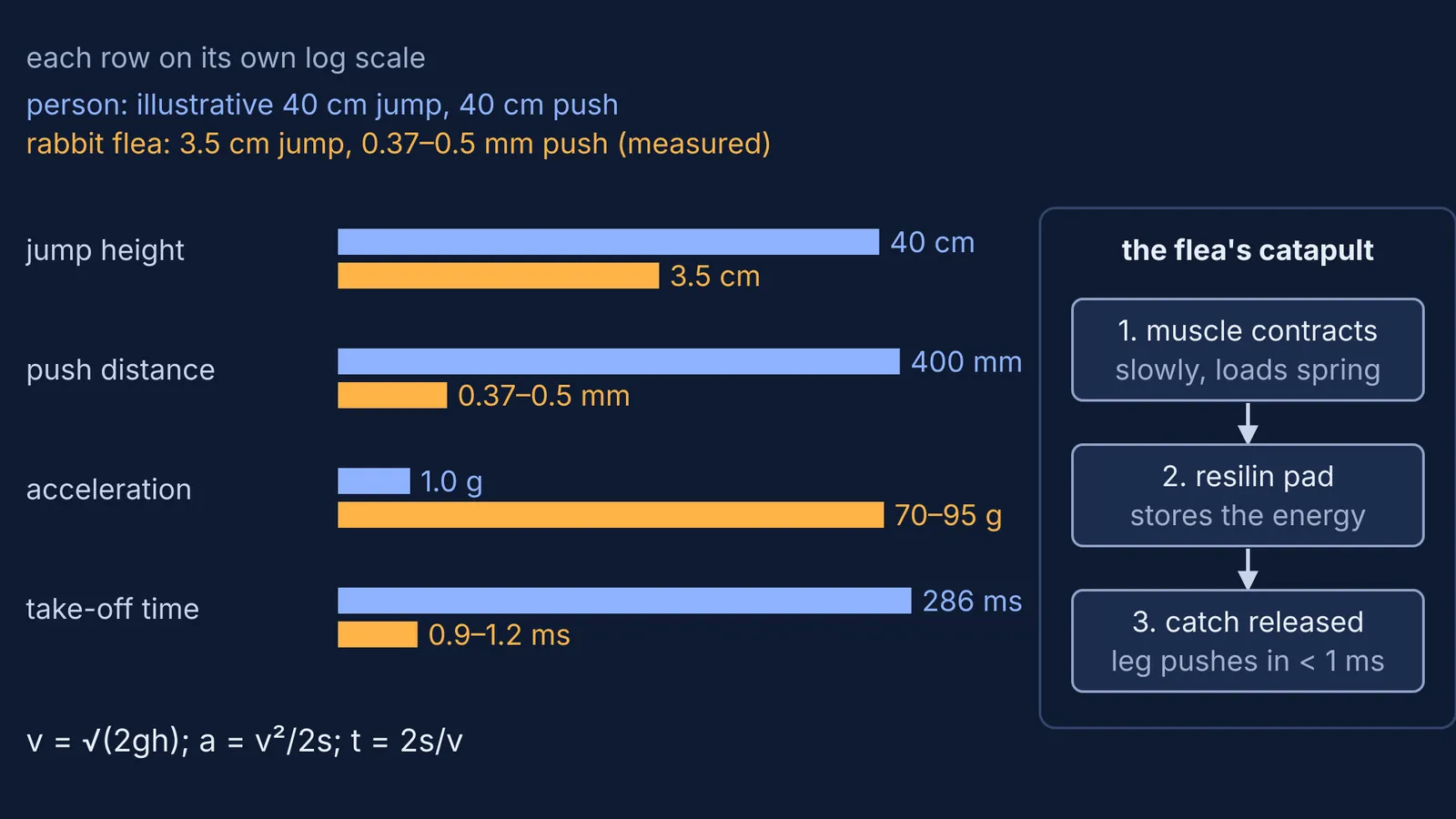
The flea figures come from Bennet-Clark and Lucey's study of the rabbit flea, Spilopsyllus cuniculi. Their 1967 paper reports a jump 3.5 cm high that needs 2.25 erg (2.25 × 10⁻⁷ J), delivered in 0.75–1.0 ms over a push distance of 0.37–0.5 mm. The person's figures are illustrative: a 40 cm jump with 40 cm of leg extension.
Take-off speed. Person: v = √(2 × 9.81 × 0.40) = 2.80 m/s. Flea: v = √(2 × 9.81 × 0.035) = 0.83 m/s (in a vacuum; drag means the real speed is a little higher).
Acceleration. Person: a = 2.80²/(2 × 0.40) = 9.8 m/s², about 1 g. Flea, s = 0.5 mm: a = 0.83²/(2 × 0.0005) = 687 m/s², about 70 g. With s = 0.37 mm it is 928 m/s², about 95 g.
Take-off time. Person: t = 2 × 0.40/2.80 = 0.29 s. Flea: t = 2 × 0.0005/0.83 = 1.2 ms, or 0.89 ms for the shorter push. That matches the 0.75–1.0 ms measured on film.
Power per kilogram. Kinetic energy per kilogram at take-off is gh. Divided by the push time, that is 9.81 × 0.40/0.29 = 14 W/kg for the person and 9.81 × 0.035/0.001 = 343 W/kg for the flea, about 25 times more.
Check the units: v²/s is (m/s)²/m = m/s², an acceleration, and s/v is a time. Note that for the person a = g × h/s, so when the push distance equals the jump height, the push is exactly 1 g.
Why does a flea need a spring instead of just muscle?
The flea's muscle can supply the energy; it just cannot supply it fast enough. Bennet-Clark and Lucey state that delivering the energy in under a millisecond over half a millimetre "is not compatible with direct muscular action". Their solution, from high-speed film and operations on live fleas, is a catapult:
Load slowly. The main jumping muscle contracts while its tendon sits over-centre at the leg joint, which works as a catch and holds the leg still. Its work goes into a pad of resilin, a rubber-like protein, in the thorax. The paper gives the muscle about 1.96 erg on each side and the pad room for about 4 erg on each side.
Release fast. A second muscle pulls the tendon off the over-centre position. The pad recoils and drives the hind legs down in under a millisecond.
The spring does not create energy. The muscle still does all the work; the spring just lets the muscle take its time and then hands the energy to the legs very quickly. Power is energy divided by time, so cutting the time from many milliseconds to one multiplies the power. Archers and catapults use the same trick. A later high-speed study by Sutton and Burrows, reported by the University of Cambridge, measured take-off speeds as high as 1.9 m/s.
For a related calculation with g changed instead of size, see how high you could jump on the Moon. To practise take-off problems with v², a and t, try the Fermi Problem Library, which has a step-by-step solver that explains the reasoning.
Quick checklist
Muscle energy grows with body mass, so h = e/g is roughly the same for all sizes.
Real heights: fleas about 0.1 m, locusts about 0.35 m; drag hurts small jumpers most.
Take-off speed v = √(2gh); acceleration a = v²/2s; time t = 2s/v.
A rabbit flea's 0.37–0.5 mm push means about 70–95 g for about 1 ms.
Muscle cannot act that fast, so the flea loads a resilin spring and releases it.
A spring stores energy; it does not add any.


