On this page
Watch ants dragging a dead beetle home and it looks like a superpower. Part of the story is good engineering. The bigger part is plain geometry: small bodies get more strength for every gram they carry.
How can ants lift many times their own weight?
Asian weaver ants (*Oecophylla smaragdina*) can carry more than 100 times their own body weight while upside down on a smooth surface, according to Popular Science's report on a 2010 BBSRC photo competition winner. These are the ants that stitch leaves into nests with silk from their larvae. Their range runs from India through Indonesia and the Philippines to northern Australia, and mango is among the trees they nest in.
Engineers at Ohio State tested a different ant, the Allegheny mound ant. Their 2014 study in the Journal of Biomechanics found that the ant's neck joint can withstand about 5,000 times the ant's weight. The university's news release adds that the neck started to stretch at 350 times body weight and ruptured at 3,400 to 5,000 times. The ants were spun in a centrifuge, so this measures what the joint survives, not what an ant lifts. Ants are well built, but size does most of the work.
Why does muscle strength depend on area, not volume?
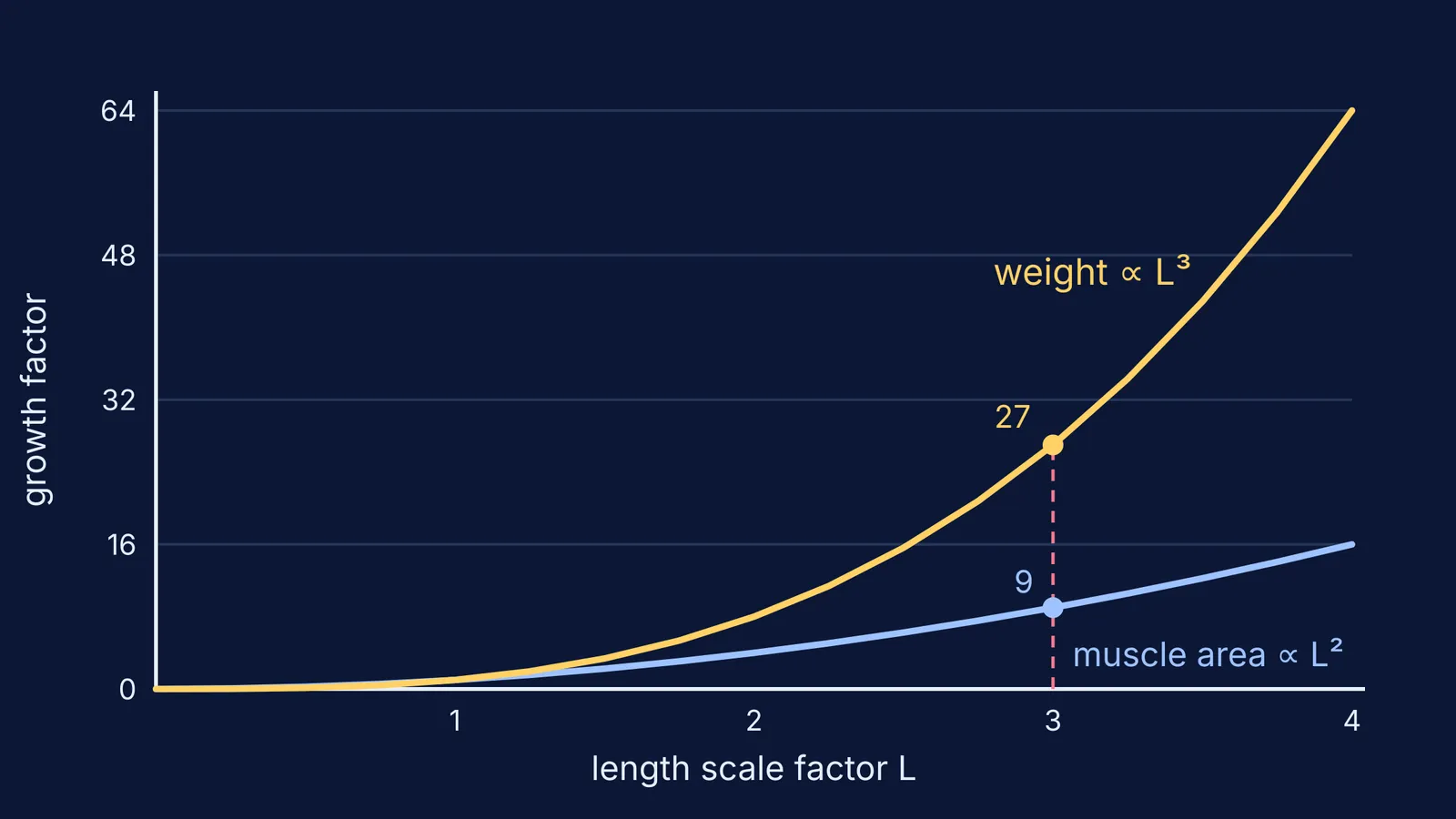
The maximum force a muscle can produce is directly proportional to its physiological cross-sectional area, as researchers state in a 2022 Journal of Anatomy paper. A muscle is a bundle of fibres pulling side by side: more fibres across means more pull, while longer fibres add no extra force.
Weight is different. It depends on how much body there is, so it grows with volume.
Now scale a body up by a length factor L. Any area grows as L², and any volume grows as L³. J. B. S. Haldane put it neatly in his essay On Being the Right Size: "Divide an animal's length, breadth, and height each by ten; its weight is reduced to a thousandth, but its surface only to a hundredth."
Divide strength by weight and you get L² ÷ L³ = 1/L. Halve the size and strength per kilogram doubles. Shrink by ten and it rises ten times.
What if an ant were as big as a person?
Here is a worked example you can redo on paper. Weaver ant workers are 5 to 7 mm long, and major workers 8 to 10 mm. For easy numbers, imagine a 1 cm ant blown up to 1.7 m, the height of a person. That is a length factor of L = 170.
Muscle cross-section, and so strength, grows by 170² = 28,900 times.
Volume, and so weight, grows by 170³ = 4,913,000 times.
Strength-to-weight changes by 28,900 ÷ 4,913,000 = 1/170.
An ant that carries 100 times its weight at normal size could now carry only 100 ÷ 170, about 0.6 times its weight.
The giant ant couldn't even hold up its own body. Ohio State's news release makes the same point: a human-sized ant would fail because its weight rises with dimensions cubed while muscle strength rises only with dimensions squared. The flip side is that you are not weak. You are just big.
Where else does the square-cube rule show up?
Bones. In Haldane's essay, giants ten times as tall as a man have bones with only a hundred times the cross-section, so every square inch of bone bears ten times the load and they break their thighs at every step. A big animal can instead make its legs short and thick, like a rhinoceros.
Wires and cables. A wire's breaking load depends on its cross-sectional area, not its length, for the same reason a muscle's pull does.
Lungs. Your body packs a huge area into a small volume, which is why alveoli increase surface area for rapid gas exchange.
Pure maths. See what happens to a cube's area and volume when you double its side.
How do you solve any "scale it up" question?
Use this four-step check in board exams, JEE Main or olympiad problems:
Name the length factor. Write k = new length ÷ old length.
Sort every quantity. Lengths go as k. Areas go as k²: muscle strength, bone strength, a wire's breaking load, skin area for losing heat. Volumes go as k³: mass, weight, heat produced by the body.
Write the ratio as a power of k. Strength ÷ weight is k² ÷ k³ = 1/k. Surface ÷ volume is also 1/k.
Sanity-check the direction. Bigger should mean relatively weaker and slower to cool. If your answer says a bigger animal is relatively stronger, you have flipped a power.
If L² against L³ still feels abstract, the Fermi Simulation Lab has interactive simulations for ideas that are easier to see than to read. And if your scaling answers keep coming out upside down, the Fermi Problem Library has worked problems with a step-by-step solver that explains the reasoning rather than just printing an answer.
Next time you see an ant hauling a crumb, you will know what you are looking at: L² beating L³.