

On this page
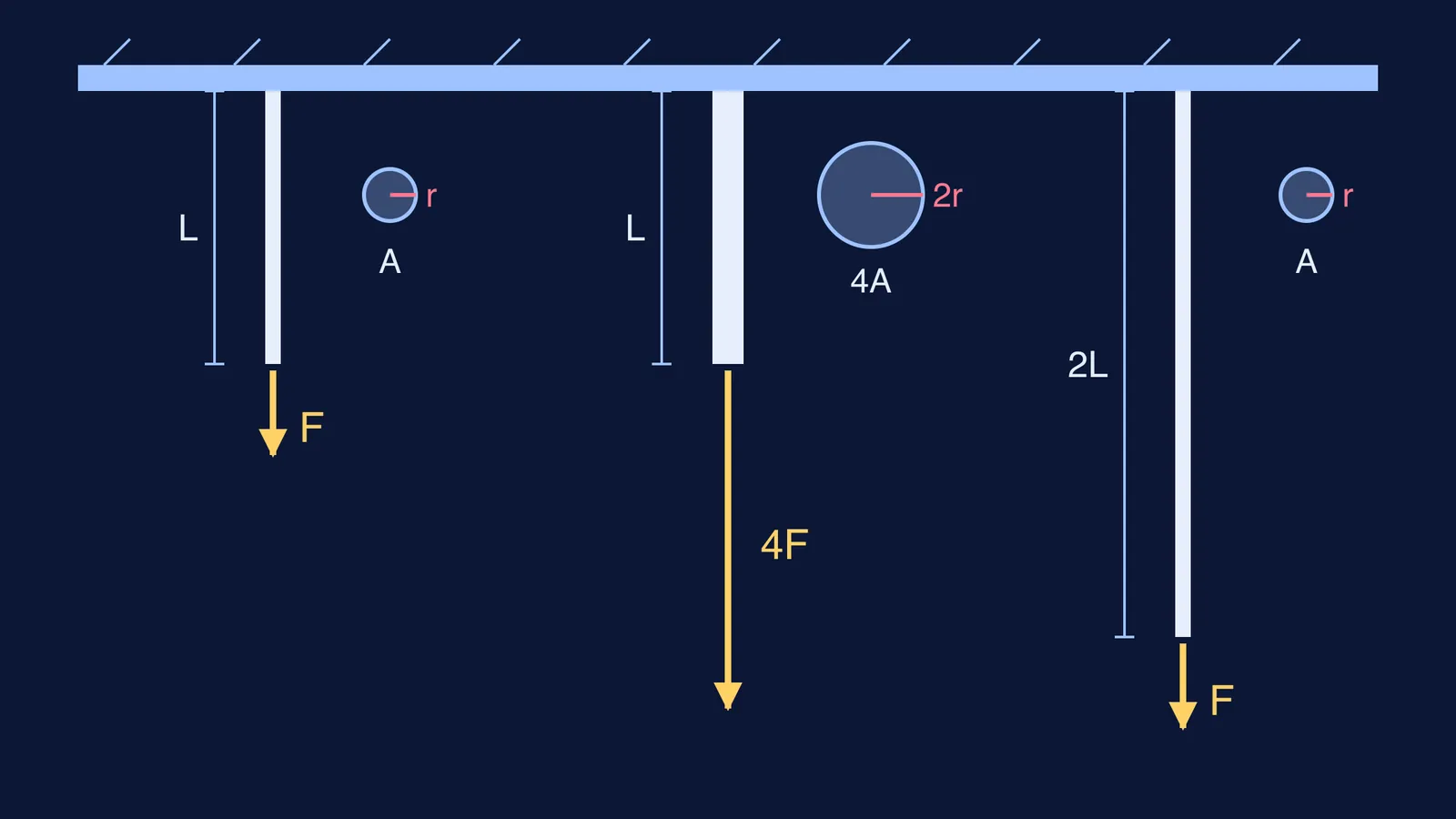
Hang a load from a steel wire and keep adding weight until it snaps. Which holds more: a thicker wire or a longer one? It is a common trap in Class 11 tests, JEE Main and NEET-UG. The breaking force depends on the wire's material and its cross-sectional area, not on its length.
What decides the breaking load of a wire?
Stress is the restoring force per unit area inside a body, so for a wire pulled by a force F, stress = F/A, where A is the area of cross-section (NCERT Class 11 Physics, Chapter 8). The same chapter calls the highest point on a metal's stress-strain curve its ultimate tensile strength, beyond which the wire goes on to fracture.
That breaking stress belongs to the material, not to the particular piece of wire. The ultimate tensile strength of a material is an intensive property, so its value does not depend on the size of the test specimen (Wikipedia: Ultimate tensile strength), though it can still vary with specimen preparation, surface defects and temperature. NCERT's Table 8.1 lists the ultimate strength of steel as about 400 × 10^6 N/m² and of aluminium as about 110 × 10^6 N/m².
So the breaking load is the breaking stress times the area:
Breaking load F = σ × A = σ × πr²
Doubling the radius (or the diameter) multiplies the area, and so the load, by 4
Tripling the radius multiplies it by 9
Why does length not change the breaking force?
Length does not appear in F = σA. A longer wire does stretch more under the same load, because extension ΔL = FL/(AY) grows with L (NCERT, equation 8.8). But every cross-section along the wire carries the same force over the same area. The stress is the same at every point, so it reaches the breaking value at the same load whether the wire is 1 m or 10 m long. Our post on what happens to extension when a wire's length and radius are doubled works through the extension side.
Worked example: one steel wire, three sizes
Take steel with a breaking stress of 400 × 10^6 N/m², the value in NCERT Table 8.1, and use g = 9.8 m/s².
Radius 1 mm, length 2 m. A = π × (1 × 10^-3 m)² = 3.14 × 10^-6 m². Breaking load = 400 × 10^6 × 3.14 × 10^-6 ≈ 1.26 × 10^3 N, about the weight of 128 kg.
Radius 2 mm, length 2 m. A = 1.26 × 10^-5 m², four times larger. Breaking load ≈ 5.03 × 10^3 N, about the weight of 513 kg: four times the first wire.
Radius 1 mm, length 4 m. Same area as wire 1, so the breaking load is still about 1.26 × 10^3 N. Within the elastic limit it stretches twice as much under the same load, but it holds no more.
NCERT uses the same A = F/σ idea in reverse to size a crane rope, though it designs against permanent deformation (yield strength) rather than breaking. To lift 10 tonnes with mild steel of yield strength about 300 × 10^6 N/m², the rope needs an area of at least 3.3 × 10^-4 m², a radius of about 1 cm; with a safety margin of about ten times the load, the recommended radius is about 3 cm (NCERT, section 8.6). Notice that ten times the load needs ten times the area, but only about √10 ≈ 3.2 times the radius.
When does length matter after all?
Length enters only when the wire's own weight is part of the load. A wire hanging under its own weight feels the greatest stress at the top, equal to ρgL, so it snaps when L = σ/(ρg), and the area cancels out. For steel, with density 7860 kg/m³ and breaking stress 400 × 10^6 N/m² from NCERT Table 8.1, that limit works out to about 5.2 km. Our explainer on the maximum length of a wire before it breaks under its own weight covers that case step by step.
How do you solve a breaking-load question fast?
Underline what is fixed: the material (so σ is fixed) or the wire's size.
Write F = σπr² before touching any numbers.
Convert diameter to radius, and mm to m (1 mm² = 10^-6 m²).
For ratios, square the radius ratio: F₂/F₁ = (r₂/r₁)².
Ask whether the wire's own weight counts. If it does not, ignore length.
If you keep reaching for the wrong formula, the Fermi Problem Library has worked problems with a step-by-step solver that explains the reasoning rather than printing an answer. To rebuild stress, strain and Young's modulus from the start, the Fermi Concept Library gives each concept its own lesson and its place in the map.
Next, see why physics calls steel stiffer in why steel is more elastic than rubber.


