

On this page
Keep making a hanging wire longer and at some length it snaps under its own weight. This Class 11 and JEE question has two follow-ups that catch students: why thickness does not matter, and what changes with a load at the bottom.
Why is the stress greatest at the top of a hanging wire?
NCERT's Class 11 chapter on mechanical properties of solids defines stress as the restoring force per unit area, F/A, measured in N/m² or pascal (NCERT Physics Part 2, Chapter 8). If you want the idea behind that definition first, our post on whether stress is the same as pressure in solids covers it.
Pick a cross-section at height y above the lower end. It holds up only the wire below it, of mass ρAy (ρ is density, A the cross-sectional area), so the tension there is T = ρAyg.
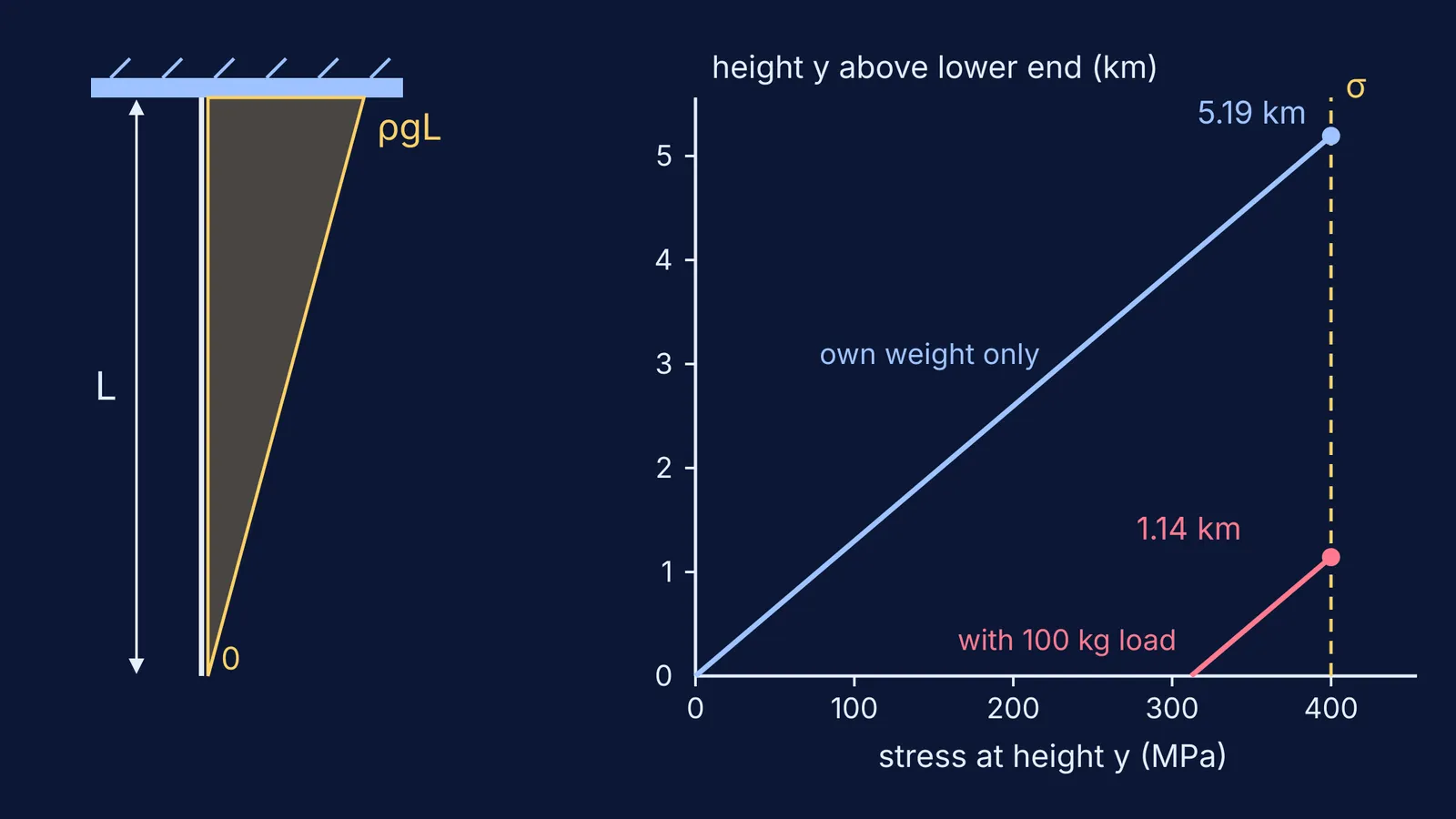
Divide by the area and the stress there is σ = ρgy. It grows from zero at the free end to ρgL at the support, which is why a hanging wire breaks at the top.
What is the maximum length of a wire before it breaks?
The breaking stress (or ultimate stress) is the stress at the fracture point (OpenStax University Physics, Section 12.4). The wire fails when the stress at the top reaches it:
ρgL = σ, so L(max) = σ / (ρg).
Putting in NCERT's Table 8.1 values (NCERT Physics Part 2, Chapter 8) with g = 9.8 m/s²:
Steel: ultimate strength 4.00 × 10^8 N/m², density 7860 kg/m³, so L = 4.00 × 10^8 / (7860 × 9.8) ≈ 5190 m, about 5.2 km.
Copper: 4.00 × 10^8 N/m² and 8890 kg/m³, so L ≈ 4590 m.
Aluminium: 1.10 × 10^8 N/m² and 2710 kg/m³, so L ≈ 4140 m.
If the question asks for the longest wire that does not stretch permanently, use the elastic limit instead: NCERT's yield strength for steel, 2.50 × 10^8 N/m², gives about 3250 m. Real steels vary too; OpenStax notes steel's ultimate stress can reach 20.0 × 10^8 Pa depending on the type (OpenStax University Physics, Section 12.4). Always use the σ the question gives.
Why does the answer not depend on the area of the wire?
Double the area and you double the weight hanging below the top cross-section. You also double the area that carries it. The two cancel, so the stress at the top stays ρgL whatever the thickness.
The answer depends on the material alone, through the ratio σ/ρ. That is why copper and steel above have the same breaking stress but different maximum lengths: copper is denser.
What if a load hangs from the bottom of the wire?
Now the top carries the load Mg as well as the wire's weight ρALg, so:
Mg/A + ρgL = σ, so L(max) = σ/(ρg) − M/(ρA).
The area no longer cancels: a thicker wire spreads the load, leaving more stress for its own weight. For two masses on one wire, see our walkthrough of tension and extension in a wire supporting two masses.
Worked example: steel wire with a 100 kg load
Take a steel wire of radius 1.0 mm carrying 100 kg, with NCERT's ultimate strength of 4.00 × 10^8 N/m² and density of 7860 kg/m³ (NCERT Physics Part 2, Chapter 8).
Area: A = π(1.0 × 10^-3)² ≈ 3.14 × 10^-6 m².
Stress from the load alone: Mg/A = 980 / (3.14 × 10^-6) ≈ 3.12 × 10^8 N/m². This is below 4.00 × 10^8, so the wire can hold the load at all.
Stress left for the wire's own weight: 4.00 × 10^8 − 3.12 × 10^8 = 0.88 × 10^8 N/m².
Length: L = 0.88 × 10^8 / (7860 × 9.8) ≈ 1140 m.
Double the radius to 2.0 mm and the load's stress falls to a quarter, about 0.78 × 10^8 N/m². The maximum length rises to about 4180 m.
How do you solve any hanging-wire question?
Find where the tension is largest: for a hanging wire, the top.
Write that tension as the weight of everything below, wire and load.
Divide by the area to get the stress.
Set it equal to the limit the question names: breaking stress, elastic limit, or breaking stress over a safety factor.
See whether A cancels. If it does not, the answer depends on thickness, as with the thickness of a crane rope needed to lift a load safely.
If step 2 is where you get stuck, the Fermi Problem Library has worked problems with a step-by-step solver that explains the reasoning rather than printing an answer. If stress itself feels shaky, the Fermi Concept Library gives each concept its own lesson and its place in the map.


