

On this page
In short
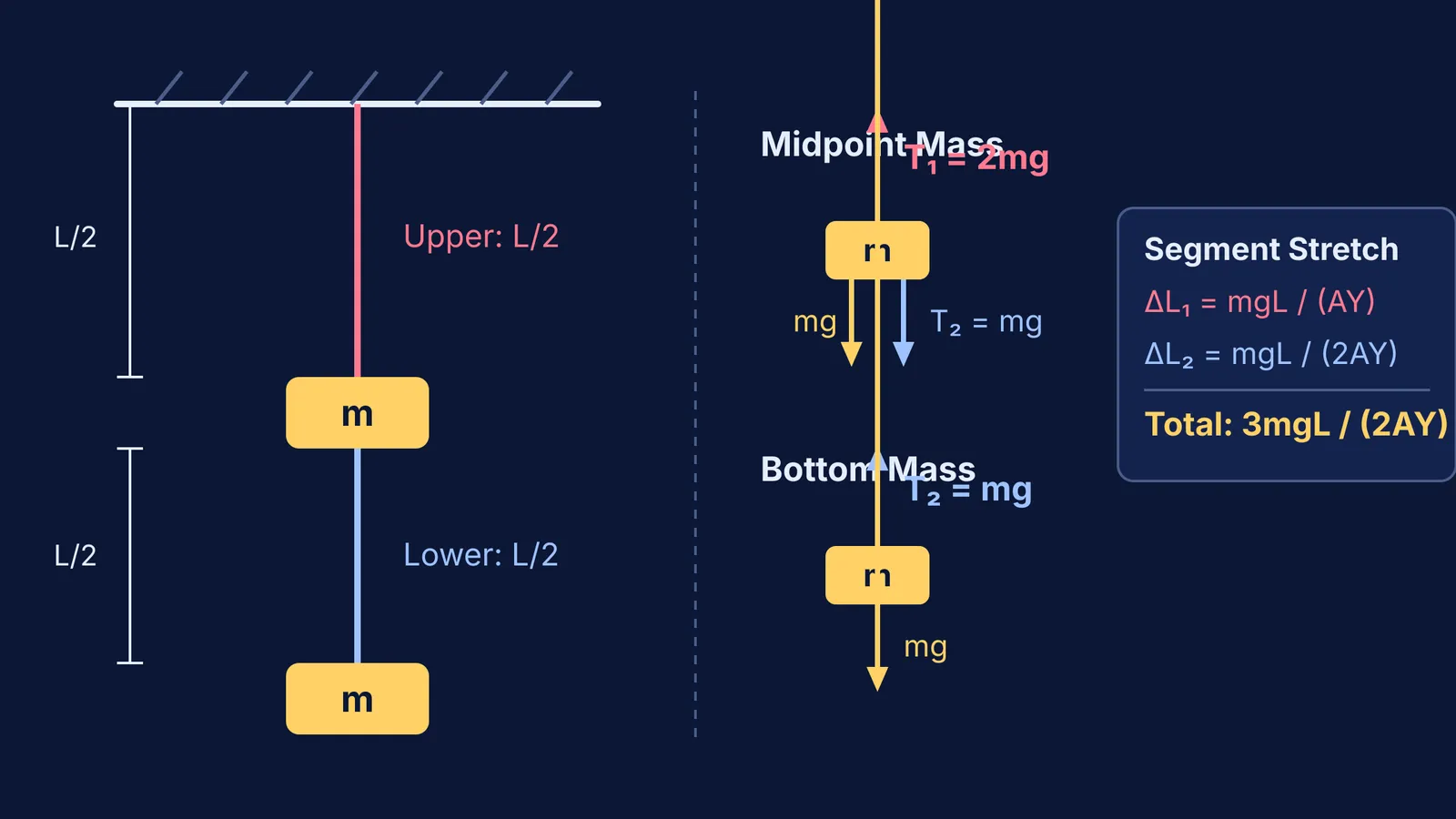
When a wire of length L supports identical masses m at its midpoint and lower end, the upper half experiences double the tension of the lower half. Because each segment stretches independently according to Hooke's law, the total elongation is 3mgL/(2AY).
Suspend an elastic wire from a ceiling, attach one mass halfway down, and hang an identical mass at the bottom tip. If you ask physics students how much the wire stretches, many will calculate the extension as if a single load of 2m hung from the bottom, or assume that each half carries the same tension.
Because tension is an internal restoring force transmitted across cross-sections rather than an intrinsic constant of the wire, each section carries a different load. To find how much the wire elongates, you must treat each segment as an independent elastic element and calculate its stretch from the forces acting on it.
Why is tension different in each segment of the wire?
Consider the system in static equilibrium. The wire has original length L, uniform cross-sectional area A, Young's modulus Y, and negligible mass compared to the suspended loads. Mass m₁ hangs at the midpoint (distance L/2 from the ceiling), and mass m₂ hangs at the lower free end.
An imaginary cut through the lower segment reveals that it supports only mass m₂. Newton's first law requires the upward tension T₂ to balance the downward pull of gravity: T₂ = m₂g
An imaginary cut through the upper segment reveals that it supports both the middle mass m₁ and the entire lower assembly carrying m₂. Upward tension T₁ must balance their combined weight: T₁ = (m₁ + m₂)g
When the two masses are identical (m₁ = m₂ = m), T₂ = mg while T₁ = 2mg. The upper half bears double the tension of the lower half because it supports the entire assembly.
In physics education research, David E. Brown and John Clement demonstrated that students often struggle to recognize passive restoring forces in stationary structures. Learners frequently fail to see that a wire adjusts its internal tensile stress locally, behaving like coupled springs where each section responds strictly to the weight below it.
How do you calculate the total extension of the wire?
Within the elastic limit, materials obey Hooke's law. According to OpenStax University Physics, tensile stress is force per unit area (σ = F / A), and tensile strain is the fractional change in length (ε = ΔL / L₀). Young's modulus Y is their ratio, giving the elongation formula: ΔL = (F × L₀) / (A × Y)
As detailed in Chapter 8 of the NCERT Class 11 Physics textbook, this relationship applies across every individual segment of a uniform solid. For our wire with two segments of unstretched length L/2:
Upper segment extension: ΔL₁ = (T₁ × (L/2)) / (AY) = (m₁ + m₂)gL / (2AY).
Lower segment extension: ΔL₂ = (T₂ × (L/2)) / (AY) = m₂gL / (2AY).
The total extension is the sum of both segment extensions: ΔL = ΔL₁ + ΔL₂ = (m₁ + 2m₂)gL / (2AY)
When both masses are equal (m₁ = m₂ = m), ΔL₁ = mgL / (AY) and ΔL₂ = mgL / (2AY), giving ΔL = 3mgL / (2AY). This additive property connects directly to standard elasticity problems and calculations of elastic potential energy in a stretched wire.
What happens in a worked numerical example?
Consider a vertical steel wire with length L = 2.0 m (each segment L/2 = 1.0 m), cross-sectional area A = 3.1416 × 10⁻⁶ m² (radius r = 1.0 mm), and Young's modulus Y = 20 × 10¹⁰ Pa (from OpenStax Table 12.1). Two 10 kg masses hang at the midpoint and bottom, with g = 9.8 m/s².
Segment tensions are T₂ = 10 × 9.8 = 98 N and T₁ = 20 × 9.8 = 196 N.
The extensions for each 1.0 m segment are:
ΔL₁ = (196 × 1.0) / (3.1416 × 10⁻⁶ × 2.0 × 10¹¹) ≈ 0.312 mm
ΔL₂ = (98 × 1.0) / (3.1416 × 10⁻⁶ × 2.0 × 10¹¹) ≈ 0.156 mm
The true total elongation is ΔL = 0.312 mm + 0.156 mm = 0.468 mm.
A student who naively treats the loads as a single 20 kg mass over the entire 2.0 m wire computes ΔL = (196 × 2.0) / (AY) ≈ 0.624 mm, overestimating the true stretch by 33.3%. Assuming each mass only stretches its adjacent half under 98 N yields 0.312 mm, underestimating the stretch by 33.3%.
How should students approach multi-load elasticity problems?
When solving problems with multiple loads, follow this three-step framework:
Segment the wire: Identify distinct sections between supports and load attachment points.
Find local tension: Make a virtual cut through each segment and sum all downward forces below it.
Sum individual extensions: Apply ΔL = FL₀ / (AY) to each segment and add the elongations.
If the wire has non-negligible mass, tension varies continuously along its length, which requires integrating the local weight as shown in a rod stretching under its own weight.
When students get stuck setting up free-body diagrams across multiple segments, Fermi's AI tutor notices where a student is stuck, and decides whether to explain, ask, or show, such as drawing the figure. For dedicated practice on segmented elastic rods, the Fermi Problem Library provides worked problems with a step-by-step solver that explains the reasoning rather than printing an answer. Students can also review core stress-strain definitions in the Fermi Concept Library, which organizes every concept in physics with its own lesson and place in the map.


