

On this page
When you look at a towering crane lifting heavy steel beams or shipping containers, the entire operation depends on a remarkably thin steel wire rope. A catastrophic failure is not an option. Because of this, engineers never use a material's absolute maximum limit for everyday operations. Instead, they design the cable using a strict safety factor.
If you are studying the mechanical properties of solids, calculating the required thickness of a crane rope is a classic physics problem. It ties together applied forces, cross-sectional area, and the inherent strength of materials.
What are yield strength and elastic limit?
When a tensile force stretches a steel cable, the material naturally resists the pull. The internal restoring force per unit area is called stress. Up to a certain point—known as the elastic limit or yield strength—the steel will snap back to its exact original length when the load is safely removed. If the stress exceeds this limit, the rope stretches permanently or breaks entirely.
According to the NCERT Class 11 Physics textbook, typical structural steel has an elastic limit of about 3 × 10⁸ N/m². This means a one-square-metre cross-section of this steel could theoretically hold 300 million newtons of force without permanently deforming. However, pushing a rope right up to this limit is incredibly dangerous, as any tiny defect could trigger a failure.
Why do we need a safety factor for cranes?
In the real world, a crane does not lift loads gently in a perfect vacuum. A sudden gust of wind, a jerking motion from the winch motor, or the gradual wear and tear of individual wire strands all add unpredicted, hidden stress. A swinging load also introduces dynamic forces that far exceed the static weight.
To account for these unpredictable forces, engineers use a large safety margin. For heavy lifting operations, a safety factor of 10 is standard practice. This simply means the rope is deliberately chosen so that its actual, everyday working stress is ten times smaller than the material's yield strength. By operating at a fraction of the maximum capacity, the crane avoids fatiguing the metal.
How do you calculate the thickness of crane rope to lift load safely?
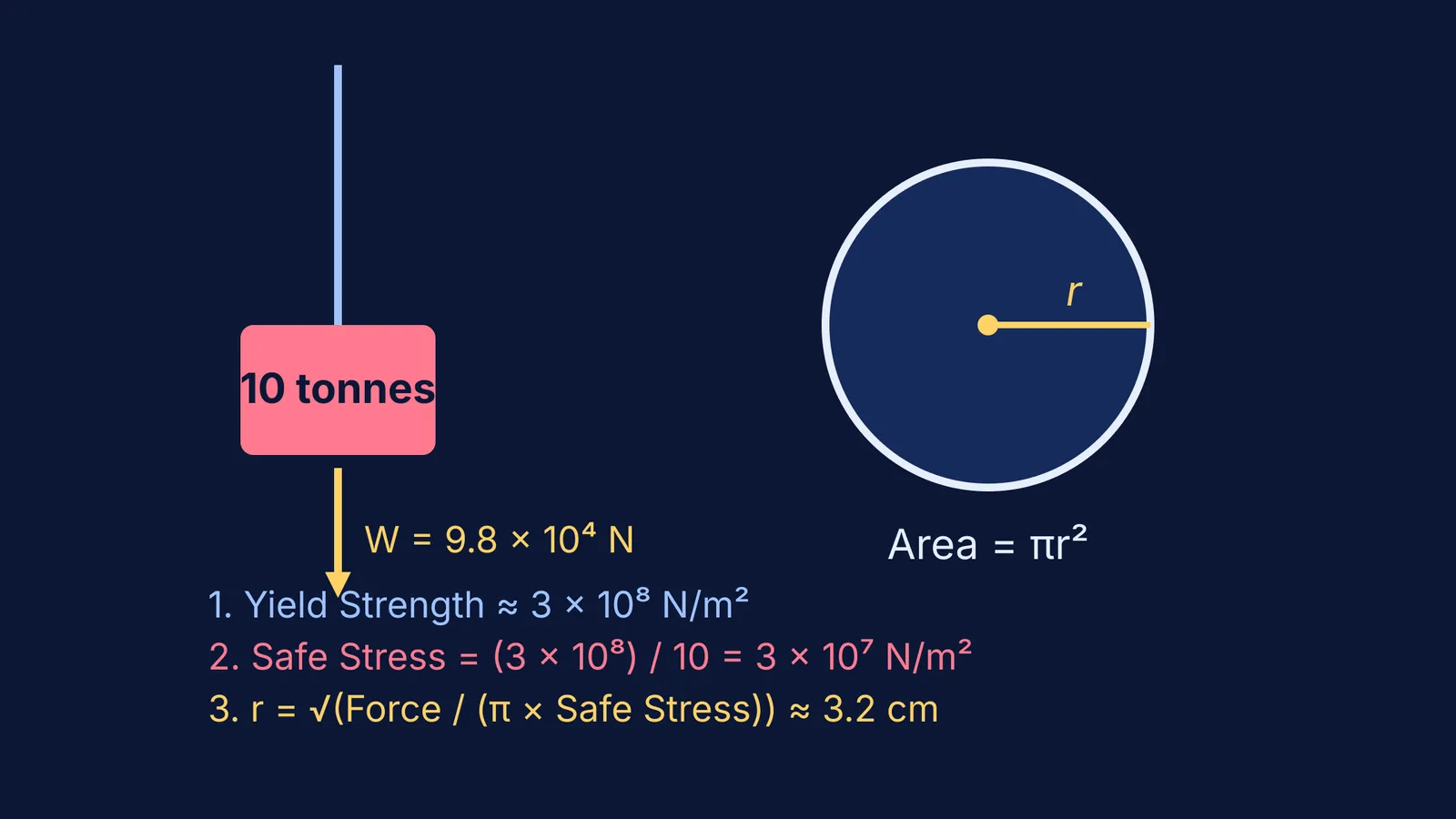
Let's walk through the standard calculation for a crane designed to lift a maximum load of 10 tonnes (10,000 kg). We want to find the minimum safe radius of the steel rope required for the job.
1. Find the actual lifting force First, convert the 10-tonne mass into a downward force (weight). Using the standard acceleration due to gravity (g = 9.8 m/s²): Force = 10,000 kg × 9.8 m/s² = 9.8 × 10⁴ N.
2. Determine the safe working stress Next, apply the safety factor of 10 to the steel's yield strength to find the allowable stress limit: Safe stress = (3 × 10⁸ N/m²) / 10 = 3 × 10⁷ N/m².
3. Calculate the required area and radius Stress is defined mathematically as Force divided by Area. Rearranging this relationship gives: Area = Force / Safe stress Area = (9.8 × 10⁴ N) / (3 × 10⁷ N/m²) ≈ 3.27 × 10⁻³ m².
Since the cross-section of the wire rope is circular, we can use the formula Area = πr²: r² = (3.27 × 10⁻³) / 3.14 ≈ 1.04 × 10⁻³ m² r = √(1.04 × 10⁻³) ≈ 0.032 m.
To lift a 10-tonne load safely under these conditions, the rope must have a radius of about 3.2 cm (or a total diameter of 6.4 cm).
How do you select a rope practically?
When facing similar elasticity problems in your exams or engineering practice, always follow this sequence:
Identify the load: Convert the mass into Newtons.
Find the safe stress limit: Divide the given yield strength or ultimate tensile strength by the provided safety factor.
Calculate the area: Divide the force by the safe stress.
Extract the dimension: Use πr² for circular cables to find the radius or diameter.
If you find yourself making wrong-method mistakes with stress and strain, the Fermi Problem Library has worked problems with a step-by-step solver that explains the reasoning rather than printing an answer.
For more on how materials behave under tension, see how to find the elastic potential energy in a stretched wire and the mathematics behind a rod stretching under its own weight.


