

On this page
When you hang a weight from a wire, it stretches. The amount it stretches depends on what the wire is made of, how long it is, how thick it is, and how heavily you load it. In physics exams like JEE Main and NEET-UG, you are rarely asked to compute a raw number. Instead, you are asked how the extension changes when the wire's dimensions are doubled or halved.
You can solve these questions in seconds without calculating any absolute values by using the ratio method.
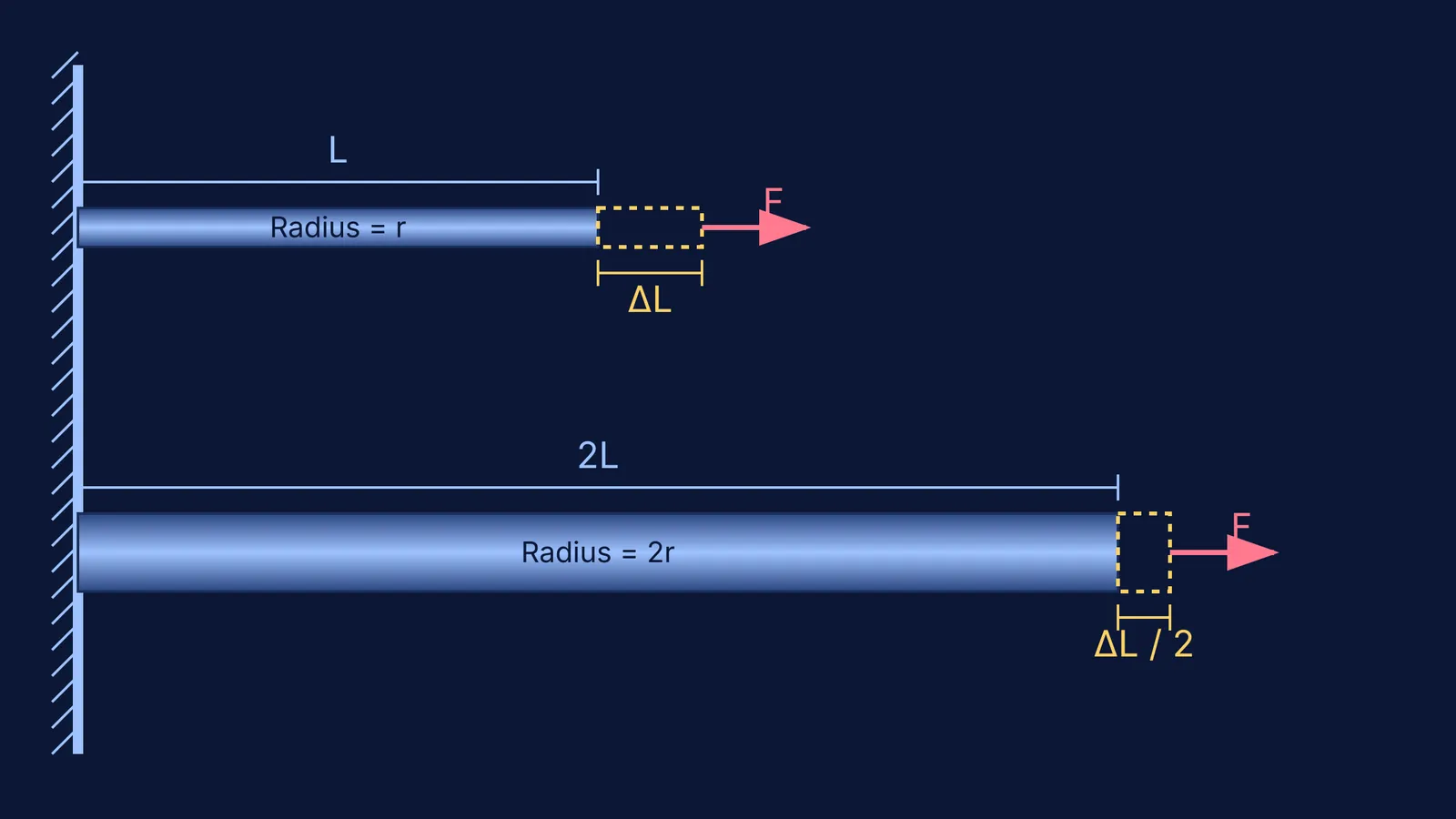
How does extension change when length and radius are doubled?
To find the new extension, we start with the formula for Young's modulus. Young's modulus (Y) is the ratio of tensile stress to tensile strain. Rearranging Y = (F/A) / (ΔL/L) for the extension (ΔL) gives:
ΔL = F × L / (π × r² × Y)
If you double the length (L → 2L) and double the radius (r → 2r) while keeping the force (F) and material (Y) the same, you can substitute the new values into the formula:
New ΔL = F × (2L) / (π × (2r)² × Y) = 2FL / (4πr²Y) = (1/2) × original ΔL
The extension becomes exactly half of what it was. Because the area grows with the square of the radius, doubling the radius makes the wire four times stiffer, which outweighs the doubling of the length.
Crucially, the Young's modulus itself does not change. Young's modulus is an intrinsic material property that remains constant regardless of the wire's dimensions, measuring approximately 200 GPa for structural steel and 110 GPa for copper.
What happens if the applied force is also doubled?
A classic variation of this problem appears in the NCERT Exemplar for Class 11. It asks what happens if you take a wire of length 2L and radius 2r, but you also double the pulling force to 2F.
Using the same formula:
New ΔL = (2F) × (2L) / (π × (2r)² × Y) = 4FL / (4πr²Y) = FL / (πr²Y)
The 4 in the numerator cancels the 4 in the denominator. The extension remains exactly the same as the original wire. If you are struggling to spot these algebraic cancellations under time pressure, the Fermi Problem Library has worked problems with a step-by-step solver that explains the reasoning rather than printing an answer.
A scaling framework for exam problems
Instead of writing out the full equation every time, you can use a scaling factor framework. Since Y and π are constants for a given material, the extension scales as:
Multiplier = (k_F × k_L) / (k_r)²
Where k is the factor by which a quantity is multiplied. For example:
Radius is halved (k_r = 0.5): Multiplier = 1 / (0.5)² = 4. The wire stretches 4 times as much.
Length is doubled (k_L = 2), force is halved (k_F = 0.5): Multiplier = (0.5 × 2) / 1² = 1. The extension is unchanged.
This approach works across the Concept Library, from calculating how stretching a wire changes its resistance to predicting thermal expansion. Whenever you see a question about elasticity and Young's modulus problems, look for the squared terms in the denominator—they always dominate the result.
Next time you encounter a wire-stretching problem, pull out the scaling factors before you touch a calculator.


