

On this page
If you ask someone on the street whether rubber or steel is more elastic, they will almost certainly say rubber. Rubber bands stretch, bounce, and bend. Steel beams, bridges, and cables do not appear to stretch at all.
But in a physics classroom or on a JEE paper, the answer is always steel. This feels like a trick question until you understand how physicists define the word "elastic". In everyday language, elasticity means stretchiness. In science, elasticity is the ability of a material to resist a distorting influence and return to its original size and shape when that influence is removed.
What does elasticity actually mean?
To compare two materials fairly, physicists use a property called Young's modulus (Y). This metric is a simple ratio of two things:
Stress: The internal restoring force per unit area.
Strain: The fractional change in length.
Young's modulus is the ratio of stress to strain (Y = Stress / Strain). A material with a high Young's modulus needs a massive amount of stress to produce even a tiny amount of strain. Structural steel has a Young's modulus of approximately 200 GPa (Wikipedia). Rubber typically has a modulus between 0.01 and 0.1 GPa.
Because it takes so much more force to deform steel, its internal restoring force is far stronger than rubber's. That resistance to deformation is exactly what physicists measure when they talk about elasticity.
How does a stress-strain curve show this?
When engineers test materials in a laboratory, they use a machine that pulls a wire and plots the results on a graph. They put strain (the amount of stretch) on the horizontal axis and stress (the force applied) on the vertical axis.
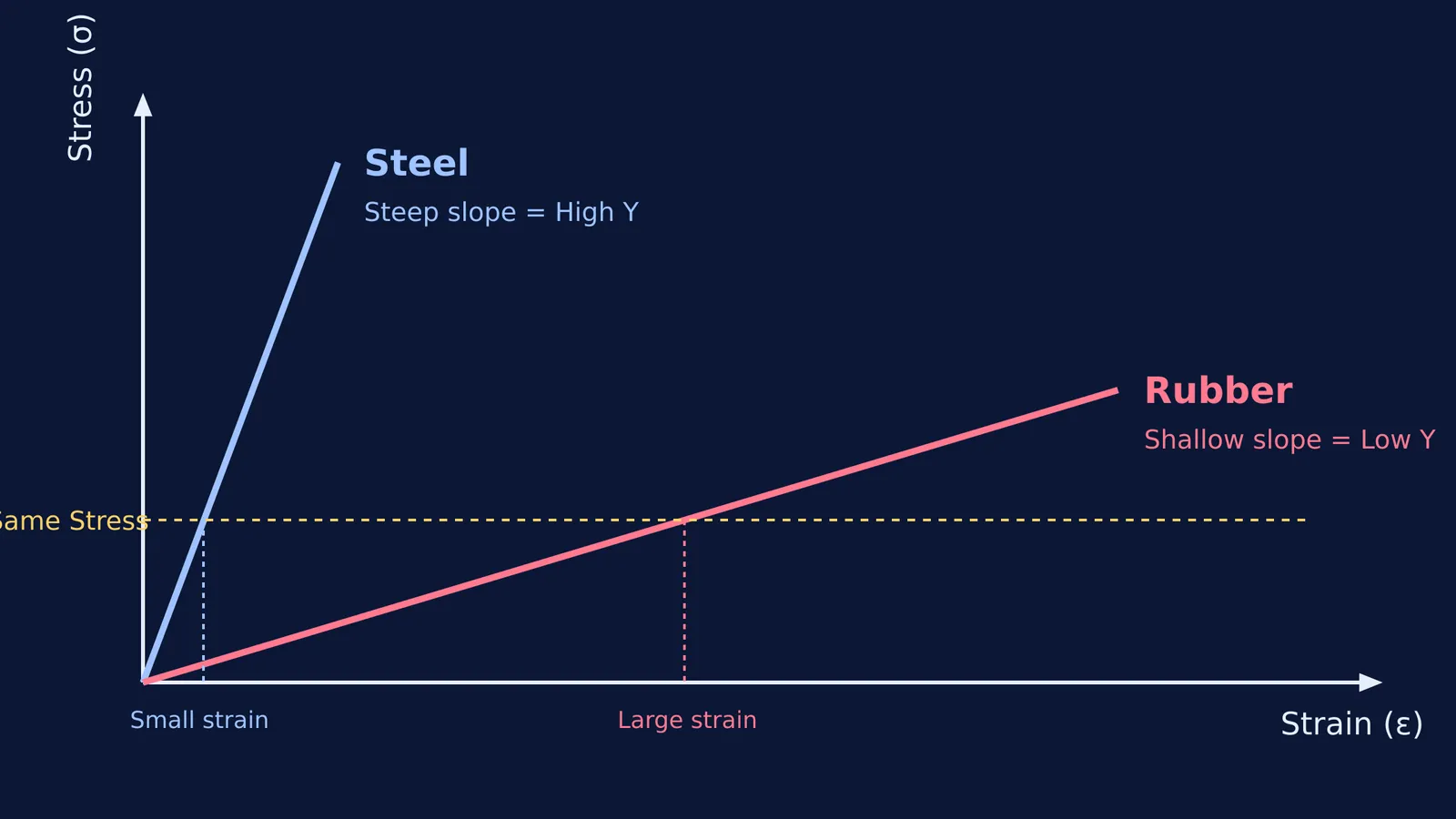
Because steel is incredibly rigid, applying a massive amount of stress only produces a tiny amount of strain. On a stress-strain graph, the line for steel shoots almost straight up. The slope of this line represents Young's modulus, and steel's exceptionally steep slope visually proves its high elasticity.
If you place a piece of rubber in the same machine, the results are entirely different. A very small stress causes the rubber to stretch significantly, pulling the line far to the right along the horizontal axis. The curve for rubber is extremely shallow, reflecting its low Young's modulus and lower elasticity.
If you ever find yourself struggling to picture how these graphs work, you can explore every concept in physics, chemistry, biology, mathematics and computing, each with its own lesson and its place in the map, inside the Fermi Concept Library.
Why is steel more elastic than rubber?
When you pull a rubber band, the bonds between its long polymer chains simply uncoil. The material offers very little resistance, which means it has a weak restoring force and a low Young's modulus.
When you pull a steel wire, you are pulling directly against strong metallic bonds. The atoms refuse to move without a fight. Even a microscopic stretch generates a huge internal restoring force, snapping the steel exactly back into place the moment you let go. Because steel snaps back with such immense force for a given strain, its elasticity is vastly higher.
A worked example: hanging weights from wires
To see the practical difference, we can run a quick mathematical thought experiment. Imagine hanging a 1 kg mass (roughly 10 Newtons of force) from two wires. Both wires are exactly 1 metre long and have a cross-sectional area of 1 mm² (10⁻⁶ m²).
1. The stress on both wires The mechanical stress (calculated as Force / Area) is identical for both wires in our example: a force of 10 N divided by a cross-sectional area of 10⁻⁶ m², giving a total applied stress of 10⁷ Pascals (Pa).
2. The stretch of the steel wire Using steel's Young's modulus (2 × 10¹¹ Pa, as per Wikipedia), we can find the strain: Strain = Stress / Y = 10⁷ / (2 × 10¹¹) = 0.00005. Multiply that by the 1-metre length, and the steel stretches by just 0.05 mm.
3. The stretch of the rubber wire Using a typical rubber Young's modulus of 0.05 GPa or 5 × 10⁷ Pa (Wikipedia), the strain is: Strain = Stress / Y = 10⁷ / (5 × 10⁷) = 0.2. Multiply that by the 1-metre length, and the rubber stretches by 200 mm.
The steel wire barely moves under the applied weight, stretching by just a fraction of a millimetre, while the rubber wire stretches by a full fifth of its original length. Because the definition of elasticity in physics relies on resisting deformation, the material that resists the pull better—in this case, the steel—is considered the more elastic one.
For more practice with stress and strain, the Fermi Problem Library features worked problems with a step-by-step solver that explains the reasoning rather than printing an answer.
You can read more about how this principle is measured in Searle's apparatus: measuring Young's modulus of a wire, or test your understanding with Elasticity: stress, strain and Young's modulus problems solved.


