

On this page
Every camera flash has a number printed in its specifications, such as GN 36. That number is not watts or joules. It is a distance multiplied by an f-number, and it tells you how far the flash can light a subject at a given aperture. Why it is a product is a neat exercise in the inverse-square law and the f-number. It also explains a result that surprises most photographers: raising the ISO from 100 to 400 makes the sensor four times as sensitive, yet the flash reaches only twice as far.
What is a flash guide number?
The guide number (GN) is defined by one equation:
GN = d × N
Here d is the distance from the flash to the subject and N is the f-number that gives a correct exposure at that distance with the flash at full power. If you know the GN, you can find either quantity from the other: d = GN/N, or N = GN/d.
A guide number only means something with its conditions attached. Manufacturers quote it in metres (or in feet, which gives a number about 3.3 times larger), at a stated ISO, usually ISO 100, and at a stated zoom setting of the flash head. Nikon's specification for its SB-700 flash, for example, reads "28/92 (ISO 100, m/ft.), 39/128 (ISO 200, m/ft.)" at the 35 mm zoom head position (Nikon SB-700 announcement). A zoom head set to a narrow beam puts the same light into a smaller patch and gives a larger GN, so two flashes can only be compared at the same ISO and zoom setting. In this post, GN 36 is a round example value in metres at ISO 100, not a particular product.
Why is the guide number distance times f-number?
Two separate inverse-square effects set the exposure.
Light reaching the subject. A small flash spreads its light over a sphere, so the illuminance on the subject falls as 1/d². This is the same 1/d² law you can test in the inverse-square law for light simulation.
Light passing through the lens. The f-number is N = f/D, focal length over aperture diameter. The light collected is proportional to the aperture area, πD²/4, so for a given focal length the brightness on the sensor falls as 1/N². How aperture size changes brightness and blur is covered in how camera aperture affects brightness and depth.
The exposure on the sensor is therefore proportional to (flash output × ISO sensitivity)/(d² × N²). For a correct exposure this must equal a fixed value. With output and ISO fixed, d² × N² is constant, so d × N is constant. That constant is the guide number.
Notice what is missing: the distance from the camera to the subject. A lit surface looks equally bright from near or far, because its image shrinks as the light collected falls. With a flash on the camera, the two are the same.
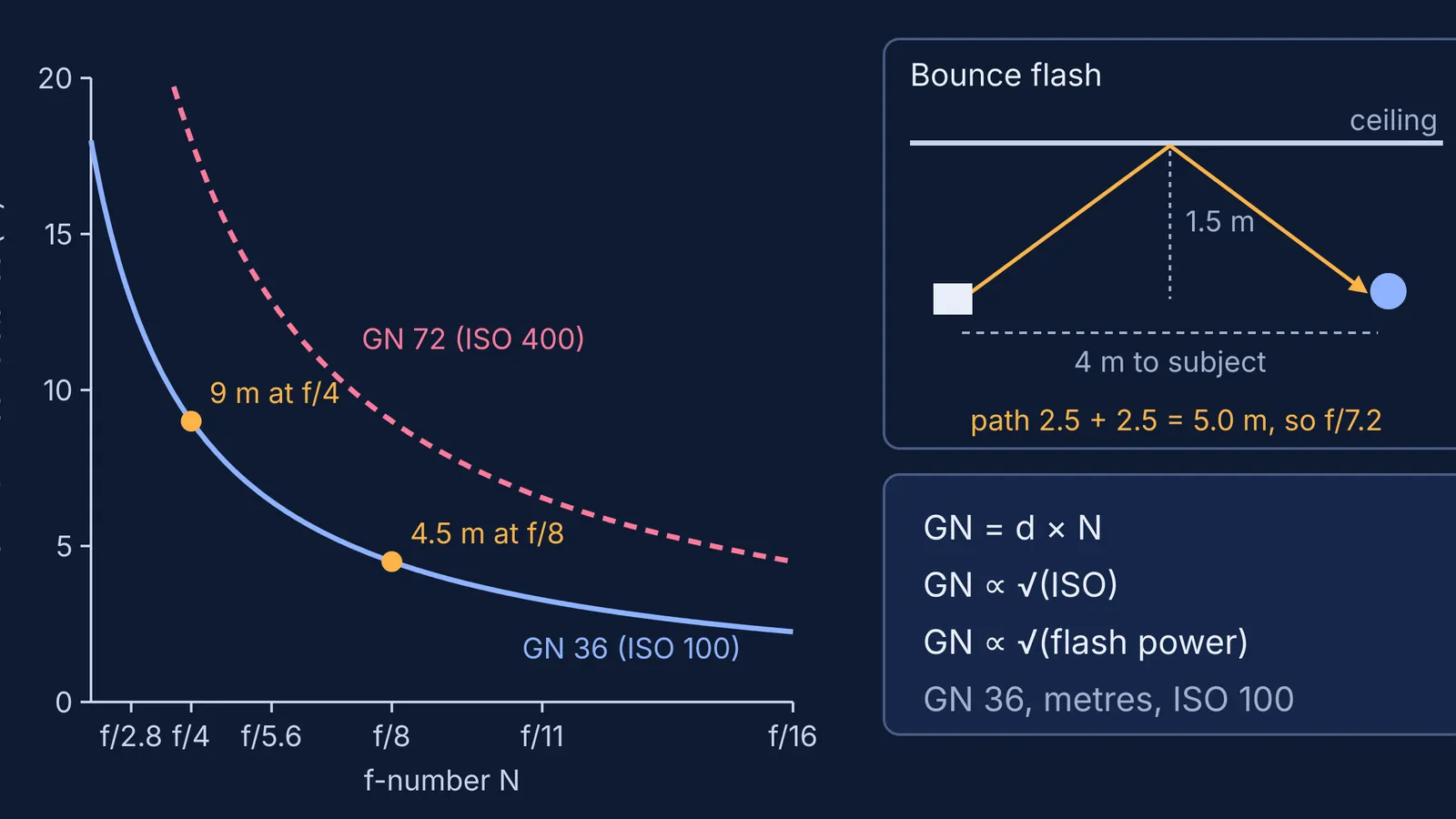
How far does a GN 36 flash reach at each aperture?
Here is the full worked example, at ISO 100 and full power.
Write the rule. d = GN/N = 36/N.
f/2.8: d = 36/2.8 = 12.9 m.
f/4: d = 36/4 = 9.0 m.
f/5.6: d = 36/5.6 = 6.4 m.
f/8: d = 36/8 = 4.5 m.
f/11: d = 36/11 = 3.3 m.
Check the pattern. Each full stop multiplies N by √2 and halves the light through the lens. To make up for it, the subject must receive twice as much light, so it must be √2 times closer. Going from f/4 to f/8 is two stops, so the distance halves, from 9.0 m to 4.5 m.
Plotted against N, the maximum distance is a hyperbola. A subject at 4.5 m with the lens at f/4 gets (9.0/4.5)² = 4 times too much light, which is two stops of overexposure.
Why does four times the ISO only double the reach?
Raising the ISO from 100 to 400 makes the sensor four times as sensitive, so it needs a quarter of the light. With the aperture fixed, the light on the subject can fall to a quarter, and since it falls as 1/d², the distance can rise by √4 = 2. So:
GN ∝ √(ISO).
ISO 200: GN = 36 × √2 = 50.9.
ISO 400: GN = 36 × 2 = 72, so at f/8 the reach is 9.0 m, the same as f/4 at ISO 100.
ISO 1600: GN = 36 × 4 = 144.
Nikon's figures show the same rule: 28 m at ISO 100 becomes 39 m at ISO 200, a ratio of 1.39, close to √2 = 1.41 after rounding.
The same reasoning applies to the flash's power setting. GN ∝ √(power):
Half power: GN = 36/√2 = 25.5.
Quarter power: GN = 36/2 = 18.
A subject 3 m away at f/4 needs GN = 3 × 4 = 12. That is a third of 36, so it needs (1/3)² = 1/9 of full power.
Why does bounce flash need a wider aperture?
Pointing the flash at a white ceiling gives softer light, but the guide number now applies to the whole path, up and down.
Set up the geometry. The ceiling is 1.5 m above the flash, and the subject's face is 4 m away at the same height as the flash.
Find the bounce point. For a mirror-like reflection it sits halfway, 2 m along and 1.5 m up.
Each leg: √(2² + 1.5²) = √6.25 = 2.5 m.
Total path: 2 × 2.5 = 5.0 m.
Aperture needed: N = 36/5.0 = 7.2, about f/7.1, compared with f/9 for direct flash at 4 m.
That is the absolute limit. A real ceiling absorbs part of the light and scatters the rest over a wide area, so it acts as a large, dim source rather than a mirror. The actual light reaching the subject is well below the 5.0 m estimate, and you need a wider aperture still. The inverse-square law itself holds closely only for a small source; a large softbox or a broad patch of lit ceiling falls off more slowly close up.
How does this connect to JEE and NEET physics?
Guide-number questions test the inverse-square law and the f-number in one problem. The position of the flash close to the lens, which keeps the guide number arithmetic simple, is also what causes red eye, explained in why eyes look red in flash photos.
If you want to practise turning a word problem like this into ratios of squares, the Fermi Problem Library has a step-by-step solver that explains the reasoning at each stage.
Quick checklist
GN = flash-to-subject distance × f-number, quoted in metres or feet at a stated ISO and zoom setting.
d × N is constant because the subject's light falls as 1/d² and the lens passes light as 1/N².
GN 36 at ISO 100: 9.0 m at f/4, 4.5 m at f/8.
GN ∝ √(ISO) and GN ∝ √(power): ISO 400 gives GN 72, quarter power gives GN 18.
For bounce flash, use the full up-and-down path, then allow extra for light lost at the ceiling.
Camera-to-subject distance does not enter; flash-to-subject distance does.


