On this page
Take a flash photo of your cousins on Diwali night and a few may stare back with glowing red pupils. Nothing is wrong with your phone or their eyes. You are seeing the inside of their eyes, lit by your flash and sent straight back into your camera.
Why do eyes look red in flash photos?
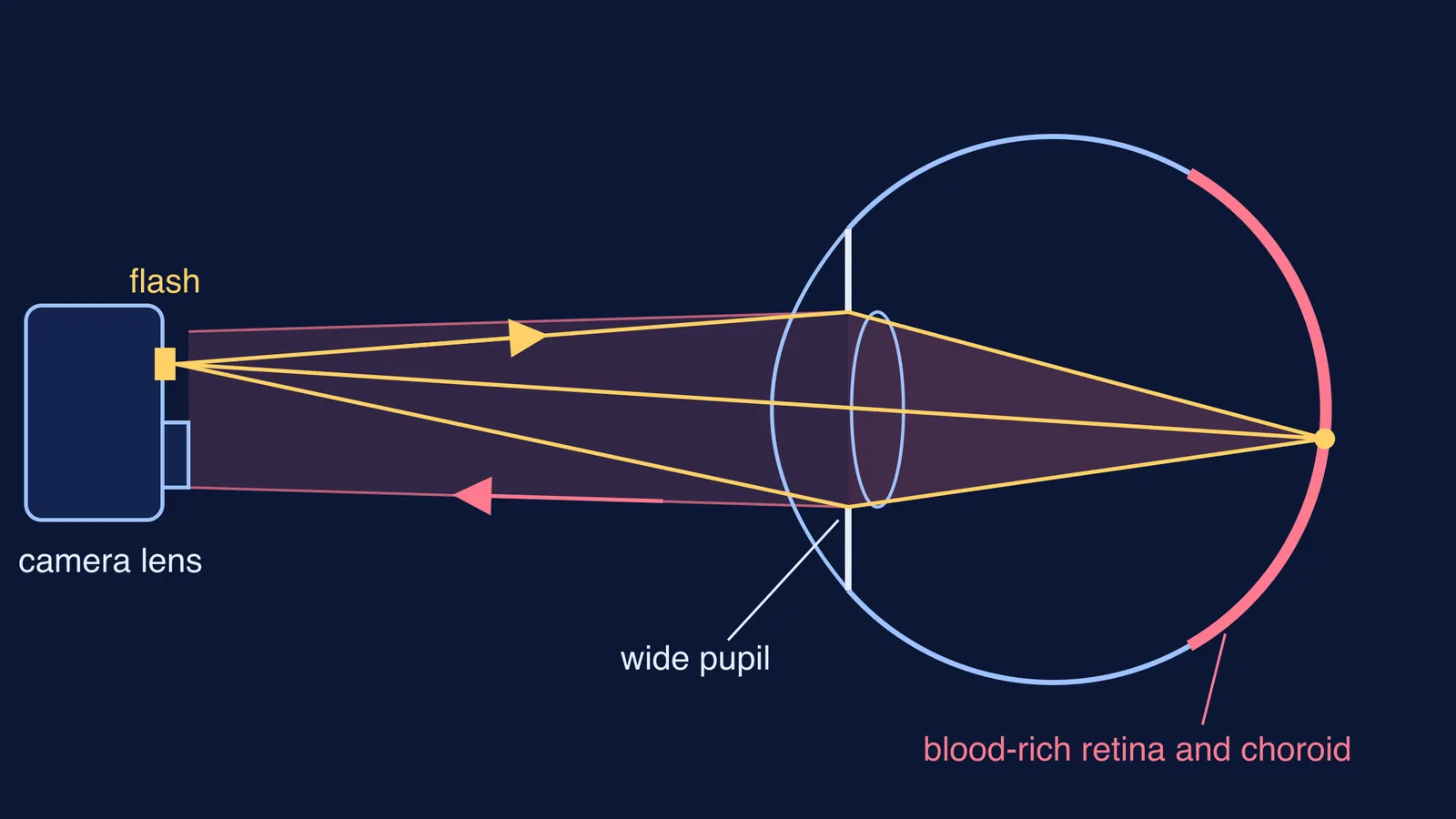
The pupil is wide open. In dim light the pupil widens to let more light reach the retina. The pupil changes from about 2 mm across in bright light to about 8 mm in the dark, according to a 2024 study in Royal Society Open Science (Lazar et al., 2024).
The back of the eye is red. The American Academy of Ophthalmology explains that a camera flash "lights up the blood-rich retina" (AAO). Much of that colour comes from the choroid, the layer of blood vessels behind the retina that nourishes it (Yale Scientific).
The light goes back the way it came. The eye's lens focuses the flash to a spot on the retina. Light scattered from that spot passes back out through the same lens, which bends it back towards its source: the reversibility of light paths from ray optics. A camera lens right beside the flash sits inside that returning beam.
So the red disc in the photo is the pupil, glowing with light from the blood-rich layer behind it. For why blood is red in the first place, see why blood is red: haemoglobin and iron.
Why doesn't the pupil shrink in time?
The pupil reacts, but too late. The latency of the pupillary light reflex is around 200 ms, according to a 2015 paper in BioMedical Engineering OnLine (Espinosa et al., 2015). A flash is far shorter. As an example, the encyclopaedia entry on photographic flash describes a flash whose light stays above 10% of its peak for 1/450 of a second (Flash (photography))). The photo is taken before the pupil starts to close. For how the reflex works, see why your pupil gets smaller in bright light.
Worked example: how much does the setting matter?
Pupil area. Using the 2 mm and 8 mm figures from the Royal Society Open Science study, the area of a circle goes as diameter squared, so (8 / 2)^2 = 16. A dark-adapted pupil lets in up to 16 times as much flash light as a pupil in bright light, and the glowing disc in the photo is 4 times as wide.
Timing. 1/450 s is about 2.2 ms. Compare that with the 200 ms reflex delay from Espinosa et al.: 200 / 2.2 is roughly 90. The reflex would need to be about 90 times faster to beat the flash.
Angle. A Michigan Technological University camera guide notes a built-in flash about 4.5 cm from the lens and says red-eye can still occur when the subject is farther from the camera (MTU guide). Work out the angle between flash and lens as seen from the subject's eye, using tan θ = 4.5 / distance: at 0.5 m it is about 5.1 degrees, at 1 m about 2.6 degrees, and at 3 m only about 0.9 degrees.
The surprise: standing farther back makes red-eye more likely, because flash and lens start to look like one point to the subject's eye.
How do you avoid red eyes in photos?
Turn on more lights. Brighter rooms mean smaller pupils before the flash fires.
Use red-eye reduction. The AAO notes that many cameras fire the flash twice: "the first time is to cause the eye's pupil to contract; the second time is to take the picture" (AAO).
Move the light away from the lens. An external flash on a bracket, or flash bounced off a white wall or ceiling, stops light from returning straight into the lens (Red-eye effect).
Step closer. From the worked example, a bigger angle between flash and lens helps.
What does it mean if one eye is not red?
A red glow in both eyes, when someone looks straight at the camera, is usually a good sign that light reaches both retinas clearly (AAO). The same AAO page says a white, yellow or black reflection in one or both eyes can be a warning sign, and advises parents to take the photo to the child's paediatrician or a paediatric ophthalmologist. Odd reflections can also come from the camera angle, so a doctor decides, not the photo.
Where does this fit in your syllabus?
Red-eye joins reflection of light in physics with the human eye in biology. Road reflectors use the same trick of sending light back to its source; read how Percy Shaw's cat's eyes bounce headlights back to you.
If light paths are hard to picture, the Fermi Simulation Lab has interactive simulations for ideas that are easier to see than to read. To revise reflection and the eye together, the Fermi Concept Library has a lesson for every concept in physics and biology.
Next time eyes glow red in a party photo, you will know which three things lined up.