

On this page
Circulation diagrams usually paint veins blue and arteries red, and it is easy to conclude that blood without oxygen is blue. It is not. The real story is one iron atom, the ring around it, and which colours of light that ring swallows.
What makes blood red?
Blood gets its colour from haemoglobin, the protein inside red blood cells. According to the RCSB Protein Data Bank's guide to haemoglobin, each haemoglobin molecule is built from four protein chains, two alpha and two beta, and each chain holds a ring-shaped haem group with an iron atom at its centre. Oxygen binds reversibly to those iron atoms, so one haemoglobin molecule can carry up to four oxygen molecules.
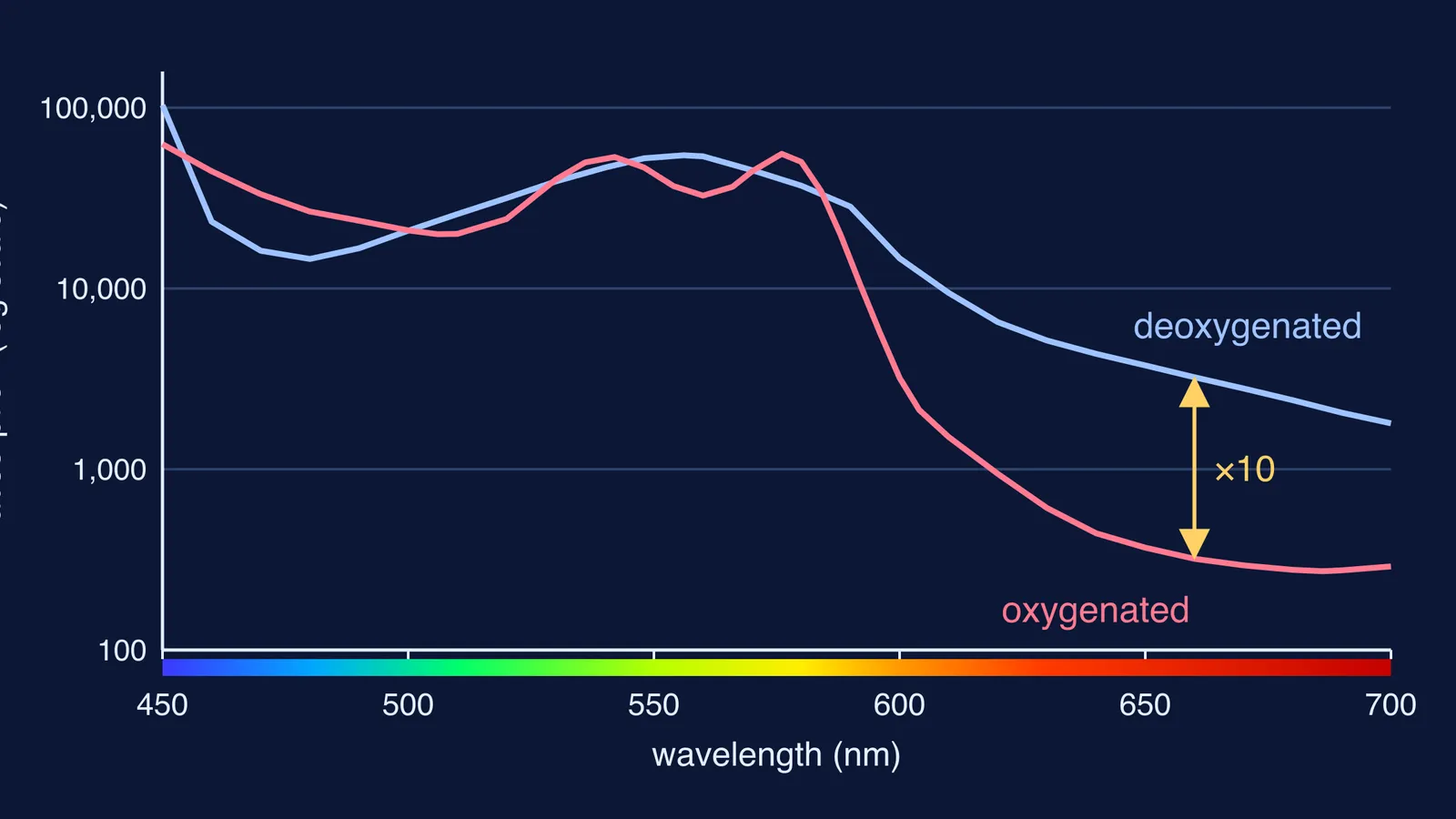
The colour comes from how haem treats light. Data compiled by Scott Prahl at the Oregon Medical Laser Center, show that oxygenated haemoglobin absorbs blue and green light strongly, with two peaks near 542 nm and 576 nm, and absorbs far less light beyond about 600 nm. White light goes in, the blue-green part is soaked up, and the leftover red is what you see.
The colour belongs to the whole haem complex, not to iron alone (iron metal is grey). For how metal ions bind surrounding groups, see why transition metal ions form so many complexes.
Why is oxygenated blood bright red and deoxygenated blood darker?
When oxygen binds, it pulls the iron atom upward in the haem, as the PDB-101 haemoglobin guide describes. Binding oxygen also changes which colours haem absorbs. In Prahl's table, deoxygenated haemoglobin has a single broad peak near 556 nm instead of two, and it absorbs much more red light. At 660 nm, deoxygenated haemoglobin absorbs about 10 times as much light as oxygenated haemoglobin (molar extinction coefficients of about 3,227 versus 320 per cm per mol/L).
So blood leaving the lungs looks bright scarlet, while blood returning from the tissues, having given up part of its oxygen, looks darker. As the PDB-101 guide notes, blood from a cut is brilliant red, but blood drawn into a storage tube away from oxygen looks dark purple.
How much red light gets through 1 mm of blood?
Prahl's page gives the formula: absorbance A = e × x × L ÷ 64,500, where e is the molar extinction coefficient, x is haemoglobin in g/L (typically 150 g/L in whole blood), L is the path length in cm and 64,500 g/mol is haemoglobin's molar mass. The fraction of light transmitted is 10 to the power minus A. Take x = 150 and L = 0.1.
Oxygenated blood, red light at 650 nm: e = 368, so A = 368 × 150 × 0.1 ÷ 64,500 ≈ 0.086. About 82% of the red light gets through.
Deoxygenated blood, same red light: e = 3,750, so A ≈ 0.87. Only about 13% gets through.
Oxygenated blood, green light at 550 nm: e = 43,016, so A ≈ 10. About one part in ten billion gets through.
This model ignores scattering by cells, so real values differ, but the pattern holds: green is blocked, red passes, and losing oxygen cuts the red sharply. The Fermi Problem Library has worked problems with a step-by-step solver that explains the reasoning rather than printing an answer.
Why do veins look blue if blood is red?
In 1996, Alwin Kienle and colleagues imaged skin over a vein at different wavelengths and simulated light travelling through tissue, reported in Applied Optics. A vessel's colour, they found, depends on four things: how skin scatters and absorbs each wavelength, how oxygenated the blood is, the vessel's diameter and depth, and how our visual system perceives colour.
The PDB-101 guide sums up the key part: blue light is reflected in the surface layers of the skin, whereas red light penetrates more deeply. Over a vein, the dark blood absorbs much of that deep-travelling red light, so more of what comes back from that spot is blue light reflected near the surface, and the vein looks bluish.
Some animals, such as snails and crabs, do have blue blood because they use copper instead of iron to carry oxygen. To see how haemocyanin compares with haemoglobin, read why octopus blood is blue.
How do you explain why blood is red in an exam?
A four-line answer covers most questions:
Name the pigment: haemoglobin, inside red blood cells (see why mammalian red blood cells have no nucleus).
Locate the iron: four haem groups, each with one iron atom that binds one oxygen molecule reversibly.
Explain colour as absorption: haem absorbs blue-green and lets red through; oxygen binding changes the absorption, so oxygenated blood is bright red and deoxygenated blood dark red to purple.
If veins come up: the bluish look is an optical effect of skin and colour perception.
Avoid these slips:
Writing that deoxygenated blood is blue.
Saying blood is red because iron is red.
Mixing up haemoglobin (iron, red) with haemocyanin (copper, blue).
If one link in the chain feels shaky, the Fermi Concept Library gives every concept in biology and chemistry its own lesson and its place in the map, so you can trace an idea back to its foundations.


