

On this page
You meet the answer in one line of your Class 12 textbook, and it is easy to memorise without understanding. Section 4.3.11 of NCERT's chapter on the d- and f-block elements says transition metals form a large number of complex compounds due to “the comparatively smaller sizes of the metal ions, their high ionic charges and the availability of d orbitals for bond formation” (NCERT Class 12 Chemistry, Unit 4).
Here is what each of those three causes does.
What is a complex, and what does the metal ion have to do?
A complex compound is one in which a metal ion binds a number of anions or neutral molecules to give a complex species with characteristic properties (NCERT Class 12 Chemistry, Unit 4). The textbook's examples are [Fe(CN)₆]³⁻, [Fe(CN)₆]⁴⁻, [Cu(NH₃)₄]²⁺ and [PtCl₄]²⁻.
Each ligand brings a lone pair of electrons. So the metal ion has two jobs. It must pull those lone pairs towards itself, and it must offer empty orbitals for them to sit in. Small size and high charge do the first job. Available d orbitals, together with the ns and np orbitals, do the second.
How do small size and high charge help an ion hold ligands?
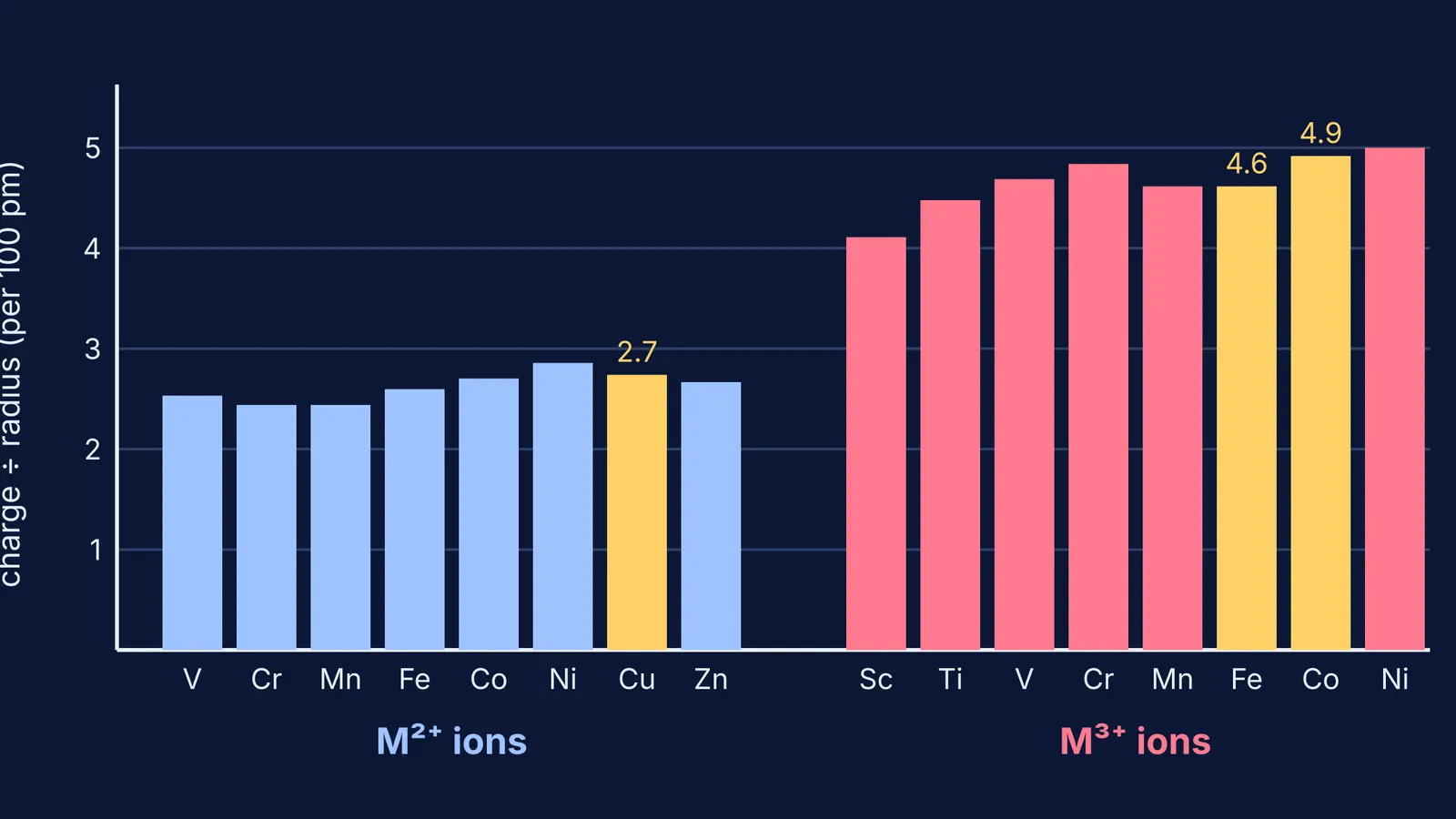
A lone pair is drawn to the ion's positive charge, and the pull is stronger when the charge is larger and the ligand can get closer. A quick way to compare ions is to divide charge by radius.
NCERT's Table 4.2 gives the ionic radius of Fe³⁺ as 65 pm, Co³⁺ as 61 pm, Cu²⁺ as 73 pm and Fe²⁺ as 77 pm (NCERT Class 12 Chemistry, Table 4.2). Work it through:
Fe²⁺: 2 ÷ 77 × 100 ≈ 2.6 units of charge per 100 pm.
Fe³⁺: 3 ÷ 65 × 100 ≈ 4.6.
Co³⁺: 3 ÷ 61 × 100 ≈ 4.9.
Cu²⁺: 2 ÷ 73 × 100 ≈ 2.7.
Removing one more electron from iron shrinks the ion by 12 pm and raises its charge, so Fe³⁺ carries about 1.8 times as much charge per unit size as Fe²⁺.
Across a series, ions of the same charge generally get smaller, because each added d electron shields the rising nuclear charge poorly (NCERT, section 4.3.2).
Why do d orbitals matter for complex formation?
Attraction alone is not a bond. A coordinate bond needs an empty orbital on the metal to receive the lone pair. NCERT notes in section 4.2 that there is very little energy difference between the (n−1)d and ns orbitals of transition elements. In the valence bond picture in NCERT's coordination compounds chapter, the ion uses its (n−1)d, ns and np orbitals to form a set of equivalent hybrid orbitals of definite geometry (NCERT Class 12 Chemistry, Unit 5).
Here is the textbook's own example, [Co(NH₃)₆]³⁺:
Co³⁺ has the configuration 3d⁶.
With six NH₃ ligands, the six d electrons pair up in three 3d orbitals, leaving two 3d orbitals empty.
Those two 3d orbitals mix with the empty 4s and three 4p orbitals to give six d²sp³ hybrid orbitals.
Each NH₃ donates one pair into one hybrid orbital: six pairs, an octahedral shape, no unpaired electrons, so the complex is diamagnetic.
The same Co³⁺ ion with six F⁻ ligands behaves differently. NCERT shows [CoF₆]³⁻ using outer 4d orbitals (sp³d² hybridisation) and staying paramagnetic. Which way an ion goes is the question in our guide to deciding between high spin and low spin complexes. The energy picture behind it, ligands splitting the d orbitals, goes back to Hans Bethe and the crystal field.
If hybridisation is where you lose the thread, the Fermi Concept Library covers every concept in chemistry, each with its own lesson and its place in the map.
How can you tell whether an ion forms complexes easily?
Four checks for any ion:
Charge: for the same metal, the +3 ion usually holds ligands more strongly than the +2 ion.
Size: look up the radius; at equal charge, the smaller ion pulls harder.
Empty orbitals: write the configuration and count the vacant (n−1)d, ns and np orbitals the ion can offer.
Ligand: note how many lone pairs it donates and through which atom.
A model short answer, one part per cause:
“Transition metal ions are small and highly charged, so they attract ligand lone pairs strongly; Fe³⁺, for example, carries a +3 charge on an ion of radius 65 pm. They also have d orbitals available for bonding, close in energy to their ns and np orbitals. These can hybridise and accept electron pairs, as in the d²sp³ complex [Co(NH₃)₆]³⁺.”
To test the reasoning on fresh questions, the Fermi Problem Library has worked problems with a step-by-step solver that explains the reasoning rather than printing an answer.
Complexes of these ions also have uses in medicine and chemical analysis; see our guide to applications of coordination compounds in medicine and analysis.


