

On this page
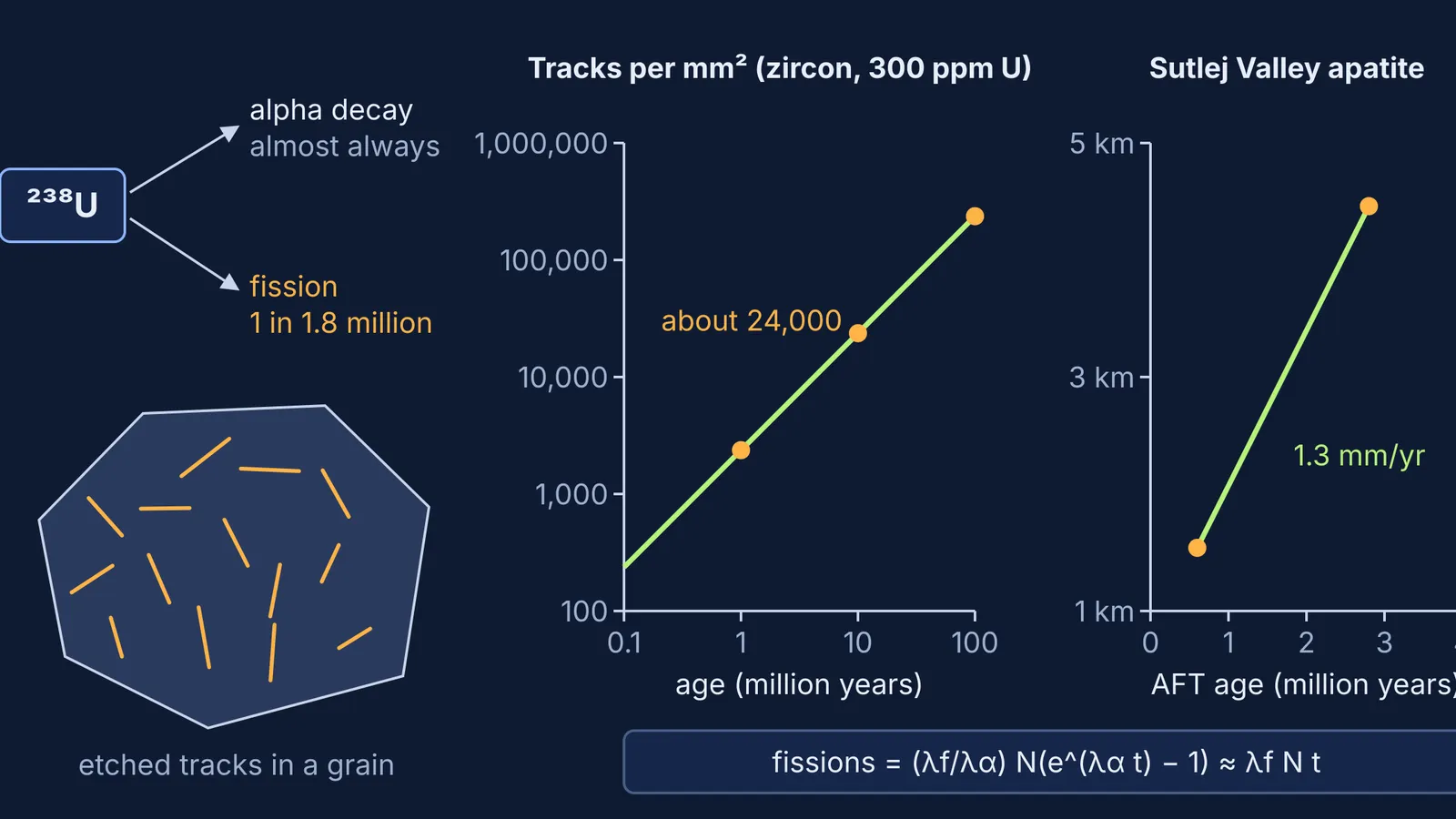
Almost every uranium-238 nucleus that decays gives off an alpha particle, but a tiny fraction split in two. Each split leaves a straight scar in the crystal that can be counted under a microscope. The count tells geologists when a rock cooled, and in the Himalaya, how fast the mountains are being worn down.
What is fission-track dating?
When a ²³⁸U nucleus splits on its own (spontaneous fission), the two fragments fly apart and tear a narrow damage trail through the crystal. Apatite and zircon contain traces of uranium, so they slowly collect these trails, which acid etching turns into short, straight lines. In apatite a fresh track is about 16 µm long, from end to end, according to Gleadow and co-workers' measurements of confined track lengths (1986).
More tracks means an older crystal, or more uranium, so an age needs both the track count and the uranium content.
Why heavy nuclei can split at all is explained in how Bohr and Wheeler described fission with a liquid drop. Here we only need the rate at which it happens.
Why does only one uranium-238 atom in 1.8 million split?
²³⁸U has two ways to decay, and they run in parallel. Each has its own decay constant, and the fraction going each way is the ratio of decay constants. The NNDC nuclear data sheet for uranium-238 gives a half-life of 4.468 × 10⁹ years and a spontaneous-fission branch of 5.45 × 10⁻⁵ %.
Alpha decay constant. λ_α = 0.693 / (4.468 × 10⁹ yr) = 1.551 × 10⁻¹⁰ per year.
Branching fraction. 5.45 × 10⁻⁵ % = 5.45 × 10⁻⁷.
Fission decay constant. λ_f = 5.45 × 10⁻⁷ × 1.551 × 10⁻¹⁰ = 8.45 × 10⁻¹⁷ per year.
One in how many? 1 / 5.45 × 10⁻⁷ = 1.83 × 10⁶, so about one decay in 1.8 million is a fission.
λ_f is so small that the half-life is set by alpha decay alone. The same idea of parallel branches appears in potassium-argon dating, where 10.72% of decays go to argon.
What about ²³⁵U? NNDC lists ²³⁵U with a half-life of 7.04 × 10⁸ years and a fission branch of only 7 × 10⁻⁹ %. That gives λ_f = 6.9 × 10⁻²⁰ per year, about 1,200 times smaller per atom than for ²³⁸U, and ²³⁵U is also about 140 times rarer. So the natural tracks come almost entirely from ²³⁸U.
How many tracks build up in a zircon crystal?
Here is the worked example. Take a zircon grain with an assumed 300 ppm of uranium by mass (an illustrative value) and a density of about 4.65 g/cm³ (the Handbook of Mineralogy gives 4.6 to 4.7 g/cm³).
Mass of uranium in 1 cm³. 4.65 g × 300 × 10⁻⁶ = 1.40 × 10⁻³ g.
Number of ²³⁸U atoms. (1.40 × 10⁻³ g / 238 g mol⁻¹) × 6.022 × 10²³ mol⁻¹ = 3.5 × 10¹⁸ atoms per cm³ (natural uranium is 99.3% ²³⁸U, which changes the answer by less than 1%).
Fissions so far. The number of decays of all kinds is N(e^(λ_α t) − 1), and a fraction λ_f/λ_α of them are fissions. For t much less than 1/λ_α (6.4 billion years), e^(λ_α t) − 1 ≈ λ_α t, so fissions ≈ λ_f N t.
Put in numbers. λ_f N = 8.45 × 10⁻¹⁷ × 3.5 × 10¹⁸ = 296 fissions per cm³ per year. That gives 3.0 × 10⁸ per cm³ in 1 million years, 3.0 × 10⁹ in 10 million and 3.0 × 10¹⁰ in 100 million. At 100 million years the exact formula is only 0.8% higher.
Tracks on a polished face. For straight tracks of length L in random directions, the number crossing each cm² of a cut equals the number per cm³ times L/2. With L = 16 µm, L/2 = 8 × 10⁻⁴ cm.
Result. In 10 million years: 3.0 × 10⁹ × 8 × 10⁻⁴ = 2.4 × 10⁶ tracks per cm², or about 24,000 per mm².
Units: per cm³ × cm = per cm². Real counts are lower, because not every track is etched or seen. Run it backwards and a count of 2,000 tracks per mm² in the same grain gives t = 2 × 10⁵ cm⁻² / (296 cm⁻³ yr⁻¹ × 8 × 10⁻⁴ cm) = 8.4 × 10⁵ years.
How do labs measure the uranium content?
The grain is covered with a sheet of mica and put in a nuclear reactor. Slow neutrons make some ²³⁵U nuclei split, and these induced fissions leave tracks in the mica. Since ²³⁵U is a fixed fraction of natural uranium, induced tracks measure the uranium, and the age comes from the ratio of spontaneous to induced track densities. Rather than rely on λ_f, neutron dose and etching efficiency separately, labs calibrate against rocks of known age (the zeta factor). The Himalayan study below worked this way: Thiede and co-workers describe neutron irradiation, mica detectors and the zeta calibration.
Why is a fission-track age a cooling age?
Tracks heal when the crystal is hot, as atoms shuffle back into place. Thiede and co-workers note that in apatite all tracks are erased above roughly 110 to 150 °C, partly erased between that and about 60 °C, and stable below about 60 °C. Zircon holds its tracks to much higher temperatures. So the clock starts only when the rock has cooled enough to keep its tracks.
A rock usually cools as erosion removes the rock above it, so a fission-track age is the time since it passed a certain depth on its way up, not the time since it formed. That makes this a different kind of clock from the one in thermoluminescence dating of pottery, where the electrons trapped in the crystal are reset by a single firing.
What do fission tracks say about the Himalaya?
In the Sutlej Valley of Himachal Pradesh, Thiede and co-workers dated apatite from the Higher Himalaya (Earth and Planetary Science Letters, 2004). Along one slope, the Wanger transect, a sample at 1,540 m by the river gave 0.6 ± 0.4 million years, and the highest at 4,460 m gave 2.8 ± 0.6 million years.
Higher rocks passed the closure depth earlier, so they are older. The slope gives the rate:
Height difference: 4,460 − 1,540 = 2,920 m.
Age difference: 2.8 − 0.6 = 2.2 million years.
Rate: 2,920 m / 2.2 × 10⁶ yr = 1.3 × 10⁻³ m per year, or 1.3 mm per year.
A regression through all the Wanger samples gives 1.4 ± 0.2 mm per year, and a second transect gave 1.1 ± 0.4 mm per year. That is 1.4 km of rock removed every million years.
If you want to practise branching and decay-law problems like these, the Fermi Problem Library has a step-by-step solver that explains the reasoning.
Quick checklist
²³⁸U: half-life 4.468 × 10⁹ yr, fission branch 5.45 × 10⁻⁷, so λ_f = 8.45 × 10⁻¹⁷ per year.
For short times, fissions ≈ λ_f N t; tracks per area ≈ fissions per volume × L/2.
²³⁵U adds almost nothing to natural tracks; it is used for induced tracks.
Tracks heal when hot, so the age dates cooling, not formation.
Age against elevation gives an exhumation rate: about 1.4 mm per year in the Sutlej Valley.


