

On this page
A piece of pottery can tell you when it was last fired. The clay holds tiny crystals, mostly quartz and feldspar, and those crystals act like a slow radiation meter. Firing the pot resets the meter to zero. After that it fills up at a steady rate, and a lab can read it by heating a few milligrams of the pot and measuring the light that comes out. That light is thermoluminescence, and the method is thermoluminescence (TL) dating.
How does thermoluminescence dating work?
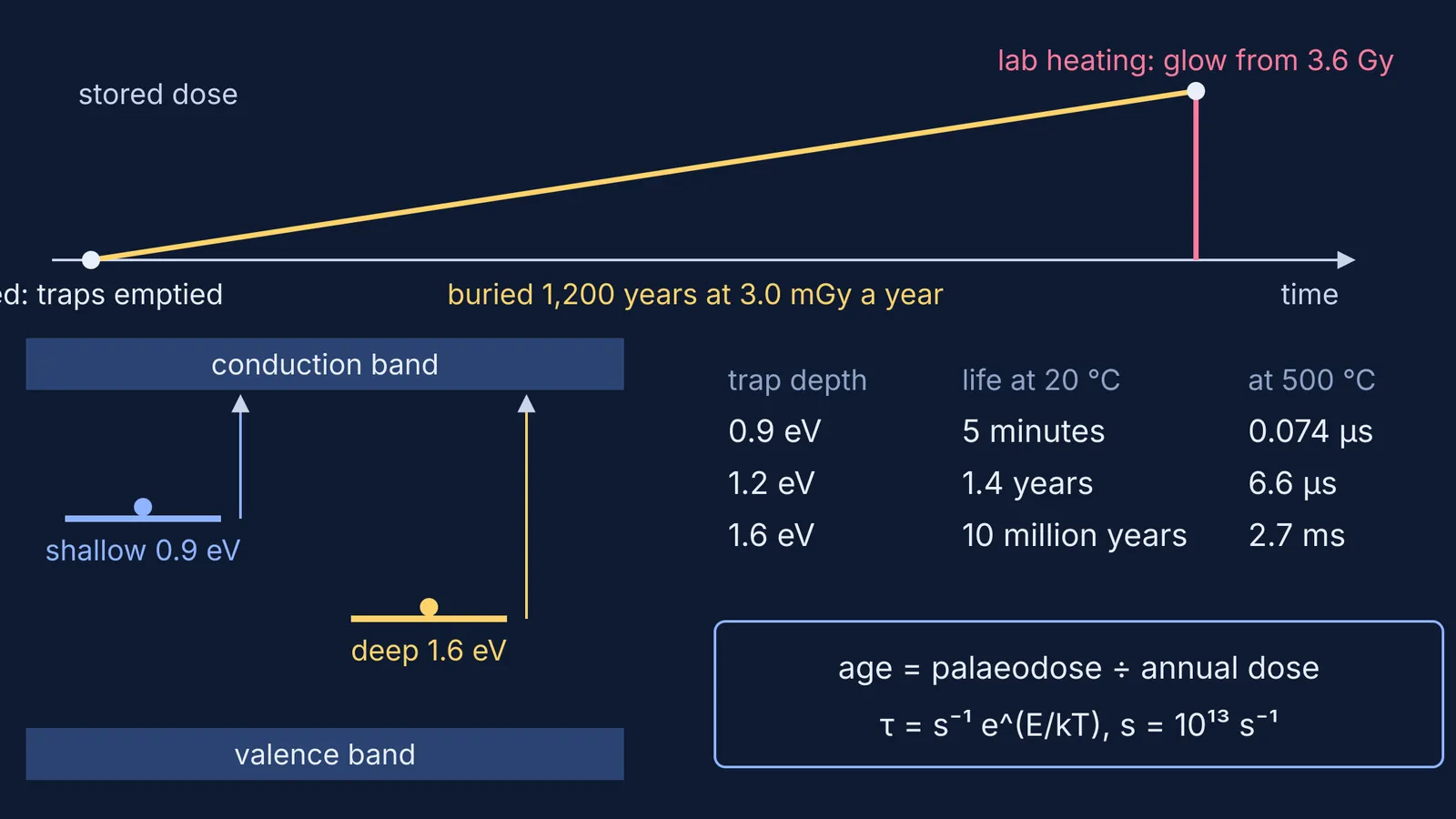
Electrons normally sit in the valence band. Radiation from potassium-40, uranium and thorium in the clay and the surrounding soil knocks some electrons up into the conduction band. Most fall straight back, but a few get caught in traps: defects in the crystal that sit at an energy E below the conduction band.
Trapped electrons stay put until they gain energy E, for example from heat. As a sample is warmed, electrons escape, recombine with holes at other defects, and some of the energy comes out as light. Plotting the light against temperature gives a glow curve. More stored dose means more trapped electrons, so more light.
A pot's life in three steps:
Firing heats the crystals to several hundred degrees and empties the traps. The clock is set to zero.
Burial lets radiation from the pot and soil fill the traps again, year after year.
Lab heating empties the traps and the light measures the total dose stored since firing.
As Geoff Duller's luminescence dating guidelines for English Heritage put it, for pottery the event dated is the last heating, not when the clay formed (Duller 2008, English Heritage guidelines). For sediments, the related method of optically stimulated luminescence (OSL) dates the last exposure to sunlight.
How do you calculate the age from the dose?
The age equation is a simple ratio:
age = palaeodose ÷ annual dose
The palaeodose (also called the equivalent dose, De) is the total absorbed dose, in gray, that the crystals collected since firing. The lab finds it by giving portions of the sample known doses until one matches the natural glow. The annual dose is how much dose the crystals receive each year, worked out from the potassium, uranium and thorium content and the burial conditions. The gray itself, 1 J of energy absorbed per kg, is explained in Louis Harold Gray and the unit of radiation dose.
Typical annual doses are a few milligray a year. Duller's guidelines give combined beta and gamma dose rates of about 2 to 3 Gy per thousand years for typical silts and sands, plus 0.1 to 0.2 Gy per thousand years from cosmic rays. They also note that 1% potassium by weight gives a beta dose rate of 0.782 Gy per thousand years and a gamma dose rate of 0.243 Gy per thousand years (Duller 2008).
Worked example: how old is a pot that stored 3.6 Gy?
These are round, illustrative values in the typical range, not from one published dating.
A sherd gives a palaeodose of 3.6 Gy. The annual dose at its site is 3.0 mGy a year.
Convert units. 3.0 mGy = 3.0 × 10⁻³ Gy, so the annual dose is 0.0030 Gy a year.
Divide. age = 3.6 Gy ÷ 0.0030 Gy a year = 1,200 years.
Check units. Gy divided by Gy per year leaves years.
Add an uncertainty. Duller's guidelines say luminescence ages typically have errors of 5 to 10% (Duller 2008). That is ±60 to ±120 years here.
Test the weak point. Water in the soil absorbs some radiation, so a wetter burial means a lower annual dose. If the true annual dose was 10% lower, 2.7 mGy a year, the age becomes 3.6 ÷ 0.0027 = 1,333 years. Duller notes that water content is often one of the largest sources of uncertainty, especially for sediments, with a 1% rise in water content raising the age by about 1%.
Compare this clock with carbon-14 dating. Carbon-14 needs once-living material. TL counts dose stored in crystals, so it works on fired clay, burnt flint and bricks.
Why do only deep traps keep a record for thousands of years?
A trapped electron is always jiggling with thermal energy. The chance that it escapes per second follows the Boltzmann factor, so the mean time it stays trapped is
τ = s⁻¹ e^(E/kT)
where E is the trap depth, T the absolute temperature, k = 8.617 × 10⁻⁵ eV/K, and s is the frequency factor, the number of escape attempts per second. This is the equation used in a 2022 study of quartz traps by Biernacka and co-workers, who report trap depths of about 1.54 to 1.67 eV and frequency factors of about 5 × 10¹¹ to 3 × 10¹³ s⁻¹ for the main dating signal in quartz (Biernacka et al. 2022, Materials). They stress that E and s are fitted from measurements and vary between samples, so they are not universal constants. We use round values below: s = 10¹³ s⁻¹ and E = 1.6 eV.
At 20 °C (T = 293.15 K):
kT = 8.617 × 10⁻⁵ × 293.15 = 0.02526 eV.
E/kT = 1.6 ÷ 0.02526 = 63.3.
e^63.3 = 3.2 × 10²⁷, so τ = 3.2 × 10¹⁴ s.
Divide by 3.156 × 10⁷ s a year: τ ≈ 1.0 × 10⁷ years, about 10 million years.
The exponent makes τ very sensitive to E and T:
1.6 eV at 30 °C: 1.3 × 10⁶ years. Ten degrees warmer cuts the lifetime about eight times.
1.6 eV at 500 °C: 2.7 ms.
1.2 eV at 20 °C: 1.4 years.
0.9 eV at 20 °C: about 5 minutes. This is the glow-in-the-dark range, covered in why glow-in-the-dark stars keep glowing.
A 10-million-year trap loses only about 0.01% of its electrons in 1,200 years, so the record is complete. Shallow traps leak, so their glow underestimates the dose. Duller gives a real example: in quartz, the TL peak near 110 °C has a mean lifetime of about 20 hours at room temperature, while the peak near 325 °C is stable over millions of years (Duller 2008). Dating uses the high-temperature part of the glow curve.
What can go wrong with TL dates?
The dose rate changed. Wetter or drier burial, or potassium leaching from the pot, changes the annual dose.
The pot was reheated. A later fire resets the clock.
The signal saturates. Once most traps are full, more dose gives no more light, which limits the oldest ages.
Shallow-trap light is mixed in. Labs heat gently first to empty shallow traps before reading the deep ones.
If the Boltzmann factor or exponential lifetimes feel shaky, the Concept Library explains energy bands and thermal activation one idea at a time.
Quick checklist
Firing empties the traps; radiation refills them; lab heating reads them out as light.
age = palaeodose ÷ annual dose; 3.6 Gy at 3.0 mGy a year gives 1,200 years.
Convert mGy to Gy before dividing.
Trap lifetime τ = s⁻¹ e^(E/kT); a 1.6 eV trap lasts about 10 million years at 20 °C but milliseconds at 500 °C.
Only deep traps (the high-temperature glow) keep a record for archaeological times.
TL dates the last heating; the largest error usually comes from the annual dose, especially water content.


