On this page
An aircraft, a ship or a satellite has to know which way it is pointing, even when it cannot see the stars or receive a GPS signal. A fibre-optic gyroscope has no moving parts at all. It sends light both ways round a coil of glass fibre and measures how far the two beams have fallen out of step. The effect behind it is the Sagnac effect, and it works by two-beam interference.
What is the Sagnac effect?
Split one beam of light into two. Send one half clockwise round a closed loop and the other half anticlockwise, then bring them back together at the same point. If the loop is still, both halves travel the same distance and arrive in step.
Now let the loop rotate at angular speed Ω. While the light is travelling, the point where the beams started has moved. The beam going the same way as the rotation has to chase the moving end point, so it takes a little longer. The beam going the other way meets the end point early. The two beams now arrive with a small time difference, and so with a phase difference. That is the Sagnac effect, first shown by Georges Sagnac in 1913.
The Earth's own spin was shown by Foucault with a mechanical gyroscope, which you can read about in how Foucault's 1852 gyroscope proved Earth's rotation. The fibre-optic version measures the same spin with light instead of a wheel.
How do you derive the Sagnac phase shift?
Here is the Class 12 version. Take a circular loop of radius R and area A = πR², rotating at Ω. The rim moves at speed RΩ.
Beam going with the rotation. It must cover one perimeter plus the distance the end point moves. Its time is t₁ = 2πR/(c − RΩ).
Beam going against the rotation. Its time is t₂ = 2πR/(c + RΩ).
Subtract. Δt = t₁ − t₂ = 4πR²Ω/(c² − R²Ω²). Since RΩ is tiny compared with c, Δt ≈ 4AΩ/c².
Add turns. A coil of N turns repeats this N times: Δt = 4NAΩ/c².
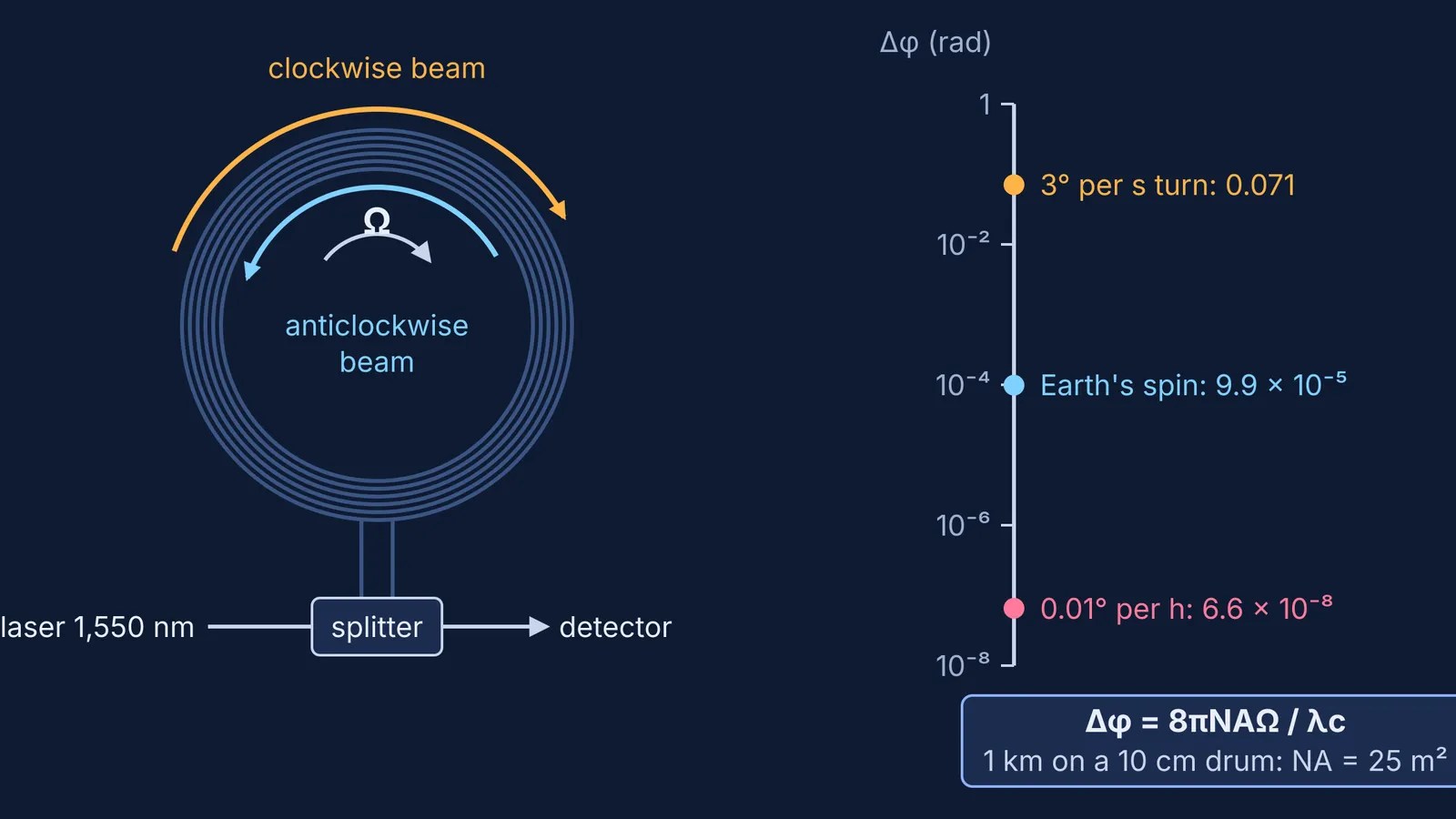
Turn time into phase. Δφ = 2π(cΔt)/λ, so Δφ = 8πNAΩ/(λc), where λ is the vacuum wavelength.
Be honest about the shortcut. This argument uses c for light that is actually travelling inside glass at about c/n. The careful treatment needs special relativity (the Fresnel–Fizeau drag of light by a moving medium), and it shows that n cancels exactly. So the simple argument gives the right answer for a slightly wrong reason. The physicist Hervé Lefèvre explains this in his 2014 review of the fibre-optic gyroscope in Comptes Rendus Physique.
Why is the fibre a kilometre long?
Because one loop gives almost nothing. A single 10 cm loop has A = 7.85 × 10⁻³ m². For the Earth's rotation (Ω = 7.29 × 10⁻⁵ rad/s) at λ = 1,550 nm, Δφ = 3.1 × 10⁻⁸ rad. No detector can read that against noise.
Winding many turns multiplies the area. If a length L of fibre is wound on a drum of diameter D, the number of turns is N = L/(πD) and the area of each is πD²/4. So NA = LD/4, and the formula becomes Δφ = 2πLDΩ/(λc). Doubling the fibre length doubles the signal. That is why real instruments use hundreds of metres to several kilometres of fibre.
Worked example: how big is the Earth's rotation signal?
Problem. A gyroscope has 1.0 km of fibre wound on a drum 10 cm across and uses light of wavelength 1,550 nm. Find the phase shift caused by the Earth's rotation (a) at the North Pole and (b) in Delhi (latitude 28.6°), with the coil lying flat. Also find the time difference between the beams at the pole.
Turns. N = L/(πD) = 1000/(π × 0.10) = 3,183 turns.
Area per turn. A = π(0.05)² = 7.85 × 10⁻³ m².
Total area. NA = 3,183 × 7.85 × 10⁻³ = 25 m². Check: LD/4 = 1000 × 0.10/4 = 25 m².
Earth's rotation rate. Ω = 2π/(sidereal day of 86,164 s) = 7.29 × 10⁻⁵ rad/s.
Phase at the pole. Δφ = 8π × 25 × 7.29 × 10⁻⁵/(1.55 × 10⁻⁶ × 3.0 × 10⁸) = 9.9 × 10⁻⁵ rad.
Phase in Delhi. A flat coil only feels the part of the Earth's spin about the vertical, Ω sin(latitude). sin 28.6° = 0.479, so Δφ = 4.7 × 10⁻⁵ rad.
Time difference at the pole. Δt = 4NAΩ/c² = 4 × 25 × 7.29 × 10⁻⁵/(3.0 × 10⁸)² = 8.1 × 10⁻²⁰ s.
Units check: m² × s⁻¹/(m × m s⁻¹) is dimensionless, as a phase must be. No clock can time 10⁻²⁰ s, so the gyroscope measures phase instead.
For comparison, an aircraft in a standard 3° per second turn gives Δφ = 0.071 rad with the same coil, about 700 times the Earth's signal.
If you want to practise more interference and rotation problems like this one, the Fermi Problem Library has a step-by-step solver that explains the reasoning at each stage.
How precise does a navigation gyroscope need to be?
A gyroscope measures how fast you are turning, not where you are. A navigation computer adds up (integrates) the rotation over time to know which way the vehicle points, and then uses that heading with accelerometer readings to work out position. Any small steady error, called bias, is added up too, so the position error grows the longer you travel.
Lefèvre's review gives the target figures. Navigation grade, the level needed for airliners, means a long-term bias stability better than 0.01° per hour. The most precise fibre gyroscopes reach strategic grade, below 0.001° per hour, needed for very long marine and submarine voyages.
For our 1 km coil, 0.01° per hour is 4.85 × 10⁻⁸ rad/s, which gives Δφ = 6.6 × 10⁻⁸ rad. The instrument must hold its zero steady to that level for hours.
Real high-grade units use more fibre than our example. The same review describes a marine navigation system whose gyro coils are 3 km long on a mean diameter of 170 mm, with light at 1,550 nm. That gives NA = 3000 × 0.17/4 = 127.5 m², five times our example, and an Earth-rotation signal of 5.0 × 10⁻⁴ rad at the pole. Because both beams share exactly the same fibre, temperature and stretching affect them almost equally and cancel, which makes such a tiny difference readable.
The same habit of measuring a minute path difference by interference is what made LIGO possible, described in how Rainer Weiss designed the LIGO laser interferometer.
Quick checklist
Light sent both ways round a rotating loop arrives out of step: the Sagnac effect.
Δt = 4NAΩ/c² and Δφ = 8πNAΩ/(λc); with fibre length L on a drum of diameter D, NA = LD/4.
The result does not depend on the fibre's refractive index or the loop's shape; the full proof needs relativity.
1 km of fibre on a 10 cm drum at 1,550 nm: Earth's spin gives 9.9 × 10⁻⁵ rad at the pole, 4.7 × 10⁻⁵ rad in Delhi.
Use Ω sin(latitude) for a coil lying flat.
A gyroscope measures rotation rate; navigation integrates it, so small errors grow with time.