On this page
In 1851, Léon Foucault suspended a heavy pendulum from the dome of the Panthéon in Paris. As it swung back and forth, the plane of its swing appeared to slowly rotate clockwise, proving that the Earth was turning beneath it. It was a spectacular public demonstration, but Foucault was not entirely satisfied with the physics it conveyed.
The pendulum's apparent rotation depended heavily on the observer's latitude. In Paris, a full rotation took about 31.8 hours rather than a clean 24 hours, which confused both the public and some of the era's scientists. Foucault wanted a purer, more direct mechanical proof of the Earth's rotation—one that offered an absolute directional reference independent of where the machine was placed on the globe.
Why did Foucault invent the gyroscope?
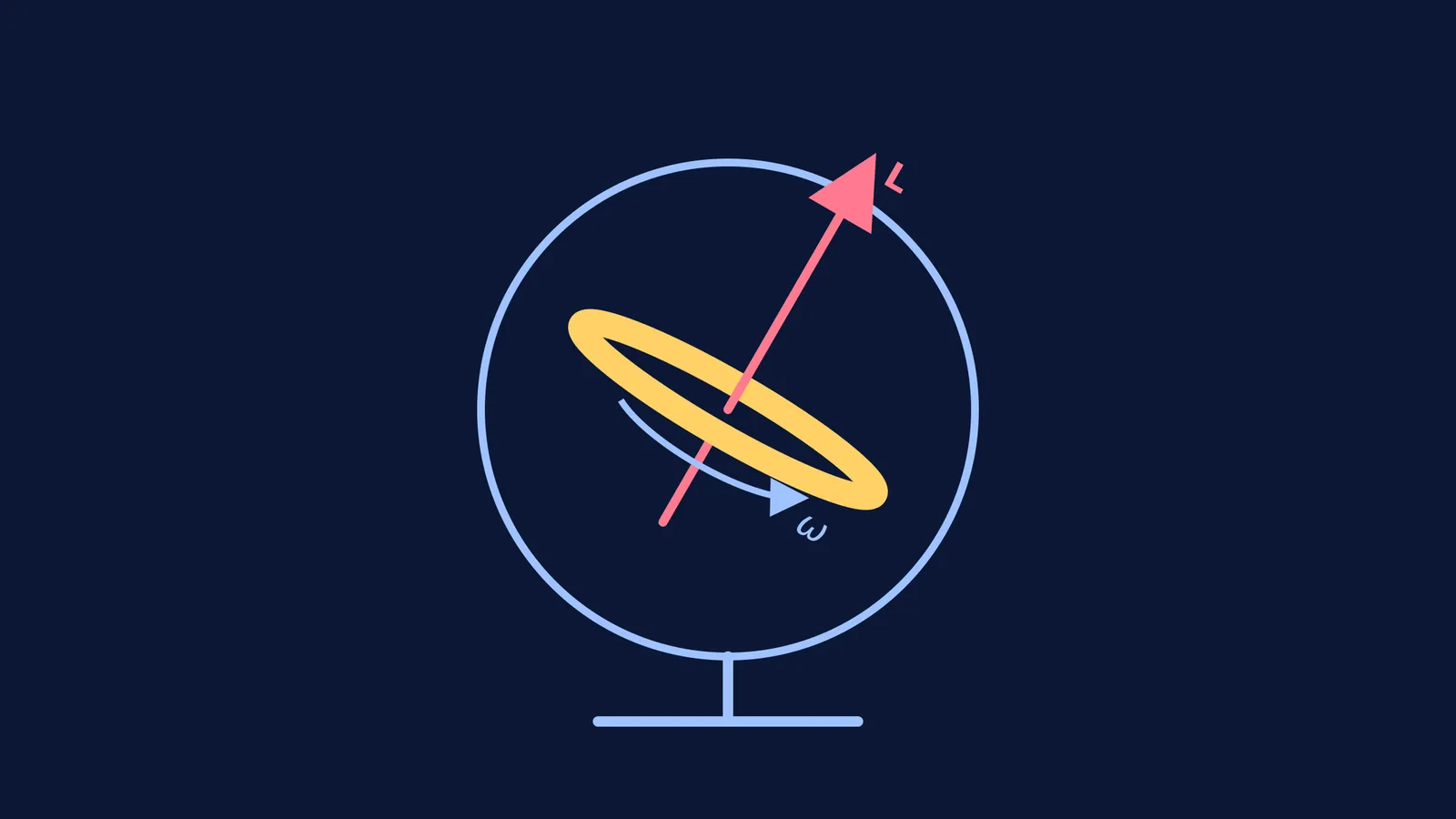
To create this direct proof, Foucault teamed up with the Parisian instrument maker Paul-Gustave Froment in 1852. Instead of a swinging pendulum, they built a device relying on rotational mechanics, using a heavy brass disk mounted in a series of carefully balanced, low-friction rings called gimbals.
Using a hand-cranked gear mechanism, Foucault and Froment spun the brass disk up to a high speed. Once the rapidly spinning disk was disengaged from the gears and set free in its gimbals, it relied on the principle of rigidity in space—what modern physicists call the conservation of angular momentum.
Because angular momentum is a conserved vector quantity, a rapidly spinning object will strongly resist any forces attempting to tilt its axis of rotation. Much like how a spinning cricket ball creates a pressure difference in flight—a phenomenon related to the Gustav Magnus effect—a spinning disk exhibits unique physical stability. The disk's axis stayed rigidly fixed relative to the absolute space of the stars.
As the laboratory rotated with the Earth over a period of 8 to 10 minutes (before air resistance and friction slowed the rotor down), the axis appeared to slowly drift. By looking through a microscope aimed at a fixed scale on the device, an observer could precisely measure the apparent shift, effectively watching the Earth move around the stationary disk.
Where does the word gyroscope come from?
Because the device allowed an observer to directly observe the Earth turning in real time, Foucault coined a completely new name for it. He combined the Greek words *gyros* (meaning circle or rotation) and *skopeein* (meaning to see), to create the word gyroscope.
Literally translated, a gyroscope is a machine used "to see rotation." It removed the complex sine-of-latitude calculations required by the pendulum, offering a pure visual confirmation of the planet's daily spin.
How do we learn from physical demonstrations?
Foucault's primary drive was not simply to write down the mathematics of angular momentum; he built an elaborate apparatus to make an invisible physical principle visible to anyone who looked through his microscope. When students learn physics today, relying purely on static textbook diagrams can make these concepts feel abstract and out of reach.
Physics still comes alive when you can see it working. That is why the Simulation Lab provides interactive simulations for the ideas that are easier to see than to read. Whether you are manipulating variables like the radius of gyration or observing how torque affects angular momentum, simulations let you experiment with the very mechanics Foucault studied.
When solving homework problems on rotational mechanics, breaking down the physical systems step-by-step is critical. Here is a three-step checklist to avoid getting stuck:
Identify the axis of rotation: Is it fixed like Foucault's gyroscope, or does it move?
Find the torques: What forces are trying to twist the object, and how far are they from the axis?
Apply conservation laws: If there is no external torque, angular momentum remains constant.
If you struggle to translate these steps into equations, the Problem Library helps. It features worked problems with a step-by-step solver that explains the reasoning rather than printing an answer. Just as Foucault's mechanical proofs made planetary motion tangible, breaking down the mathematical steps makes the invisible logic of a physics problem visible.
Foucault's brilliant mechanical proofs earned him the prestigious Copley Medal in 1855. Though his original gyroscope could only spin for 10 minutes at a time, electrically powered gyroscopes eventually became the beating heart of navigation systems in ships, airplanes, and spacecraft, permanently changing how we find our way across the Earth and beyond.