

On this page
In 1916, Albert Einstein predicted that massive accelerating objects would create ripples in spacetime called gravitational waves. For decades, detecting these waves seemed impossible because the ripples were unimaginably small. It took an extraordinary feat of engineering—and a 1972 blueprint by MIT physicist Rainer Weiss—to finally measure them.
What is a laser interferometer?
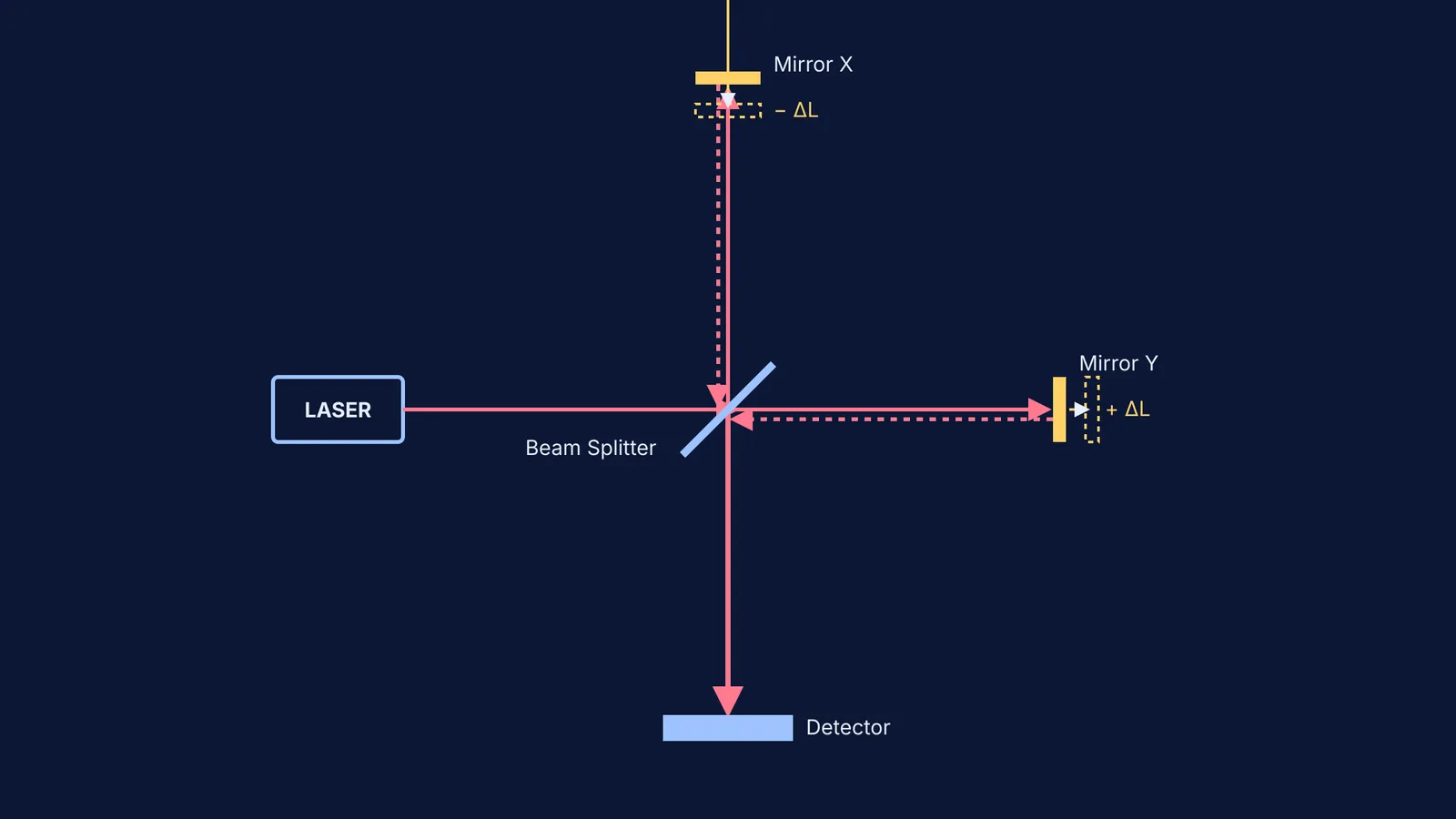
To detect a gravitational wave, you need to measure an incredibly tiny change in distance. An interferometer does this by splitting a single laser beam into two perpendicular arms. The light travels down the arms, bounces off mirrors at the ends, and recombines at a central beam splitter.
Because the two light waves are perfectly synchronised when they leave the laser, converting phase difference and path difference tells us exactly how far the mirrors have moved. If the arms are exactly the same length, the returning waves line up perfectly and their crests and troughs can cancel each other out. But if a gravitational wave passes through, it stretches space in one direction and squeezes it in the perpendicular direction. One arm gets slightly longer, while the other gets slightly shorter.
When the light waves recombine, they are no longer in phase. The shift creates an interference pattern at the detector. If you struggle to picture how such tiny changes in path length alter a wave's phase, the Fermi Simulation Lab lets you interact with simulations for the ideas that are easier to see than to read.
How did Rainer Weiss design LIGO?
The core challenge is that the change in arm length caused by a gravitational wave is thousands of times smaller than an atomic nucleus (Nobel Prize Press Release). At this microscopic scale, any vibration on Earth is vastly larger and threatens to completely overwhelm the delicate measurement.
In April 1972, Rainer Weiss published a report titled "Electromagnetically Coupled Broadband Gravitational Antenna" (General Relativity and Gravitation republication). This document became the foundational blueprint for the Laser Interferometer Gravitational-Wave Observatory (LIGO).
The brilliance of Weiss's report was his exhaustive mathematical analysis of the background noise that would hide a signal. Instead of just proposing the instrument, he rigorously tracked every physical factor that could move the mirrors:
Seismic noise: The constant rumble of the Earth from ocean waves crashing on distant shores, minor earthquakes, and heavy human traffic. To beat this, the mirrors had to be suspended on pendulum systems.
Thermal noise: The random Brownian motion of the mirrors and their suspension wires driven by ambient heat. Even at room temperature, atoms vibrate enough to ruin the measurement.
Photon shot noise: The quantum fluctuations in the arrival rate of laser photons, whose individual energies follow the E = 1240/λ formula. Because light is made of discrete particles, the photons hit the mirrors like rain on a tin roof, causing tiny, random jitter.
His rigorous blueprint proved that building such a colossal detector was theoretically possible. On 14 September 2015, LIGO detected gravitational waves for the first time, originating from two colliding black holes 1.3 billion light-years away (Nobel Prize Press Release). In 2017, Weiss shared the Nobel Prize in Physics for this work alongside Barry C. Barish and Kip S. Thorne.
The Weiss Framework for physics problems
When you sit down to solve a complex physics or engineering problem for a competitive exam like JEE Advanced, you can learn a lot from Weiss's methodical approach to noise.
Start with the ideal system: Draw the perfect, frictionless, noiseless model first (like the basic Michelson interferometer). Establish what the mathematical theory predicts.
List the real-world factors: Ask yourself what the textbook model ignores. Is there friction, air resistance, or thermal energy? Break the messy reality down into individual forces.
Calculate the limits: Work out the mathematical bounds of each factor to see which ones matter. You do not need to eliminate every problem—you just need to prove that the remaining errors are small enough to ignore.
If you are not sure where to start with a multi-step physics problem, the Fermi Problem Library has worked problems with a step-by-step solver that explains the reasoning rather than printing an answer. It teaches you to hold a line of reasoning across a whole problem, just as Weiss tracked every noise source to build the most sensitive ruler in human history.


