

On this page
Put a dish of ferrofluid over a strong magnet and its smooth black surface suddenly breaks into a field of sharp spikes, packed in a neat hexagonal pattern. Take the magnet away and the spikes slump back into a flat pool. This is the normal-field instability, first worked out by M. D. Cowley and R. E. Rosensweig in 1967 and often called the Rosensweig instability. You can understand most of it with three ideas from your syllabus: magnetisation, gravity and surface tension.
What is a ferrofluid?
A ferrofluid is an oil or water with tiny magnetic particles, usually magnetite about 10 nanometres across or smaller, kept apart by a soap-like coating. The University of Wisconsin's MRSEC ferrofluid background page describes how the coating and thermal jiggling stop them clumping.
Each particle is a single tiny magnet, but thermal motion keeps flipping their directions at random. With no field, they cancel and the liquid is not magnetised. In a field, they line up partly and the liquid gains a magnetisation M, much like a paramagnet but far stronger. This behaviour is called superparamagnetism. Remove the field and M falls back to zero, so a ferrofluid is not a permanent magnet. If you need a refresher on magnetisation and susceptibility, see diamagnetic, paramagnetic and ferromagnetic materials.
Why does a magnetic field make the surface spiky?
Suppose the field points straight up through a flat layer. Now let a small bump form on the surface.
Magnetism pushes the bump up. The fluid is more permeable than air, so field lines crowd into the bump, just as they crowd into a piece of iron. The magnetic pull on the fluid is strongest at the tip, which lifts the bump further.
Gravity pulls it down. Raising fluid costs gravitational potential energy.
Surface tension pulls it down. A bumpy surface has more area than a flat one, and surface tension resists extra area.
When the magnetisation is small, gravity and surface tension win and the bump dies away. Above a critical magnetisation, the magnetic push wins, the bump grows, and the whole surface breaks into spikes. The magnetic pull here is related to the magnetic pressure B²/2μ₀ that sets the grip of a scrap-yard lifting magnet.
What sets the critical magnetisation and the spike spacing?
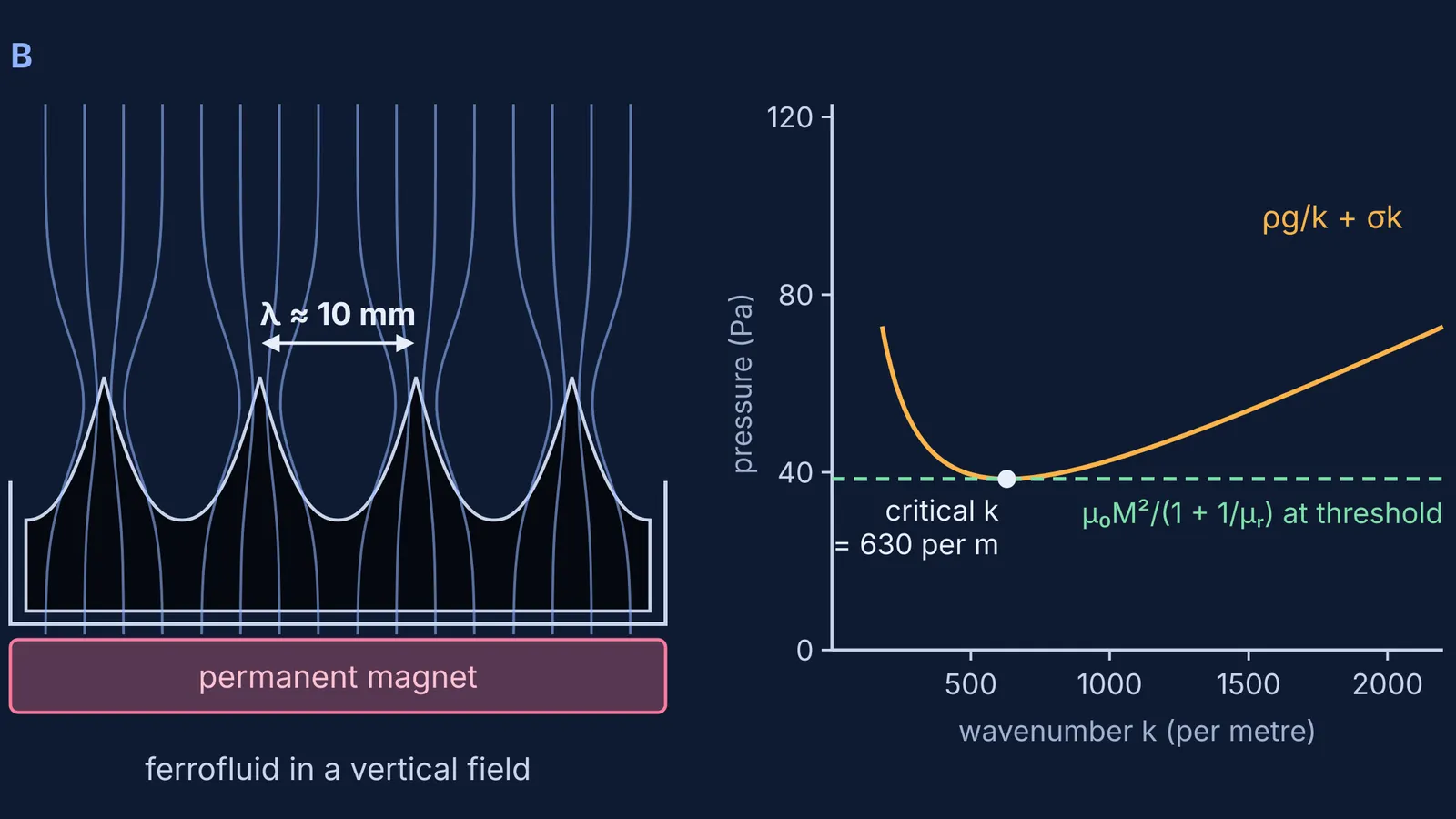
Think of the surface as made of ripples of wavenumber k = 2π/λ. For each ripple, the full analysis compares three effects, each written as a pressure.
Gravity's restoring part goes as ρg/k. Long, gentle waves lift a lot of fluid.
Surface tension's restoring part goes as σk. Short, sharp waves add a lot of area.
The magnetic drive is μ₀M²/(1 + 1/μᵣ) for a fluid with a constant relative permeability μᵣ, the same for every k. This is a stated result from Cowley and Rosensweig's analysis; it is beyond the JEE syllabus, so take it as given.
The surface goes unstable when μ₀M²/(1 + 1/μᵣ) > ρg/k + σk for some ripple. The right side is a sum of two terms whose product, ρgσ, is fixed. By AM ≥ GM, ρg/k + σk ≥ 2√(ρgσ), with equality when ρg/k = σk, that is k = √(ρg/σ). So:
The first ripple to grow has λ_c = 2π√(σ/ρg). It depends only on the liquid, not on the magnet.
The threshold is μ₀M_c²/(1 + 1/μᵣ) = 2√(ρgσ), which gives M_c² = (2/μ₀)(1 + 1/μᵣ)√(ρgσ).
The same length 2π√(σ/ρg) is where water ripples travel slowest, as shown in why no ripple on water travels slower than 23 cm/s. That is no coincidence: in both problems, gravity and surface tension trade off at the same balance point.
Worked example: spikes on a real ferrofluid
Gollwitzer and colleagues measured the spikes on a commercial ferrofluid, APG512a from Ferrotec, in a 2007 Journal of Fluid Mechanics study (free preprint). Their fluid had ρ = 1236 kg/m³, σ = 30.57 mN/m and an initial susceptibility χ = 1.172. Take g = 9.81 m/s² and treat the fluid as linear, with μᵣ = 1 + χ = 2.172.
Spacing. σ/ρg = 0.03057/(1236 × 9.81) = 2.52 × 10⁻⁶ m². Its square root is 1.59 mm. So λ_c = 2π × 1.59 mm = 9.98 mm, about 1 cm between spikes.
Restoring pressure at threshold. √(ρgσ) = √(1236 × 9.81 × 0.03057) = 19.25 Pa, so 2√(ρgσ) = 38.5 Pa. Check units: (kg/m³)(m/s²)(N/m) = N²/m⁴, whose square root is N/m², a pascal.
Permeability factor. 1 + 1/μᵣ = 1 + 1/2.172 = 1.460.
Critical magnetisation. M_c² = (2/4π × 10⁻⁷) × 1.460 × 19.25 = 4.47 × 10⁷ A²/m². So M_c = 6.69 × 10³ A/m, about 6.7 kA/m.
Field needed. Inside the fluid, H = M/χ = 6690/1.172 = 5.71 kA/m. The normal component of B is continuous across the flat surface, so just above it B = μ₀(H + M) = 4π × 10⁻⁷ × 12,400 = 15.6 mT.
The study reports a measured threshold of about 16.7 mT, and 17.2 mT from linear theory using the fluid's real magnetisation curve. Our 15.6 mT is about 7% lower because we treated the fluid as linear. A real ferrofluid's magnetisation bends over towards saturation, so it needs a little more field to reach 6.7 kA/m. Either way, the field is a few tens of millitesla, which a modest permanent magnet under the dish can supply.
Compare water: with σ = 0.0728 N/m and ρ = 1000 kg/m³, the same formula gives 17.1 mm. The ferrofluid's spikes sit closer because its surface tension is lower and its density higher.
What happens above the threshold?
Experiments show the spikes do not grow gently from zero. As the field rises past the threshold, they jump to a finite height, and as you lower the field they persist slightly below the threshold before collapsing. Above the threshold the pattern can also change, for example from hexagons to squares, and the spacing shifts a little. None of this changes the onset spacing.
If you want to see how a changing field reshapes a magnetic material, the Simulation Lab has interactive simulations for ideas that are easier to see than read.
Is it safe to try at home?
Ferrofluid stains skin, cloth and paper and is hard to clean. Keep it in a sealed glass cell or a closed jar, hold the magnet outside the container, and keep strong magnets away from phones and cards.
Quick checklist
A ferrofluid is superparamagnetic: magnetised only while a field is applied.
Bumps gather field lines and are pulled up; gravity and surface tension pull them back.
Instability when μ₀M²/(1 + 1/μᵣ) exceeds ρg/k + σk; AM ≥ GM gives the minimum 2√(ρgσ).
Spacing at onset: λ_c = 2π√(σ/ρg), about 10 mm for a typical ferrofluid.
Threshold: M_c² = (2/μ₀)(1 + 1/μᵣ)√(ρgσ), about 6.7 kA/m and 16 to 17 mT here.


